Financial Operations
Common vs Preferred Shares: Rights, Payouts and Control
Compare common vs preferred shares on voting, dividends, liquidation preference and conversion, with worked exit-value math for founders and investors.
ByJumpstart Partners, CPA, QuickBooks ProAdvisor
··18 min readYou can sell your company for $15 million, own most of the common stock, and still watch a preferred investor take the first $5 million before you receive a dollar. That's not a drafting error. It's how a liquidation preference works, and it's why the debate over Common vs Preferred Shares matters more at a mid-range exit than your headline valuation ever will.
If you're a founder, CEO, or finance leader at a $500K to $20M revenue SaaS company, agency, or services firm, stop reading your cap table as a simple ownership split. Read it as a payout order. The class you hold, the preference stacked ahead of you, and the point at which preferred converts to common decide what you keep.
Table of Contents
- Common vs Preferred Shares at a Glance
- How Preferences and Conversion Set Your Payout
- Why Ownership Percentage Misleads on Control
- Voting Control and Anti-Dilution Protection
- Cap Table Math in a Preferred Funding Round
- Negotiate These Terms Before You Sign
Common vs Preferred Shares at a Glance
The class you hold decides who gets paid first and who decides outcomes when money is tight. Founders who treat common and preferred as one security with two names misread their exit, their control, and their employees' options.
| Criterion | Common shares | Preferred shares |
|---|---|---|
| Voting rights | Usually full voting rights | Often limited or none, with class-specific consent rights |
| Dividends | Declared at board discretion | Often fixed; may be cumulative and paid before common |
| Liquidation priority | Paid after creditors and preferred holders | Paid before common under the liquidation preference |
| Upside | Full participation in growth and valuation | Fixed or capped unless the holder converts |
| Price sensitivity | Moves more with growth and valuation | Moves less, but exposed to interest-rate and credit-spread risk |
| Conversion | Not applicable | Often convertible to common at a set ratio |
Common and preferred shares are legally distinct ownership claims, and their rights come from your company's charter and applicable corporate law. The U.S. Securities and Exchange Commission Investor.gov guidance on stocks explains that common shareholders generally receive voting rights and may receive dividends when declared, while preferred shareholders usually have limited or no voting rights but receive dividends before common shareholders and rank ahead of common shareholders if the company is liquidated.
That creates a clear trade-off. Common gives you governance participation and potentially unlimited upside. Preferred gives the holder contractual protection against missed dividends and loss of capital, including cumulative dividends where unpaid amounts accumulate and must generally be satisfied before common dividends resume.
Don't assume the word preferred fixes any term on its own. It doesn't. You must read the dividend rate, preference multiple, participation, conversion ratio, and redemption terms in the governing documents for each series. Delaware law has long allowed corporations to create multiple classes with stated preferences, voting powers, and restrictions, which is exactly why two preferred series in the same company can behave very differently. If you're still learning the investor vocabulary around a round, start with what VC means for founders raising capital and then return to your charter.
Your Three-Question Charter Check
Answer these from your own documents, not from memory or a term sheet summary.
- Which class do I hold: Common, a named preferred series, or options over common?
- What's the preference multiple: 1x, above 1x, participating, or capped participating?
- Is it convertible: If it's preferred, what's the exact conversion ratio into common?
If you can't answer all three today, you don't know your position. Fix that before you negotiate price.
How Preferences and Conversion Set Your Payout
Most founders fixate on valuation. You shouldn't. At a $5M, $15M, or $40M exit, the preference stack and the conversion decision move more money than a modest change in headline price. Work the numbers before you sign, not after a buyer appears.
The payout mechanics below show why dividend terms and conversion rights change the order and size of every check at exit.
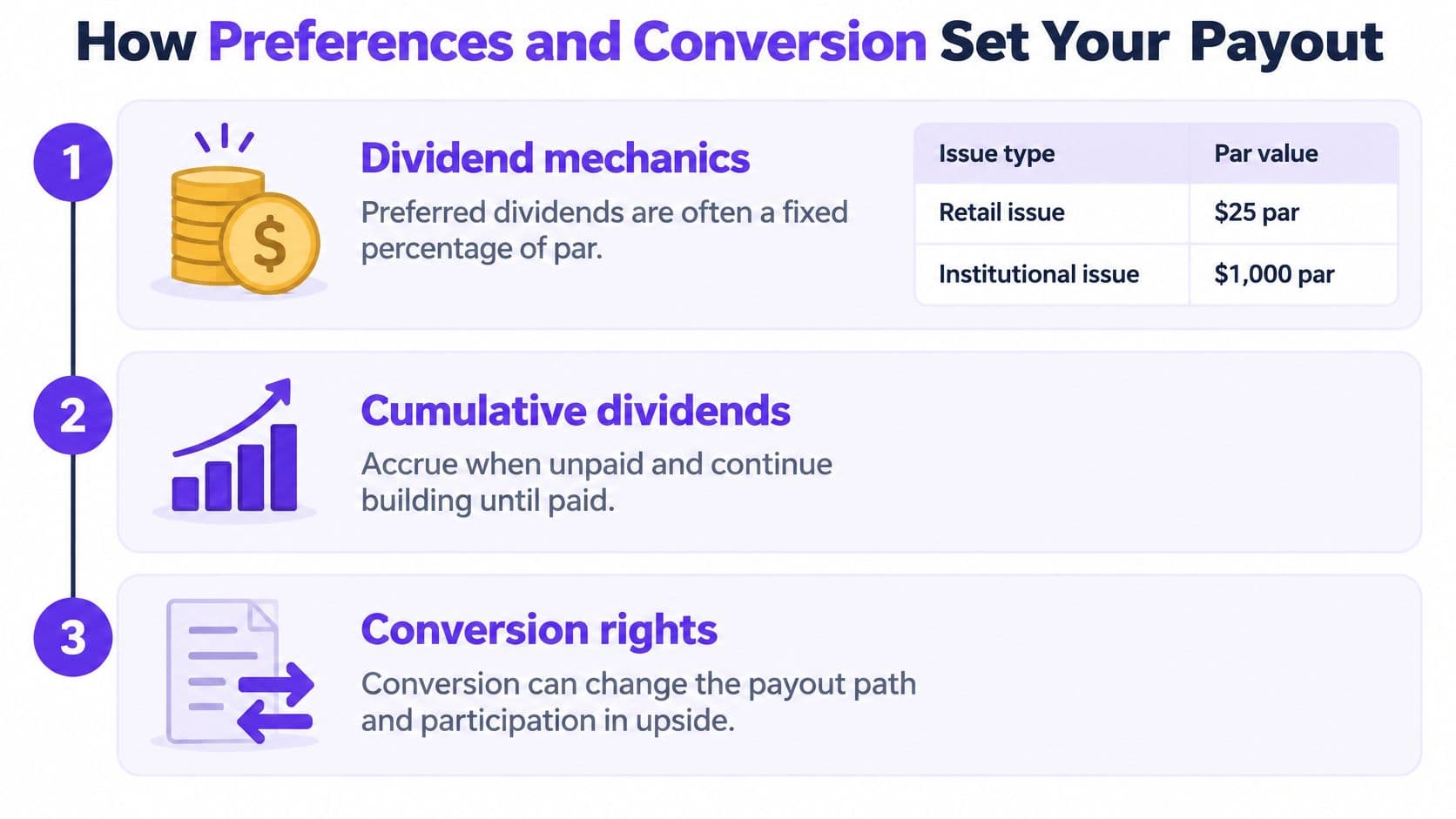
Dividend Mechanics Come First
Preferred dividends are commonly set as a fixed percentage of par value. The New York Attorney General guidance on stocks notes retail issues often use a $25 par value, while some institutional issues use $1,000, and cumulative dividends accrue when missed and must be paid before any common dividend. Common dividends sit at the opposite end of that discipline. Your board can increase, reduce, or eliminate them.
That difference changes risk. A fixed preferred payment behaves more like a bond coupon, so preferred prices generally move less with growth but carry interest-rate and credit-spread risk. Common carries the residual. When the company grows, common captures it. When it doesn't, common absorbs the shortfall after preferred claims are met.
Use this screening rule in diligence. For common, test residual upside, voting control, and dilution. For preferred, test cash-yield coverage, cumulative arrears, liquidation preference, conversion economics, redemption terms, and rate sensitivity. Lower volatility in a preferred price isn't principal protection. It's a different claim, not a guaranteed one.
The Worked Case at Three Exit Values
Take a clean hypothetical that mirrors many seed rounds. An investor puts in $5M for 25% of the company on an as-converted basis, with a 1x liquidation preference. That means the investor's first claim at exit is $5M before common holders participate, subject to whether the preferred is participating or non-participating.
| Exit value | Non-participating preferred (25%) | Participating preferred (25%) | Founders under non-participating |
|---|---|---|---|
| $5M | $5M | $5M | $0 |
| $15M | $5M | $7.5M | $10M |
| $40M | $10M | $13.75M | $30M |
At a $5M exit, the preference consumes the entire proceeds. Preferred takes $5M, founders and employees holding common or options take $0, even though they may own 75% of the shares on paper. At $40M, non-participating preferred converts because 25% of $40M is $10M, which beats the $5M preference. Founders receive the remaining $30M with other common holders under that structure.
Participating preferred changes the $40M math again. The holder takes the $5M preference, then takes 25% of the remaining $35M, which is $8.75M, for a total of $13.75M. Common holders split $26.25M, not $30M. One word in the charter, participating, moved $3.75M at that exit.
Walk the $15M Row Slowly
The $15M exit is where founders get surprised, so work it line by line. Under 1x non-participating terms, the preferred holder must choose the larger of two amounts. Option one is the preference, $5M. Option two is conversion to common, 25% multiplied by $15M, which equals $3.75M. The holder chooses $5M and does not convert.
Common holders then receive what's left. $15M minus $5M equals $10M. Founders don't receive 75% of $15M, which would be $11.25M. They share $10M because the preference is paid off the top, not pro rata.
Now switch only one term. Make the preferred participating. The holder takes the $5M preference first, then shares in the residual as if converted. The residual is $10M, and 25% of $10M is $2.5M, so preferred receives $7.5M in total. Common holders receive $7.5M, not $10M. The same company, same buyer, same $15M price, and founders lose $2.5M to a single participation clause.
The order never changes, even when the numbers do:
- Preference first: Preferred receives its liquidation preference, plus any accrued dividends the charter includes.
- Participation second: Participating preferred shares the remaining proceeds with common on an as-converted basis.
- Common last: Founders, employees, and other common holders split what's left, or all residual proceeds if preferred converts.
This is the point the Springer reference on preferred stock terms supports with its description of conversion eliminating the preference and becoming attractive only when the common-equivalent payout is larger. Participating preferred can collect its preference and then share residual proceeds, while non-participating preferred generally requires choosing between the preference and the as-converted amount. Preferred is not one standardized security, because filed terms can also add dividends, redemption rights, protective voting provisions, and distinct conversion mechanics.
Find Your Conversion Crossover
You need one formula committed to memory. Crossover exit value equals liquidation preference divided by as-converted ownership percentage. In the worked case, $5M divided by 25% equals $20M. Below $20M, a non-participating holder keeps the preference. Above $20M, conversion pays more, so rational holders convert and share pro rata with common.
Check it at the boundaries. At exactly $20M, conversion gives 25% multiplied by $20M, which is $5M, the same as the preference. At $40M, conversion gives $10M against a $5M preference, so conversion wins by $5M. At $15M, conversion gives only $3.75M, so the preference wins by $1.25M.
Accrued dividends move that line against you. Add $1M of accrued cumulative dividends to the same deal and the preferred claim becomes $6M, not $5M. The new crossover is $6M divided by 25%, which equals $24M. Your company must now sell for $4M more before preferred gives up its priority position and converts.
Practical rule: Model every term sheet at a disappointing exit, a plausible exit, and a strong exit. If founders receive $0 in the first case, you need to know that before you celebrate the valuation.
Two other structures deserve a direct warning. Capped participating preferred takes its preference plus a share of residual proceeds only until a stated cap, after which conversion economics govern. Senior-stacked preferences pay a later round before earlier rounds, so a new investor can jump ahead of your seed investors and deepen the amount that must clear before common sees value.
Watch how these payout choices play out in a visual walkthrough, then rebuild the same math on your own cap table.
Don't accept a claim that a high valuation protects founders. It doesn't if participating preferences, accrued dividends, and multiple senior layers consume the middle outcomes. For most SaaS, agency, and services businesses, the expected exit sits in that middle band, not at a venture-scale outlier. Negotiate for the exit you're likely to get. Preference and participation terms, not headline valuation, set founder outcomes there.
Why Ownership Percentage Misleads on Control
The largest holder doesn't automatically control the outcome, and the largest percentage doesn't automatically take the most money. If you're judging power from share count alone, you're reading the wrong column.
A Delaware Supreme Court case involving Hartford Accident and Indemnity Co. makes the point cleanly. The Delaware Supreme Court opinion in the Hartford case describes 260,000 shares of no-par-value preferred stock entitled to a noncumulative annual dividend of $1.00 per share and a $15.00-per-share liquidation entitlement, alongside 195,000 shares of common stock that could receive no dividends until preferred had received $1.00 per share for two consecutive years and another class had been retired.
Do the percentage math. Those two classes total 455,000 shares. Preferred represents about 57.1% and common about 42.9%. Even that majority understates the economic gap, because preferred had first access to specified dividends and liquidation proceeds while common participated only after those obligations were met.
A Founder-Sized Version of the Same Trap
Say you hold 10% of the common stock after several rounds. You may carry real voting influence on ordinary matters. You still rank behind every preferred series in a sale or liquidation. An investor with fewer shares can hold superior contractual claims to the first dollars out.
The reverse also misleads employees. An option grant described as a percentage of fully diluted shares sounds concrete, but its value depends on proceeds remaining after preferences clear and on the option strike price. Percentage without waterfall position is marketing, not analysis. This is also why you should separate ownership math from post-money valuation mechanics when you review a round.
Rebuild your own position in four columns. List each class, its share count, its preference per share, and its place in the payout order. Then compare that ranking with the ownership percentage printed on your cap table.
Percentages misstate both control and value. Put the payout order first in every term sheet and exit decision.
Modern venture financings preserve the Hartford logic through liquidation preferences and conversion rights. The instruments look newer. The hierarchy doesn't. Your job is to know exactly where your shares sit in that hierarchy before you agree to add another layer above them.
Voting Control and Anti-Dilution Protection
Preferred holders don't need to vote on every routine matter to control the decisions that matter. They need consent rights over the handful of actions that can impair their economics, and charters routinely give them those rights.
Class-specific vetoes can cover charter amendments, issuance of senior securities, acquisitions, financings, and changes to conversion rights. That means a minority preferred holder can block a sale that would pay you and your team well if that sale doesn't satisfy its preference or return target. Ordinary voting power sits with common. Deal-blocking power often sits with preferred.
An SEC filing describing preferred terms and related rights illustrates why you must read series-level terms, including accrued or payment-in-kind dividends, redemption rights, and different participation structures. The right question isn't which class is safer. It's who controls the decisions that determine whether promised economics get realized, a point you should test in venture capital due diligence on both sides of the table.
Anti-Dilution in a Down Round
Anti-dilution protection adjusts a preferred holder's conversion price when you issue new shares below that holder's original conversion price. The adjustment increases how many common shares the preferred converts into, which shifts value away from you and other common holders.
Work the harsh version first. A seed investor holds a $5M stake converting at $2.00 per share, so it converts into 2.5M common shares. You later raise a down round at $1.50 per share. Under full ratchet, the conversion price drops all the way to $1.50, and the $5M stake converts into about 3.33M shares. That's roughly 830,000 extra shares, a 33% increase in its conversion count before you count the new round's own shares.
Weighted-average protection is materially gentler. Assume 10M shares are outstanding before a $3M round at $1.50, so you issue 2M new shares. The adjusted price is $2.00 multiplied by (10M plus 1.5M) divided by (10M plus 2M), which is about $1.92. The $5M stake then converts into about 2.61M shares, an increase of about 4.3%, not 33%.
Don't treat that difference as technical trivia. Full ratchet in one bridge round can permanently re-cut the company in favor of early preferred holders. Push for broad-based weighted-average protection, confirm which issuances are exempt, and verify every protective provision before you sign. Founders review valuation first and vetoes last. Reverse that order.
Cap Table Math in a Preferred Funding Round
A cap table tells you paper ownership. A waterfall tells you cash at exit. You need both, and you must never confuse the first for the second.
| Holder | Security | Ownership |
|---|---|---|
| Founders | Common | 60% |
| Employee option pool | Common options | 15% |
| Seed investors | Series Seed preferred | 25% |
| Total | 100% |
Build the share counts behind those percentages. On 10M fully diluted shares, founders hold 6M common shares, the option pool covers 1.5M shares, and seed investors hold 2.5M preferred shares bought at $2.00 per share for $5M. That price implies a $20M post-money valuation, and at $2.00 per share the paper value totals $20M across all holders.
Paper value says founders hold 60% of $20M, or $12M. At a $5M exit under a 1x preference, founders receive $0.
Founders reach their paper value only after preferences clear and proceeds grow past the conversion crossover. At $15M with non-participating preferred, common holders share $10M, so the founders' 60% share of the common pool depends on how much of the option pool is issued and exercised. At $5M, there's nothing to debate. The preference takes the full amount.
Employees need a colder calculation. If you hold options, subtract your strike price from any per-share value that survives the waterfall, then account for exercise cost and taxes before counting value. An option over common at a $2.00 paper price is worth zero at an exit where common receives zero per share. Don't recruit or retain people with percentages you haven't waterfall-tested.
Seed investors view the same table through downside protection. Their first $5M is protected by the preference, and they keep conversion upside if the exit clears $20M. That asymmetry is the product they bought. Your job isn't to resent it. Your job is to price it consciously and limit terms that expand it, such as participation, multiples above 1x, and uncapped cumulative dividends.
Before you sign, use good capitalization table software or a disciplined spreadsheet to model $5M, $15M, and $40M exits with every series, accrued dividend, option strike, and seniority layer included. When you're sourcing the round itself, identify investors aligned with your startup so term expectations on preferences and control don't surprise you late in diligence.
Rebuild the table from the charter after every round, because each new series adds a layer to the preference stack. In our reporting work, the reporting release handoff from the controller to the founder packages P&L, cash, runway, ARR movement, and commentary into one approved operating view. Apply the same discipline to equity. One approved cap table, one approved waterfall, no side versions.
Negotiate These Terms Before You Sign
Don't negotiate valuation and skim the preference terms. That's how founders win the headline and lose the exit. Review these red flags with counsel and attach a counter-term to each one.
Use this checklist as your pre-signing screen for every preferred round, bridge, and restructuring.
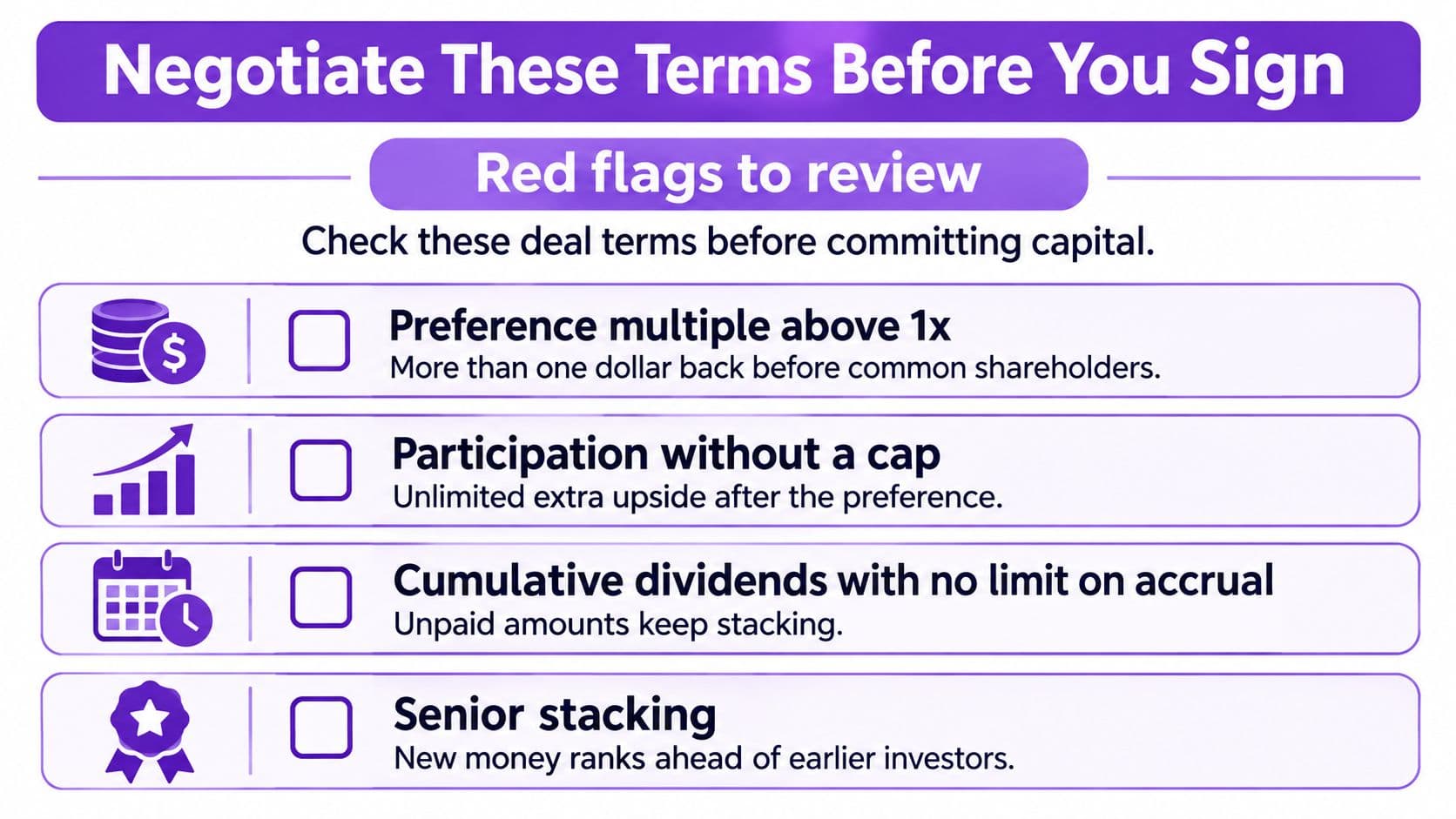
Red Flags and Counter-Terms
- Preference multiple above 1x: Ask what downside case justifies it. Request 1x, which returns capital once before common participates.
- Participation without a cap: Ask for non-participating terms first. If you concede participation, request a clear cap and model it at $15M and $40M.
- Cumulative dividends with no limit: Ask whether dividends accrue in cash or payment-in-kind and whether they add to the preference. Request non-cumulative terms or a defined accrual limit.
- Senior stacking: Ask whether new money ranks ahead of earlier rounds. Request pari passu ranking so series share priority by amount rather than by closing date.
- Silent conversion adjustments: Ask exactly which issuances trigger anti-dilution and who approves changes. Confirm the formula and exempt issuances in writing.
- Minority sale veto: Ask which preferred holders can block an acquisition. Tie consent to a meaningful ownership threshold where you have negotiating power.
- Redemption rights: Ask when holders can force the company to repurchase shares for cash. Resist redemption that can trigger during a downturn when cash is scarce.
Apply a simple decision rule. If you have limited bargaining power, accept a clean 1x non-participating preference with weighted-average anti-dilution and move on. If you expect a large exit and investors compete, capped participation may cost you little because conversion will likely govern, but model the cap anyway. If you're an employee holding options, check the full waterfall and your strike price before you count equity as compensation.
Compare these preferred terms with earlier-stage instruments in SAFE vs convertible note structures, because SAFEs and notes convert into the same stack later. A cheap instrument today can become expensive preferred tomorrow if caps, discounts, and seniority aren't modeled together.
Do two things this week. First, rebuild your cap table and exit waterfall directly from the charter at $5M, $15M, and $40M. Second, pressure-test your finance handoffs before diligence exposes gaps. Our free diagnostic asks three questions to name the likely failure point and explain why, and no email is required for the first result. The full Finance Ops Diagnostic includes a current stack and handoff review, a spreadsheet dependency map, an unclear owner and review gap inventory, a recommended cleanup path, and a monthly routine recommendation.
If your cap table says one thing and your waterfall says another, you need investor-ready numbers before the next round or exit conversation. Jumpstart Partners helps SaaS, agency, and services founders clean up reporting, model cash and equity outcomes, and present financials buyers and investors can trust. Visit Jumpstart Partners to start with the diagnostic and turn your preferred terms into a payout model you understand.