Financial Operations
Venture Capital Due Diligence: A Founder's SaaS Guide
Master venture capital due diligence with our SaaS founder's guide. Learn the stages, what VCs check, and how to build an investor-proof data room.
ByJumpstart Partners, CPA, QuickBooks ProAdvisor
··17 min readThe strongest venture-backed companies don't fail in the market first, they fail in diligence when the numbers, contracts, or customer proof don't hold up under scrutiny. That's why venture capital due diligence is a financing event with real consequences, not a paperwork ritual. A randomized study in the Review of Financial Studies found that diligence increased 2-year growth for funded firms, while also lowering continuation rates among nonfunded applicants, which tells you exactly what the process does, it sorts winners from weaker candidates and affects who keeps operating at all (RFS study).
For a founder, that's both the risk and the opportunity. If you prepare well, diligence becomes the moment you prove that your SaaS business can scale with discipline, not just ambition. If you prepare poorly, the same process exposes weak revenue quality, a messy cap table, or a story that doesn't reconcile across your data room, your customer calls, and your model.
Table of Contents
- Why Due Diligence Is More Than Just an Audit
- The Due Diligence Roadmap from Term Sheet to Close
- The Six Pillars VCs Examine in Your Business
- Mastering the SaaS Financial Deep Dive
- Building Your Investor-Proof Data Room
- Common Due Diligence Red Flags and How to Fix Them
- Get Your Financials Ready for Due Diligence
Why Due Diligence Is More Than Just an Audit
The old framing is wrong. Venture capital due diligence isn't a backward-looking audit, it's a forward-looking proof test for whether your company deserves new capital. Industry analysis shows that 9 diligence categories saw a more than 30% increase in focus among VCs, with customer diligence prioritized by 38% of investors and go-to-market analysis rising by 33% (industry analysis). That shift matters because investors are no longer satisfied with a polished pitch deck and a large TAM slide, they want evidence that customers buy, stay, and expand.
What investors are really trying to prove
VCs aren't asking for documents just to collect them. They're testing whether your business can survive scrutiny across the six areas that matter most, which include financial health, legal compliance, market analysis, product viability, business model sustainability, and founder or management capability (Affinity's diligence framework). A weak answer in any one of those areas can slow or stop a round, even when the product story sounds strong.
That's also why founders should think about evaluating potential investors as part of the process. A firm that says it values discipline but reacts badly to questions about its own process usually won't be a good long-term partner. If you want a useful framework for that conversation, Founder Connects' guide on evaluating potential investors is a solid place to pressure-test fit before you accept money.
Why this matters to your round
A clean diligence process signals more than compliance. It shows that your books reconcile, your customer claims hold up, and your team can answer hard questions without improvising. That's the difference between looking fundable and being fundable.
Practical rule: if a claim sits in your pitch deck but nowhere in your contracts, metrics, or bank records, investors will treat it as unproven.
For a deeper look at how diligence differs from a generic audit mindset, see Jumpstart Partners' guide to auditing a business. The point is simple, diligence is a validation process, and the company that treats it that way usually moves faster.
The Due Diligence Roadmap from Term Sheet to Close
Once the term sheet is signed, the clock starts. A diligence process often runs in distinct phases, and the work is usually spread across legal, financial, technical, and commercial reviews in parallel. A helpful way to visualize it is as a 4 to 8 week sequence, not a single meeting.
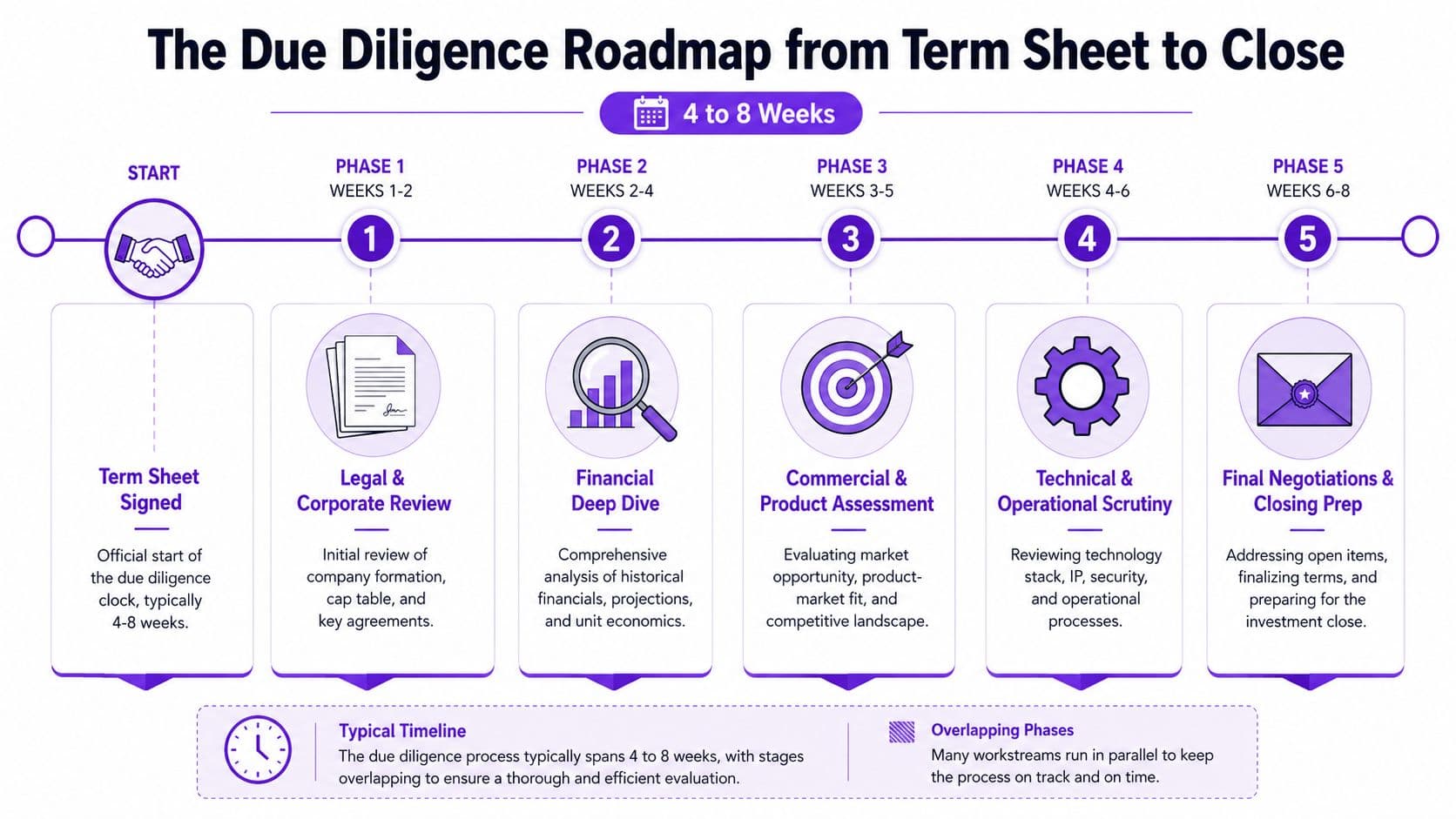
The week-by-week flow
The first move is the data request list and the virtual data room. That's where the investor team checks whether your corporate records, financials, customer evidence, and product materials are organized enough to support real analysis. Dartmouth's note splits diligence into an initial screening stage and a detailed evaluation stage before valuation and deal-structure work, which means the early materials in your data room can determine whether the deal advances at all (Dartmouth Tuck due diligence note).
The next phase is where the specialists get involved. Finance reviews historicals and projections, legal checks formation, cap table, and contracts, product and technical reviewers inspect architecture and security, and the commercial team validates customer and market claims. That sequencing is also why a founder shouldn't wait until after term sheet discussions to clean up the records.
What your team needs to deliver
At minimum, you need three things ready before diligence gets deep:
| Stage | What investors expect | What you should have ready |
|---|---|---|
| Initial review | Clear company overview and core metrics | Clean cap table, current deck, latest financials, customer summary |
| Parallel workstreams | Evidence that supports the thesis | Contracts, cohort data, product docs, legal files, pipeline detail |
| Closing prep | No material surprises | Open-item log, revised model, final approvals, signature-ready docs |
For a founder-facing view of the investor side of the process, Jumpstart Partners' investor due diligence checklist is useful because it mirrors how investors think about evidence, not just how founders store files.
A good diligence process is calm, sequenced, and traceable. A bad one is reactive, with founders answering the same question three times in different formats because the information never lived in one place.
Don't let the data room become a junk drawer. If an investor can't find the proof quickly, they assume the proof doesn't exist.
A short video overview can also help your team align on the sequence before the specialist reviews begin.
The Six Pillars VCs Examine in Your Business
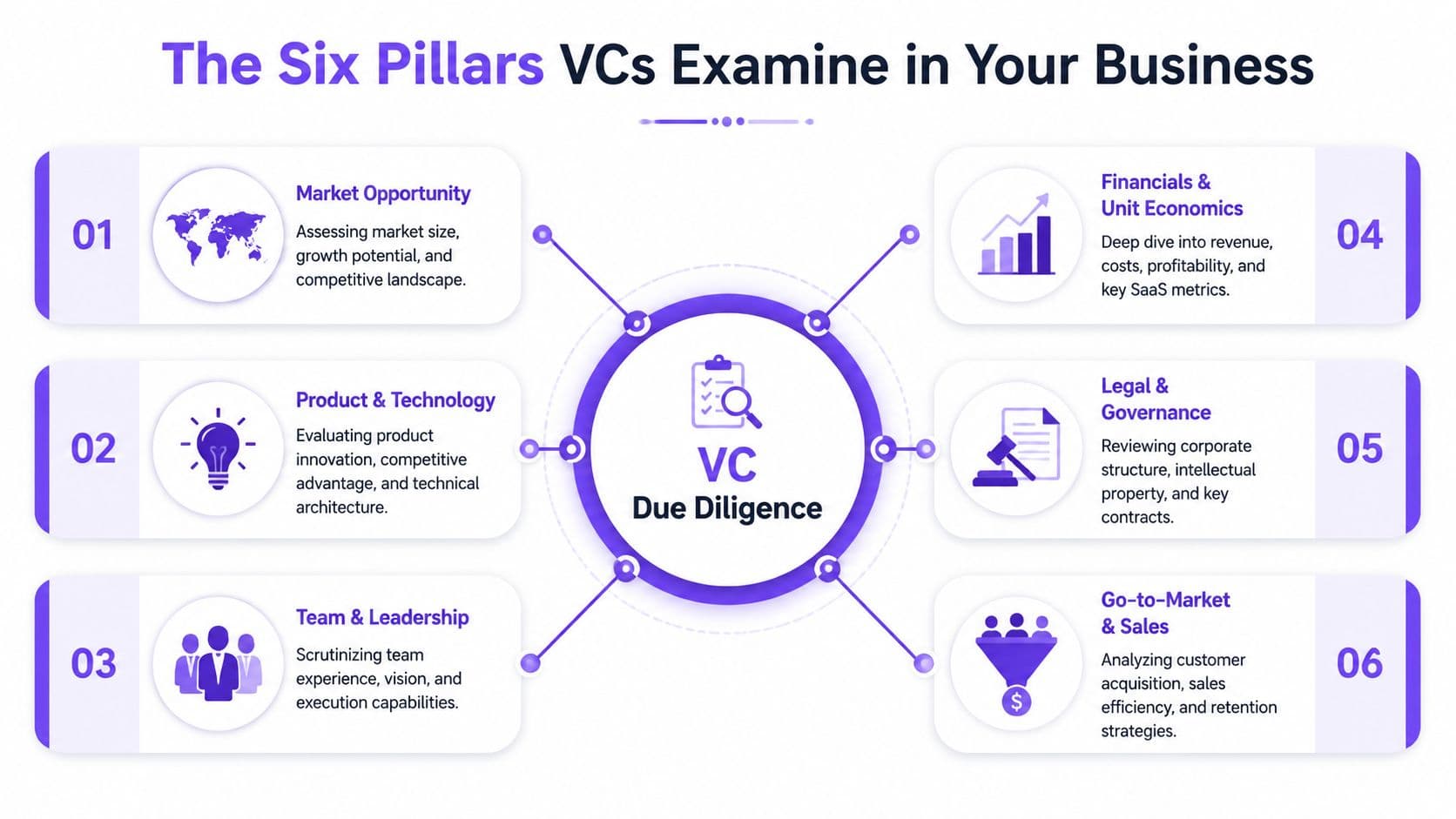
VCs do not look at your company as a stack of loose documents. They test whether the business holds together across six pillars, because each one answers a different question about risk, durability, and how much the round should really be worth. If one pillar is weak, the rest of the pitch has to carry too much weight.
Financial health
Investors want the numbers to reconcile. Revenue, cash flow, projections, burn, and the financial statements need to tell the same story, not just a growth chart on a slide, as reflected in the datarooms.org.uk checklist. Jumpstart Partners' quality of earnings guide matters here because the key question is whether reported growth is clean, repeatable, and tied back to source data.
In practice, that means the monthly close has to be tight enough that a buyer, lender, or investor can trace revenue from the ledger to the bank account without a scavenger hunt. If deferred revenue, ARR, and cash receipts do not align, the diligence team will spend time reconciling the gap instead of underlining the upside.
Legal and governance
This pillar covers corporate structure, cap table accuracy, contracts, equity, and compliance. Investors care because ownership confusion slows closings and can change deal economics in ways founders do not expect.
If your option grants are inconsistent, your board approvals are incomplete, or an old SAFE was never reflected properly, the legal review can go from routine to expensive very quickly. Clean governance does not add narrative value in the deck, but it prevents avoidable diligence friction.
Product and technology
The investor wants to know whether the product is real, defensible, and scalable. That means architecture, security, intellectual property ownership, roadmap discipline, and whether the product in the demo matches what customers use.
For SaaS companies, this often turns into a simple question: can the team support the current customer base without creating hidden engineering debt or security risk? A polished front end is not enough if permissions, uptime, or data handling are weak behind it.
Market and competition
The investor checks whether the company is pursuing a genuine opportunity or merely a fashionable category. The question is not only whether the market is large, it is whether your go-to-market motion can reach buyers efficiently.
Founders usually get more credibility here when they can show why customers buy from them now, not just why the category should exist someday. A focused wedge, a clear buyer, and a repeatable sales motion usually carry more weight than broad market language.
Team and management
Investors evaluate founder-market fit, decision quality, hiring strength, and whether the leadership team can execute under pressure. A strong product story does not offset a team that cannot manage complexity.
They also look for evidence that the team can run the company at the next stage, not only at the stage that got it funded the first time. If responsibilities are unclear, key hires are missing, or every important decision still runs through one founder, that becomes part of the valuation conversation.
Business model sustainability
This pillar separates growth from value destruction. Wall Street Prep's framing is blunt, investors break revenue and cost structure down to the unit level to test whether each customer creates value at scale, and a business that spends $1.20 to generate $1.00 of contribution margin destroys value while a business that earns $1.50 for every $1.00 spent creates it (Wall Street Prep).
That is why investors pay close attention to payback, gross margin, retention, and the shape of the sales motion. A company can grow fast and still be hard to fund if every new logo arrives with weak economics or a long, expensive recovery period.
| Pillar | What VCs are proving |
|---|---|
| Financial health | The books are real and durable |
| Legal and governance | The company can close cleanly |
| Product and technology | The product is defensible |
| Market and competition | The opportunity is worth backing |
| Team and management | The team can execute |
| Business model sustainability | Growth creates value, not just revenue |
If you want the review organized the way investors think, Jumpstart Partners' guide to financial due diligence is a practical companion because it forces the same traceability investors expect in diligence.
Mastering the SaaS Financial Deep Dive
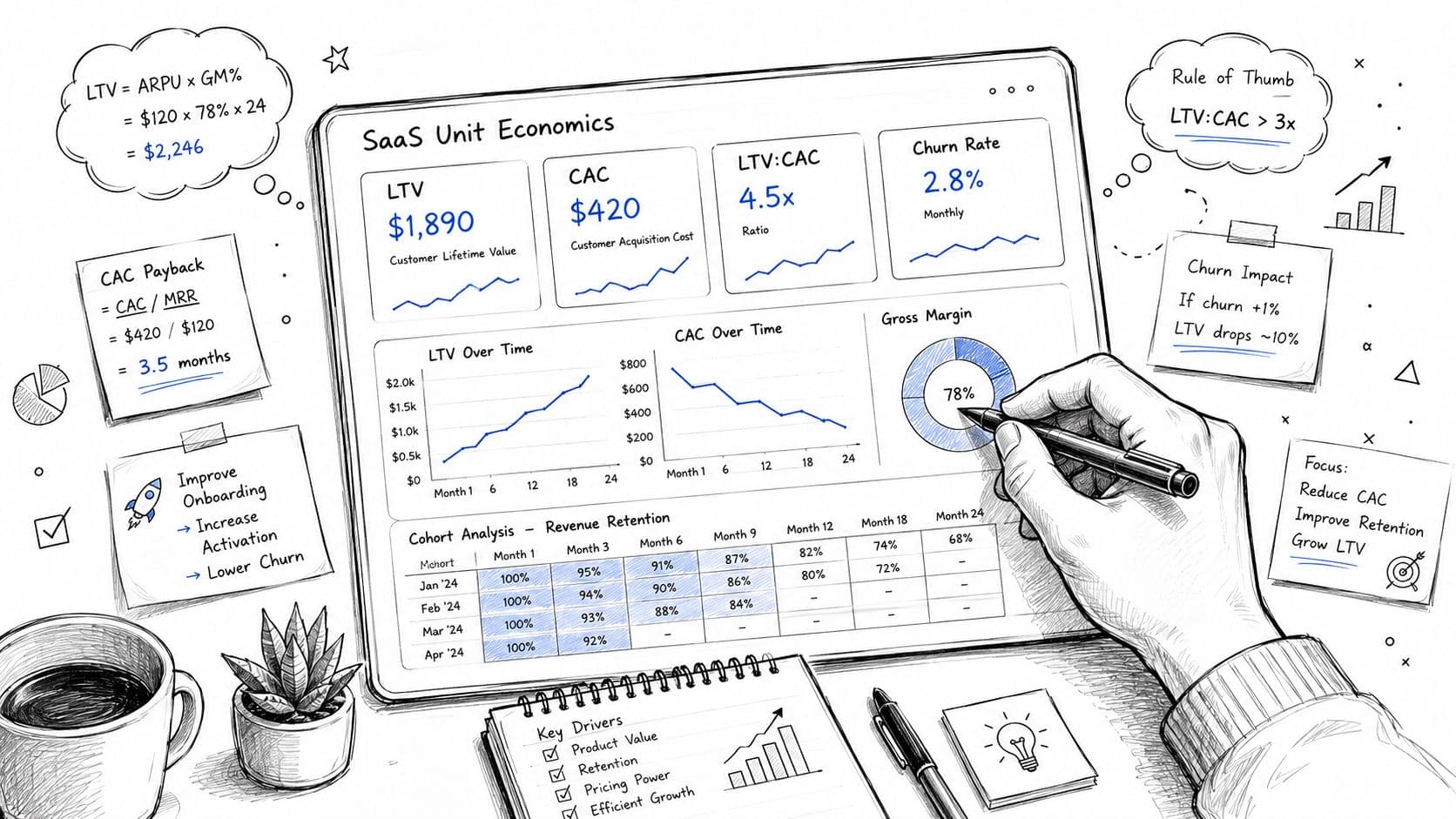
SaaS diligence lives and dies on unit economics. Investors want to know whether each customer is worth more than the cost to acquire and support it, and they'll test that with your revenue quality, churn, margins, and payback. Jumpstart Partners' accounting for SaaS guide matters here because clean SaaS accounting is what makes the metrics believable.
A worked example you can defend
Start with a simple account. Say your average revenue per account is $120 per month, gross churn is 2% per month, and gross margin is 80%. Using the standard LTV formula from the brief, LTV = (Average Revenue Per Account / Gross Churn Rate) × Gross Margin, your LTV is $4,800.
Here's the math: $120 divided by 0.02 equals $6,000, and $6,000 multiplied by 0.80 equals $4,800. If your CAC is $1,200, your LTV:CAC ratio is 4:1, which is stronger than the common benchmark target of 3:1 cited in OpenView's 2024 SaaS Benchmarks, as referenced in the brief. That doesn't make the deal done, but it does mean the acquisition engine is returning enough value to justify scale.
The payback test founders get wrong
Payback is where a lot of founders get tripped up because they use the wrong margin or the wrong denominator. If a customer pays $120 per month, gross margin is 80%, and CAC is $1,200, monthly gross profit is $96. That gives you a simple CAC payback period of 12.5 months, because $1,200 divided by $96 equals 12.5.
That number matters because it tells investors how quickly the company recovers cash after acquisition. If your sales cycle, onboarding effort, or implementation burden pushes payback out too far, the business needs more capital to keep growing. That's why investors often ask for transparent assumptions, sensitivities, and downside cases instead of a single hero metric.
Practical rule: if you can't explain where churn, margin, or CAC comes from at the cohort level, investors will assume your model is too optimistic.
What to show, not just calculate
Use a table or model tab that breaks out:
| Metric | What it should prove |
|---|---|
| CAC | You know the real cost to win a customer |
| LTV | Customers create enough gross value over time |
| LTV:CAC | Growth pays back more than it consumes |
| Payback | Cash recycles fast enough to support scaling |
If you're a SaaS founder, earning investor trust requires transparency. Investors don't need perfection, they need numbers that reconcile, assumptions that are visible, and a model that doesn't hide weak economics behind blended averages.
Building Your Investor-Proof Data Room
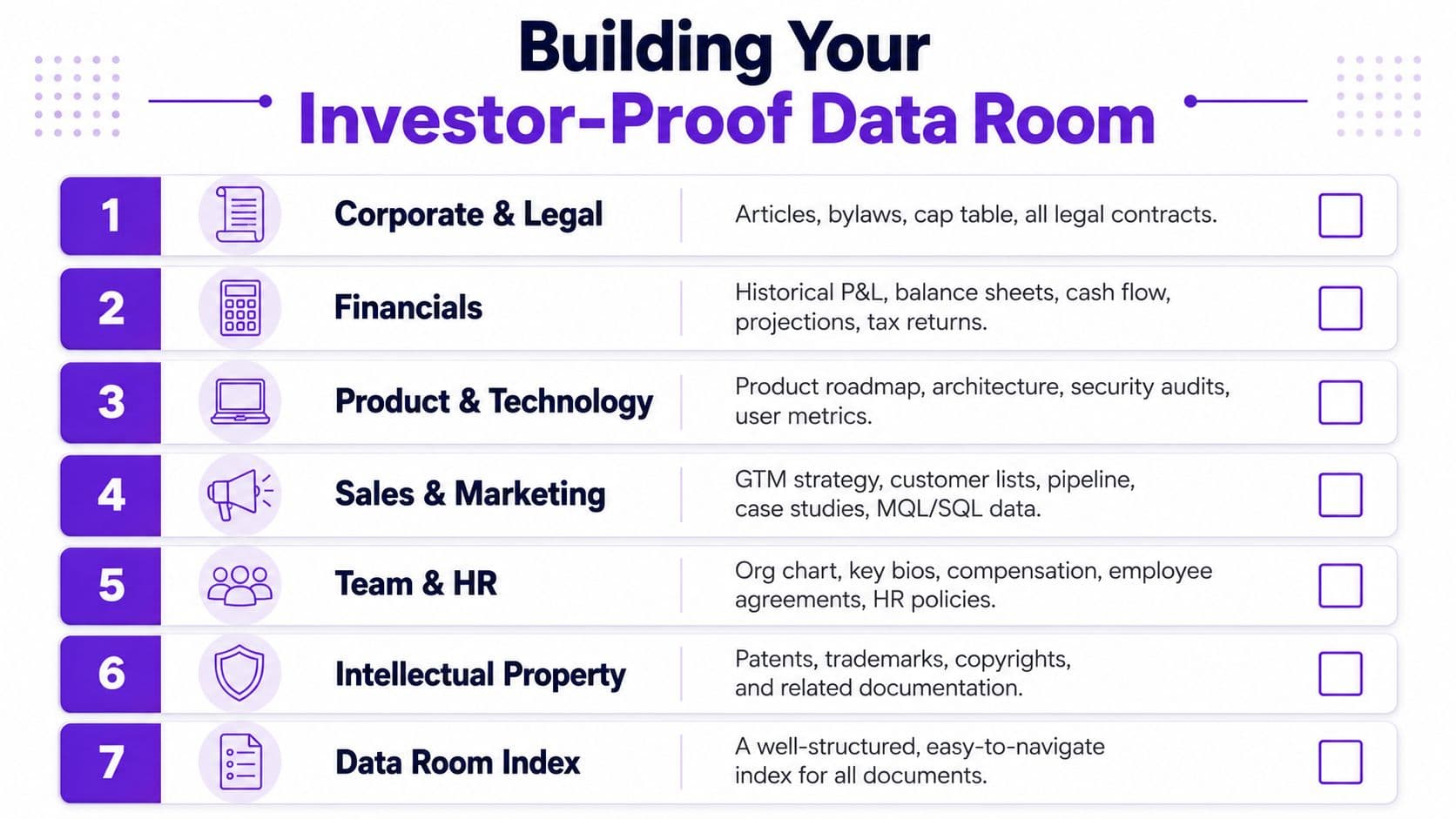
A clean data room can save weeks of back-and-forth, and it does more than speed review. It lets an investor triangulate the story across documents, calls, and the model, which is the point of diligence in the first place (venture capital careers on data triangulation). If the room is messy, the investor spends time hunting for proof instead of evaluating the business.
A folder structure that actually works
Use a structure that follows how diligence is read:
| Folder | Must-have documents |
|---|---|
| 01 Corporate & Legal | Articles, bylaws, cap table, board consents, key contracts |
| 02 Financials & Metrics | Historical P&L, balance sheet, cash flow, projections, tax returns, KPI dashboards |
| 03 Product & Tech | Product roadmap, architecture summary, security docs, user metrics |
| 04 Sales & Marketing | GTM plan, customer list, pipeline, case studies, retention data |
| 05 Team | Org chart, bios, comp details, employee agreements, HR policies |
| 06 Intellectual Property | Assignments, trademarks, copyrights, patent documents where relevant |
| 07 Index and Q&A | Folder map, request tracker, answers log |
The index is not busywork. It saves investor time, and it stops your team from answering the same question in different ways when the partner, associate, and finance lead all ask for the same file.
How to run the room
Give the investor group controlled access, not free-for-all editing rights. Track document views, keep versions clean, and route questions through the Q&A feature so there is one source of truth. If a finance partner asks how revenue recognition ties to booked contracts, you can answer once and keep the response visible for the rest of the process.
Separate facts from commentary wherever you can. Put the raw source files in the room, then add short notes that explain what the file shows and what it does not. That matters most for SaaS metrics, where a chart without a cohort, a denominator, or a time frame can create confusion fast.
A strong room also shows judgment. Investors want to see the evidence behind the claim, the assumption behind the forecast, and the structure behind the metric. That is the difference between a room that checks boxes and a room that helps close a round.
Common Due Diligence Red Flags and How to Fix Them
A lot of rounds get delayed by the same avoidable issues. The investor concern is rarely the issue itself, it's the pattern behind it. A messy cap table signals weak governance, inconsistent financials signal unreliable reporting, and customer concentration signals risk that can hit the business overnight.
| Red Flag | Why VCs Care | How to Remediate Before Diligence |
|---|---|---|
| Messy cap table | Ownership is unclear and closing economics can break | Reconcile every issuance, SAFE, note, and option grant before the process starts |
| Inconsistent financial reporting | Investors can't trust the numbers if reports don't tie out | Rebuild the monthly close, map source systems, and document accounting policies |
| Customer concentration | One client can distort revenue stability and negotiation leverage | Create a concentration memo, show diversification progress, and stress-test loss scenarios |
| Weak IP protection | The company may not fully own what it sells | Get assignments signed, clean up contractor paperwork, and confirm invention ownership |
| Key-person dependency | The company can stall if one person leaves | Document processes, cross-train ownership, and reduce single-threaded knowledge |
| Overstated pipeline | Forecasts become marketing instead of planning | Tie pipeline stages to signed activity, historical conversion, and a clear source of truth |
The most dangerous mistake is waiting for the investor to find the issue first. If you surface the problem early with a remediation plan, you control the narrative and show judgment. If you hide it, the same issue becomes a trust problem.
One thing founders often miss is that risk itself isn't fatal. Unexplained risk is what kills momentum. If one client is too large, explain the diversification plan. If a contractor assignment is missing, fix it before counsel gets involved. If the books are behind, stop the round calendar long enough to clean them up.
Get Your Financials Ready for Due Diligence
The smoothest diligence processes have one thing in common, the financials are already clean. If your books don't reconcile, your SaaS metrics are vague, or your cap table has loose ends, everything else slows down. That's why preparation beats persuasion every time.
VCs don't fund perfect companies, they fund understandable ones. That means your historicals, model, customer evidence, and legal records all need to tell the same story. If they don't, the investor will assume the gap is hiding a deeper problem.
For founders who want the operational side handled before diligence starts, Jumpstart Partners provides outsourced controller and bookkeeping support for growing SaaS, agency, and service businesses. The point isn't to decorate the numbers, it's to make them investor-ready so the process moves on evidence instead of cleanup. If you want your next round to move with fewer surprises, start with Jumpstart Partners.
A CTA for Jumpstart Partners to help you clean up your books, tighten your SaaS metrics, and get your data room ready before investors start asking hard questions.