Financial Operations
Ecommerce Accounting Services for Scaling Brands
What ecommerce accounting services include for $1M+ brands: revenue recognition, settlement reconciliation, sales tax, returns, pricing, and how
ByJumpstart Partners, CPA, QuickBooks ProAdvisor
··18 min readU.S. retail ecommerce sales reached an estimated $300.2 billion in the first quarter of 2025, equal to 16.2% of total retail sales, or approximately one dollar in every six spent in retail, according to the U.S. Census Bureau's ecommerce report. For a scaling brand, that isn't just a market milestone. It's a warning about financial complexity.
Your Shopify orders, Amazon settlements, Stripe payouts, refunds, shipping charges, sales tax, inventory movements, and bank deposits follow different timelines. If your books record only the deposits, your revenue, margins, receivables, tax liabilities, and cash forecast are all vulnerable to distortion.
That's why ecommerce accounting services need to do more than connect a sales channel to QuickBooks. The right service reconciles every settlement to the orders behind it, tracks inventory and returns at the right level, separates marketplace fees from revenue, and gives you financial statements you can use before a fundraise, audit, acquisition, or major inventory purchase. The difference between a bookkeeper and a controller is explained clearly in this guide to bookkeeper versus controller responsibilities.
Table of Contents
- Why $1M Ecommerce Brands Outgrow DIY Bookkeeping
- What Ecommerce Accounting Services Actually Include
- Why Revenue Never Equals Your Payout
- Sales Tax, Marketplace Rules, and 1099-K Confusion
- The Returns Problem Most Books Get Wrong
- Pricing Models and How to Choose a Provider
- Red Flags, Next Steps, and FAQs
Why $1M Ecommerce Brands Outgrow DIY Bookkeeping
The breaking point usually arrives during a financing conversation or year-end close. An investor asks for channel-level gross margin, a lender asks for current receivables and inventory, or your CPA asks why the 1099-K is higher than the revenue on the income statement. Your team then discovers that the accounting file contains deposits, not a reliable record of the transactions that produced them.
At smaller volumes, a founder can often inspect individual orders and make reasonable assumptions. As sales spread across marketplaces, payment processors, banks, refunds, shipping systems, tax accounts, and inventory locations, those assumptions stop working. A single payout can represent many orders, several fee categories, refunds from earlier periods, chargebacks, tax amounts collected for customers, and reserves that haven't been released.
The deposit problem
Suppose Shopify sends a payout on Friday, Stripe sends another on Monday, and Amazon releases funds later under its own settlement schedule. The bank feed shows cash arriving, but it doesn't explain which orders earned the revenue, which fees reduced the payout, or which refunds remain open.
A deposit-based system creates several predictable errors:
- Revenue gets understated: Net deposits exclude commissions, processing fees, and other deductions that still belong in the operating picture.
- Margins become unreliable: The P&L hides channel costs inside reduced cash receipts instead of showing them as separate expenses.
- Receivables disappear: Earned sales that haven't settled look like missing revenue rather than amounts due from a platform.
- Tax records drift: Platform-reported gross payments won't necessarily match the revenue account.
- Working capital gets overstated: Inventory and return obligations remain disconnected from the sales that created them.
Controller's rule: Reconcile orders to payouts, not bank deposits to revenue.
The issue isn't that your accounting software lacks integrations. Integrations move data. They don't decide how you recognize revenue, value returned inventory, classify facilitator-collected tax, or investigate a settlement difference. Those decisions require a close process with ownership, review, and documented controls.
What changes at scale
A growing brand needs a monthly package that answers operational questions, not just tax questions:
- Which channel generated revenue?
- What did each channel cost?
- Which SKUs remain profitable after returns?
- How much cash is held by processors?
- What taxes were collected by a marketplace?
- What inventory is sellable, damaged, in transit, or obsolete?
Ecommerce accounting services earn their place when they turn those questions into repeatable reports. The objective isn't more bookkeeping activity. It's a financial record that lets you make purchasing, pricing, hiring, and fundraising decisions without reconstructing the business after the fact.
What Ecommerce Accounting Services Actually Include
Professional ecommerce accounting services combine transaction processing, inventory accounting, revenue policies, tax controls, close management, and management reporting. The value is not another connector. It is a controlled process that explains each settlement from customer order through bank deposit.
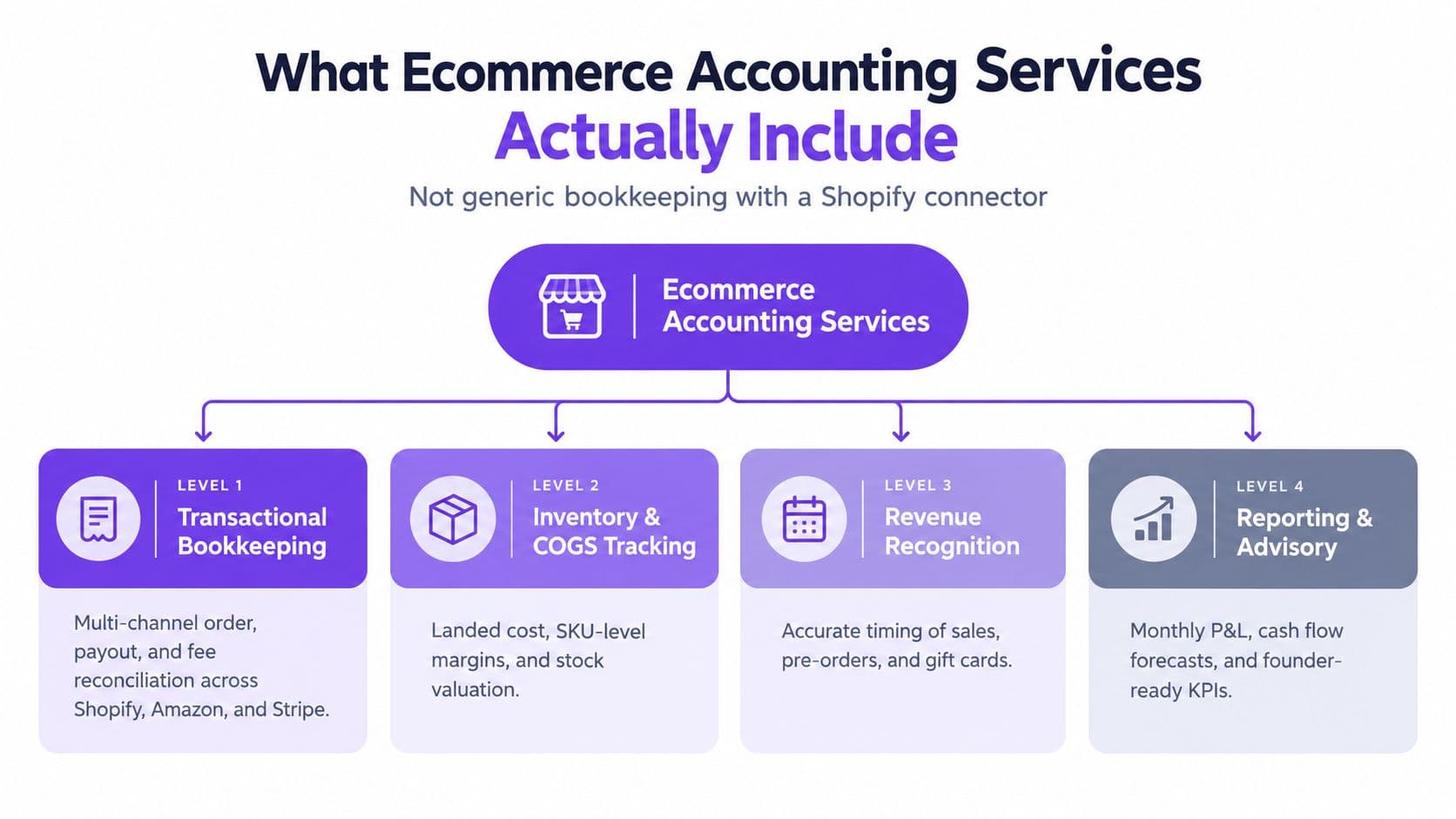
The books are the map. Integrations are the roads. The close process is traffic control. Without those controls, deposits can be matched to the bank while fees, refunds, reserves, and unsettled orders remain misclassified.
The transaction layer
The foundation is channel-specific bookkeeping across Shopify, Amazon, Stripe, Square, and other payment systems. A capable team imports order and settlement data, records gross sales, posts refunds and chargebacks, separates processing and marketplace fees, and reconciles clearing accounts to bank activity.
The chart of accounts must support channel reporting. “Sales” is too broad for a multichannel company. Separate accounts should identify direct website sales, marketplace sales, shipping income, refunds, payment fees, marketplace commissions, and taxes. Settlement-level reconciliation also shows which deductions reduced a payout and which balances remain held by a processor.
Inventory and COGS
Inventory accounting connects purchasing activity to the cost of each unit sold. The calculation may include product cost, inbound freight, customs, prep, packaging, write-offs, and adjustments for damaged or missing units. The result should be a supportable inventory balance and COGS figure for SKU-level margin analysis.
Cash reconciliation alone is incomplete. A profitable-looking P&L can coexist with overstated inventory, delayed write-offs, and margins that ignore the cost of returned or unsellable goods.
Revenue recognition and reporting
Under ASC 606, timing matters. The workflow should distinguish completed sales from pre-orders, gift cards, store credits, refunds, and amounts earned but not yet settled. The provider should document the policy and apply it consistently instead of changing classifications to fit a platform report.
At month-end, the deliverable should include:
- Channel-level profit and loss reporting
- Inventory and COGS schedules
- Gross margin and contribution reporting
- Accounts receivable and settlement-clearing balances
- Sales-tax liability detail
- Cash position and forward-looking cash visibility
- Explanations for unusual variances
A predictable close calendar matters as much as the report. If the numbers arrive long after month-end, you are managing history instead of the business. See how a virtual accounting firm can structure that calendar.
Why Revenue Never Equals Your Payout
The most common ecommerce accounting mistake is simple: a founder sees a payout and records it as revenue. That approach matches the bank statement, but it misstates the economics of the sale.
Consider a channel with $100,000 in gross order value. The customer paid that amount, so the accounting record must explain the deductions separately rather than treating the net deposit as sales.
A worked settlement bridge
| Line Item | Amount | Accounting Treatment |
|---|---|---|
| Gross order value | $100,000 | Record as gross revenue when earned |
| Marketplace commissions | ($15,000) | Record as channel selling expense |
| Payment-processing fees | ($3,000) | Record as payment-processing expense |
| Refunds | ($5,000) | Record as contra-revenue and refund liability activity |
| Chargebacks | ($2,000) | Record against receivable or as a chargeback expense, based on policy |
| Sales tax collected | ($8,000) | Record as sales-tax liability, not revenue |
| Reserve held by platform | ($7,000) | Record as restricted or held receivable |
| Expected cash payout | $60,000 | Match to the settlement and bank deposit |
If you book the $60,000 deposit as revenue, the income statement understates gross sales by $40,000. It also hides $18,000 of fees and customer-related deductions, while the $7,000 reserve disappears from the balance sheet unless you track it separately.
The correct accrual view records revenue when the performance obligation is satisfied, records deductions in their appropriate accounts, and carries earned but unsettled amounts as receivables or settlement-clearing balances. The bank deposit is the final cash movement, not the definition of revenue.
Timing changes cash visibility
Marketplace schedules create a second problem. Marketplace settlement analysis notes that Amazon may hold funds through a 14-day settlement cycle, while wholesale receivables can take 30–60 days. Those timing differences affect cash conversion even when the underlying sales are already recognized.
A channel-specific settlement bridge should show:
- Gross order value
- Refunds and chargebacks
- Marketplace and processing fees
- Taxes collected
- Reserves and withheld amounts
- Amounts earned but unsettled
- Cash deposited
- Remaining receivable balance
For Amazon sellers, fee classification deserves close attention because fulfillment, referral, storage, advertising, reimbursements, and returns can appear in different settlement categories. A focused resource on FBA margin pitfalls is useful when reviewing whether your channel report captures the full cost structure.
Your monthly close should pair the bridge with a 13-week cash forecast. The forecast needs to model payout delays, refund exposure, reserves, chargebacks, inventory commitments, and expected operating payments. Faster deposits don't automatically mean better economics if the channel is accumulating future deductions.
If your team still needs to ask why revenue doesn't match GMV, this explanation of what GMV means helps separate customer order value from recognized revenue and cash.
Sales Tax, Marketplace Rules, and 1099-K Confusion
Sales tax accounting has two separate questions: who collected the tax, and who must report the transaction. Marketplace-facilitator rules can shift collection and remittance to the platform, but they don't eliminate the seller's need to reconcile transactions, maintain records, or analyze direct website sales.
New York requires marketplace providers to collect state and local sales tax on taxable tangible goods delivered to New York addresses. North Carolina and Colorado also generally require marketplace facilitators to collect and remit applicable taxes on marketplace sales. The treatment changes when the same SKU is sold through your own storefront.
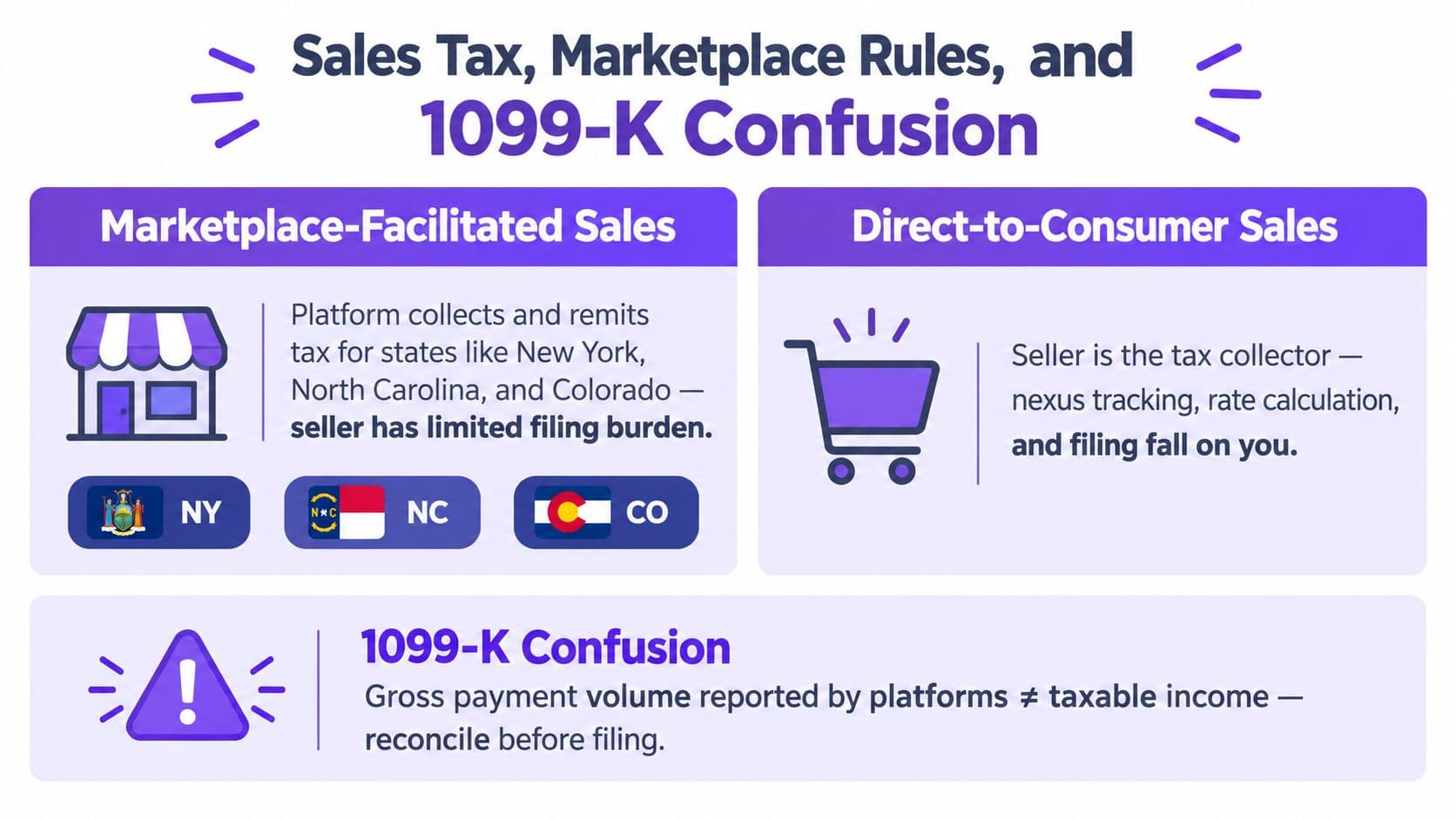
Marketplace and direct sales are not interchangeable
| Area | Marketplace-facilitated sale | Direct-to-consumer sale |
|---|---|---|
| Tax collection | Platform generally collects and remits where facilitator rules apply | Seller calculates, collects, and remits where required |
| Ledger treatment | Track facilitator-collected tax separately | Track seller-collected tax as the seller's liability |
| Filing responsibility | Seller may still need transaction reporting or documentation | Seller manages nexus, registration, filing, and payment obligations |
| Reconciliation source | Platform tax report, settlement, order data, and return | Store order data, tax engine, payment report, and bank activity |
| Key risk | Assuming the platform's collection removes every reporting duty | Treating marketplace rules as if they cover website orders |
The ledger should never combine facilitator-collected and seller-collected tax into one undifferentiated sales-tax-payable account. That can overstate your own remittance obligation and make tax-return reconciliation difficult.
A practical control is a jurisdiction-by-channel matrix containing the ship-to state, sales channel, facilitator status, taxability, exemption evidence, filing responsibility, and remittance date. Review it alongside settlement reports and sales-tax returns.
Why 1099-K forms create mismatches
The IRS reporting thresholds have changed over time. Published guidance lists $20,000 for 2023, $5,000 for 2024, $2,500 for 2025, and $600 after 2025, while platform-reported gross payments still don't equal accounting revenue, as explained by the Taxpayer Advocate Service's 1099-K guidance.
A 1099-K can reflect gross payment volume before refunds, marketplace fees, discounts, shipping amounts, sales tax, and chargebacks are presented in the way your books classify them. Your accounting file therefore needs settlement-level records that tie the form to orders, deductions, refunds, and the general ledger.
The reconciliation should answer three questions:
- Does the platform's reported gross amount tie to order data?
- Can every difference be explained by fees, refunds, taxes, chargebacks, or timing?
- Do the books preserve enough detail to support the tax return?
This short video provides additional context on the relationship between ecommerce payments and tax reporting.
The Returns Problem Most Books Get Wrong
Returns aren't a minor bookkeeping adjustment. They're a working-capital event that can distort cash, inventory, revenue, and SKU profitability at the same time.
Ecommerce return rates are commonly reported at roughly 20–30%, substantially above traditional retail, and refunds can be issued before the product reaches the warehouse, according to this ecommerce returns accounting resource. That creates a timing gap between cash leaving the business, the refund being recorded, and the returned unit being inspected.
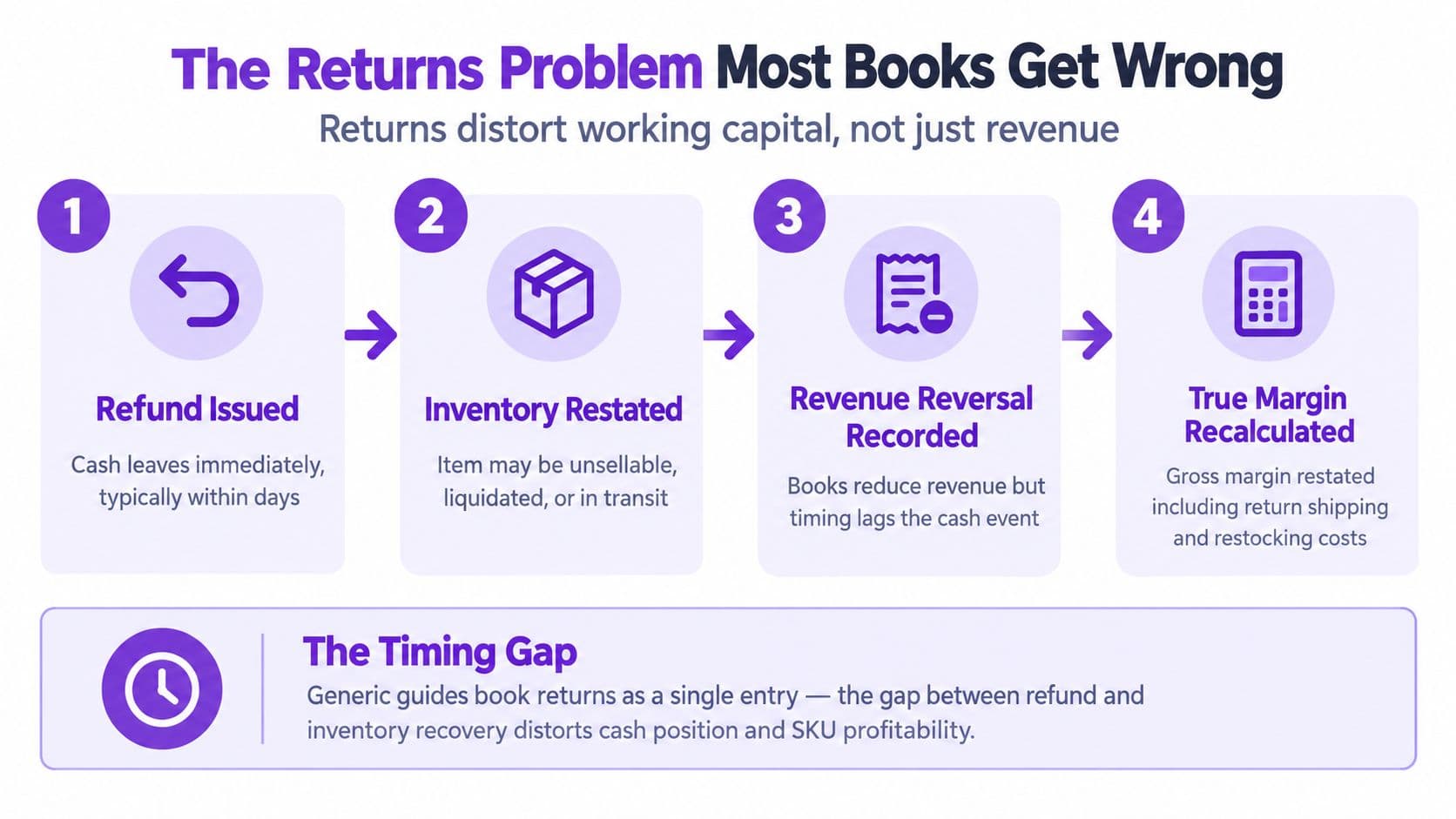
The return control model
A strong close tracks the entire return lifecycle:
- Returns initiated: Identify the original order, SKU, channel, and reason.
- Refunds issued: Record the cash or liability movement when the refund is approved.
- Units received: Match warehouse receipts to the original return authorization.
- Units resold: Restore inventory only when inspection confirms sellable condition.
- Write-offs recorded: Write down damaged, incomplete, obsolete, or unsellable products.
- Recovery costs captured: Track return shipping, inspection, restocking, liquidation, and refurbishment costs.
Estimate open-return liabilities using product, channel, seasonality, and promotion history. The estimate should reflect the time gap between a sale, a customer's return decision, the refund, and warehouse disposition.
A SKU can look profitable and still lose money
Assume a SKU produces $100,000 in gross sales. Its product cost is $40,000, marketplace and processing fees total $20,000, and operating fulfillment costs total $15,000. Before returns, the apparent contribution is $25,000.
Now assume the business has $25,000 of expected returned sales still open. Return shipping and restocking cost $4,000, and $8,000 of returned inventory is damaged or cannot be resold. The adjusted contribution becomes:
$25,000 initial contribution − $25,000 return allowance − $4,000 recovery costs − $8,000 inventory write-down = negative $12,000.
The exact accounting treatment depends on your policy and the status of each unit, but the economic conclusion is clear. Gross margin alone hides the cost of refund exposure and inventory recovery.
Report net contribution after returns by SKU and channel. For operational ideas that complement the accounting workflow, these practical e-commerce fixes address customer and fulfillment issues that often create avoidable return costs. You can also use this guide to returns and allowances when reviewing the underlying accounting logic.
Ask any prospective provider:
- How do you estimate open-return liabilities?
- Do you distinguish sellable, damaged, refurbished, and in-transit inventory?
- Can your monthly report show net contribution after returns?
- How do refunds issued reconcile to units received?
If the answer is only “we post the refund,” the provider is tracking the symptom, not the economics.
Pricing Models and How to Choose a Provider
The right pricing model depends on whether you need recurring control, a defined cleanup, or temporary technical support. Treating all three as interchangeable creates either unnecessary cost or an incomplete accounting process.
Three ways providers charge
| Pricing model | Best fit | Trade-off |
|---|---|---|
| Tiered monthly plan | Ongoing multichannel bookkeeping, close management, reporting, and controller review | Recurring commitment, but clearer ownership and predictable delivery |
| Fixed-fee project | QuickBooks cleanup, historical reconstruction, or a 13-week cash-flow sprint | Defined scope, but it doesn't replace ongoing monthly controls |
| Hourly arrangement | Narrow technical questions or short-term assistance | Flexible, but total cost and accountability are less predictable |
A $1M-plus brand generally needs recurring ownership rather than isolated data entry. A fixed-fee cleanup makes sense when historical records are unreliable, but the provider should then implement a repeatable settlement and returns process. Hourly support works for a specific issue, not as the primary close model.
Score the provider before signing
| Criterion | What to Ask | Green Flag |
|---|---|---|
| Close process | Can you show a five-day close calendar? | Named owners, deadlines, review steps, and variance explanations |
| Settlement control | Do you reconcile orders to payouts? | Channel-specific settlement bridges and clearing accounts |
| Revenue policy | How do you handle earned but unsettled sales? | Documented accrual policy and consistent treatment |
| Returns | How do you estimate open-return liabilities? | SKU and channel reporting that includes recovery costs |
| Sales tax | Do you separate facilitator-collected tax? | Separate ledger accounts and a jurisdiction-by-channel matrix |
| Integrations | Which platforms do you support directly? | Demonstrated workflows for Shopify, Amazon, Stripe, Square, and the general ledger |
| Accuracy | How do you detect and correct errors? | Review evidence, correction procedures, and a clearly defined guarantee |
| Team | Who performs and reviews the close? | Named accounting and controller-level contacts |
| Security | How is financial data protected? | Written security controls and access procedures |
Don't choose a provider because it lists every ecommerce platform on its website. Ask them to walk through one real settlement, one refund, one chargeback, one held reserve, and one facilitator-collected tax entry. Their explanation will tell you more than a software logo.
When evaluating an agency or marketplace specialist, a list of questions for an Amazon agency can help you test whether the team understands commercial operations as well as accounting.
Migration without losing the history
A controlled transition should include:
- Export historical orders, settlements, payouts, refunds, tax reports, and inventory records.
- Identify uncategorized transactions, unreconciled clearing accounts, and unexplained balance-sheet items.
- Document the revenue, returns, inventory, and tax policies before posting new entries.
- Lock the old books after the agreed cutoff date.
- Run one parallel close and compare revenue, fees, cash, receivables, inventory, and liabilities.
- Resolve differences before the new provider becomes the system of record.
For a broader view of recurring fees and project scope, compare the options in this guide to outsourced accounting services pricing.
Red Flags, Next Steps, and FAQs
Your setup needs attention if bank deposits are booked as revenue, facilitator and seller-collected taxes sit in one account, inventory has never been properly costed, the close takes three weeks, or margins change whenever someone recategorizes transactions.
Start with three checks:
- Audit your last three settlements against the underlying orders.
- List every sales channel and document its tax treatment.
- Book a consultation with an outsourced controller service that can own the close.
Jumpstart Partners offers a relevant benchmark for what a modern provider can provide, including a US-based CPA-certified team, a five-day month-end close, $47K+ in errors detected per client on average, 40% cash-flow improvement, SOC 2 Type II security, a 99.8% accuracy guarantee, 98% client retention, and a 30-day money-back guarantee.
At what revenue should you outsource?
Revenue alone isn't the only trigger. Outsource when settlement timing, inventory, returns, taxes, or investor reporting exceed your team's ability to reconcile them consistently.
How long does migration take?
The timeline depends on the condition of your historical records and the number of channels. A clean cutoff, documented opening balances, and one parallel close reduce transition risk.
Do you still need a CFO?
Often, yes. Outsourced accounting services can provide bookkeeping and controller execution, while a CFO focuses on financing, capital allocation, pricing, acquisitions, and strategic planning. Those roles solve different problems.
Jumpstart Partners provides outsourced bookkeeping and controller services for growing companies that need settlement-level reconciliations, accurate revenue recognition, inventory and returns visibility, and investor-ready reporting. Visit Jumpstart Partners to discuss your ecommerce accounting needs and build a close process that shows where every dollar went.