Financial Operations
Financial Compliance Requirements: A Founder's Guide
Stay ahead of the 2026 financial compliance requirements. Learn how to keep your startup legal with this essential founder's guide.
ByJumpstart Partners, CPA, QuickBooks ProAdvisor
··18 min readThe fastest way to lose a financing round or blow up a first audit is to treat financial compliance requirements like a bookkeeping afterthought. Regulators don't care that your revenue is still modest, and investors don't lower their standards because you're pre-scale. The hard lesson is simple, enforcement is expensive, documentation failures are expensive, and weak controls make your company look harder to trust.
In the U.S., many companies had to start reporting beneficial ownership information to FinCEN on January 1, 2024, adding a new identity and disclosure layer on top of AML, tax, and recordkeeping obligations. In parallel, EEA supervisory reporting has been estimated to cost about EUR 0.9 billion annually across institutions, or roughly EUR 304.7 thousand per institution, which is a blunt reminder that compliance is now a recurring operating burden, not a one-time filing exercise. If you want a plain-English definition of the risk bucket you're managing, the resource on what is regulatory compliance risk is worth a look before you assume your current process is “good enough.”
You don't need more theory. You need a control environment that survives investor diligence, cleanly supports your books, and doesn't collapse when someone asks for evidence. If you're preparing for an audit, the audit preparation checklist is the kind of practical reference that saves time because it forces the work into evidence, not opinions.
Table of Contents
- The Real Cost of Ignoring Financial Compliance Requirements
- Major U.S. Financial Compliance Laws You Need to Know
- Common Compliance Misconceptions That Get Founders in Trouble
- Building a Control Framework That Scales With Your Business
- When to Outsource Compliance to a Controller Service
- Your 90-Day Financial Compliance Action Plan
The Real Cost of Ignoring Financial Compliance Requirements
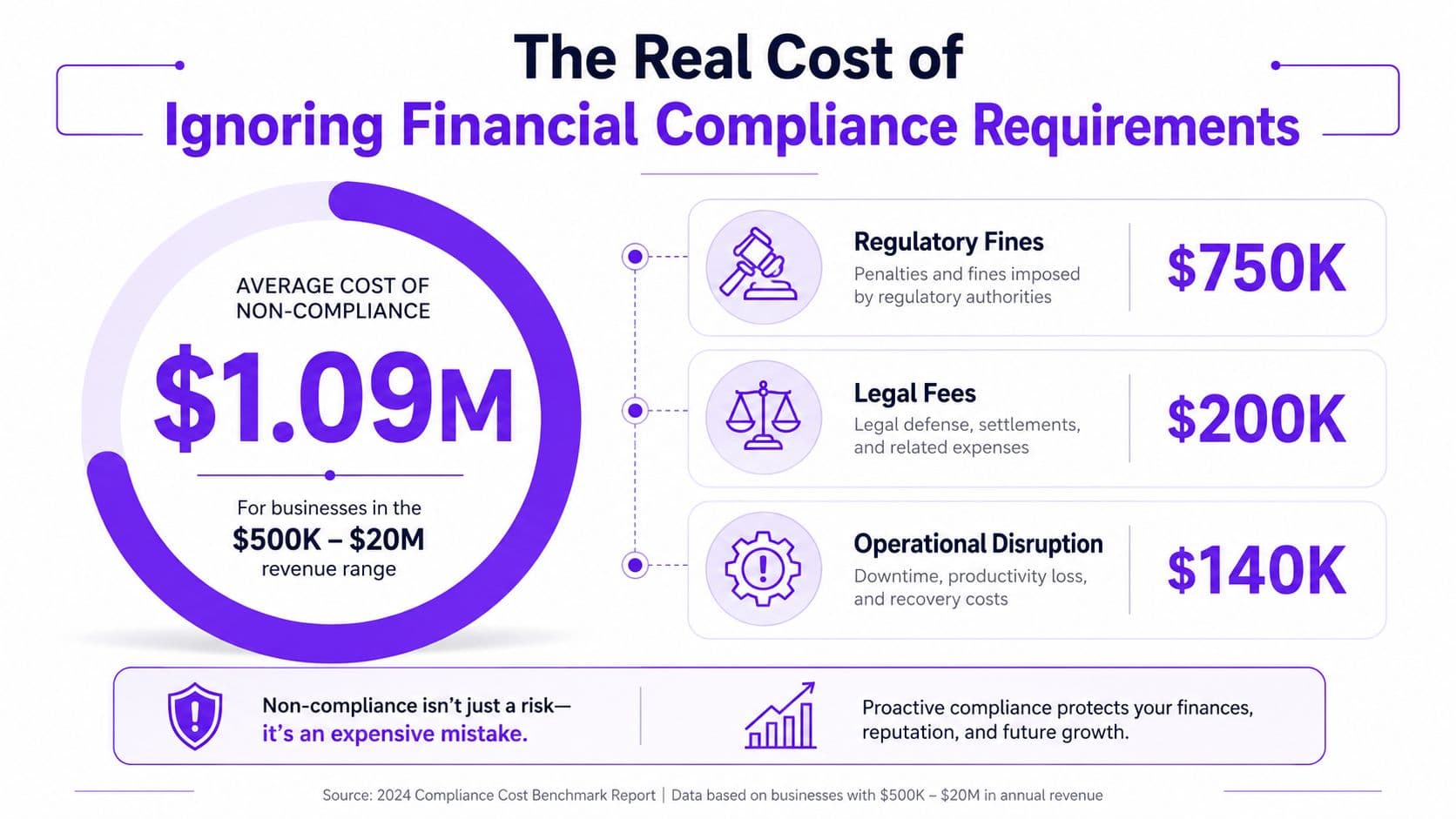
The SEC didn't hand out $1.3 billion in September 2022 because broker-dealers were being a little sloppy. It fined 16 broker-dealers for recordkeeping failures, which is exactly the kind of outcome founders underestimate until a diligence request or regulator demands proof that records are controlled, retained, and retrievable. That's the cost of ignoring compliance. It turns a preventable process gap into a valuation problem.
Fines are only the visible cost
The visible penalty is the headline number. The hidden cost is slower fundraising, more expensive cleanup, and a finance team that spends its time reconstructing evidence instead of running the business. When your books can't prove control over records, approvals, or revenue recognition, every outside reviewer assumes the worst and asks for more.
Practical rule: if a control can't be demonstrated with dated, stored evidence, it doesn't exist for audit purposes.
A lot of founders read about compliance as if it were a legal checkbox. It isn't. It's part of the operating model, and once you cross into regulated workflows, sloppy documentation affects customer trust, lender confidence, and acquisition readiness. If you need a framework for thinking about the downstream risk, the internal controls assessment is where founders should start, because control gaps compound long before the audit begins.
Non-compliance turns into fixed cost
In the U.S. and Canada, financial crime compliance costs reached $61 billion in 2024, and 99% of financial institutions reported increased costs. In the UK, institutions spent £38.3 billion on financial crime compliance in 2023, up 12% year over year and 32% since 2021, with smaller firms spending a median £6.9 million and larger firms a median £130 million. Those numbers tell you something founders need to hear clearly, compliance is not a temporary project, it becomes part of your cost structure. (Egnyte guide on financial compliance)
That's why “we'll fix it later” is a bad strategy. Later is when you have more transactions, more systems, more stakeholders, and less room to improvise. At that point, remediation costs more because you're rebuilding under pressure.
Compliance protects valuation
Investors don't buy cleaned-up explanations. They buy evidence. A founder who can show clean approvals, auditable records, and a consistent close process looks investable. A founder who can't, looks risky, even if the underlying business is strong.
Compliance is a valuation control, not just a legal control.
For founders in the $1M to $5M ARR range, the right move is to treat compliance as part of enterprise readiness. You're not building a binder for a regulator. You're building proof that the business can scale without breaking.
Major U.S. Financial Compliance Laws You Need to Know
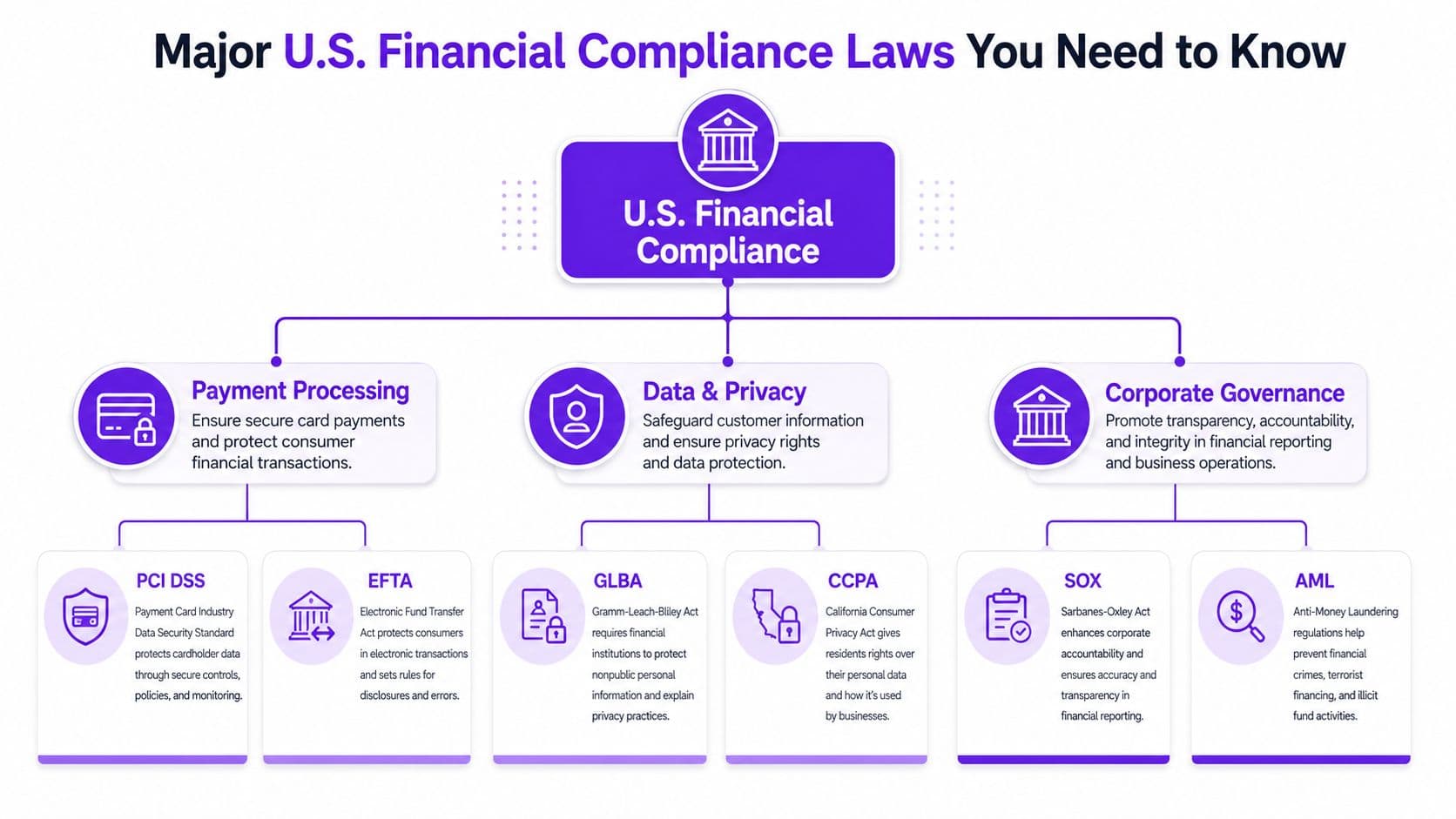
Founders usually start with the wrong question. They ask for the one rule that covers everything. There isn't one. U.S. financial compliance is a stack of laws, and the right control depends on whether you handle securities, customer funds, payment flows, or financial reporting. The main statutory anchors for U.S. businesses include the Securities Exchange Act of 1934, the Bank Secrecy Act of 1970, the Dodd-Frank Wall Street Reform and Consumer Protection Act of 2010, and the Sarbanes-Oxley Act of 2002. SEC rules live in Title 17 of the CFR, while Bank Secrecy Act implementing rules sit in Title 31. (National Compliance Authority)
That matters because compliance work scales with business activity, not with company optimism. A public SaaS company needs a different evidence trail than a marketplace moving customer funds. A firm touching regulated payment workflows needs tighter monitoring than a professional services business with straightforward invoicing.
Map the law to the business activity
If you process payments, your risk profile changes fast. If you handle customer funds, investor capital, or sensitive financial reporting, you need controls tied to the actual rule that applies. One policy document does not solve that. You need a mapping from activity to obligation, then from obligation to control.
A public company is where Sarbanes-Oxley becomes unavoidable. SOX ties financial reporting to secure record management, monitoring, logging, and auditing of certain activities. In practical terms, you need a system that shows who changed records, when they changed, and whether the change was authorized. If your month-end close sits in spreadsheets with no audit trail, that is not a software preference. That is a control failure. (Arctic Wolf)
If you are hiring around these responsibilities, use essential compliance interview questions to test whether candidates understand control design, not just bookkeeping tasks.
AML obligations are event driven
The Bank Secrecy Act is where many smaller businesses get caught out because they assume AML is just for banks. Under the NFA's regulatory requirements guide, firms must establish an AML program by April 24, 2002, file a Suspicious Activity Report when a transaction or pattern involves an aggregate of at least $5,000 and the firm knows, suspects, or has reason to suspect suspicious conduct, and file an FBAR when they have a financial interest in, or signature authority over, foreign financial accounts exceeding $10,000 at any time during the calendar year. (NFA regulatory requirements guide)
Those thresholds turn compliance into an operating process. Finance needs escalation rules. Operations needs documentation rules. Leadership needs to know which workflows trigger review.
Operational takeaway: if your team cannot name the trigger, it cannot control the risk.
Use the right lens for each law
The Securities Exchange Act covers market disclosure and reporting. The Bank Secrecy Act covers suspicious financial behavior. Dodd-Frank shapes consumer and systemic protections. Sarbanes-Oxley protects reporting integrity and internal control. If you mix those up, you end up buying tools and writing policies that do not match the exposure.
A useful shortcut is simple. Public-company reporting risk points you toward SOX. Transaction monitoring points you toward BSA/AML. Governance and disclosure issues point you toward securities law. Once you know the trigger, you know what evidence to build.
The revenue recognition guidance matters for SaaS founders too, because revenue recognition errors are one of the fastest ways to create avoidable audit pain. If the books do not match the contract terms, the compliance issue becomes an accounting issue immediately. Build the policy, then test it against the contract flow, deferred revenue schedule, and close process before an auditor does.
Compliance Requirements by Business Type and Revenue Stage
A founder running a SaaS company does not face the same control burden as an agency or nonprofit. The trigger is not the logo on the website. It is the revenue model, the data path, and the evidence investors expect. That is why a useful control design starts with the business model, then layers in the financial compliance requirements that apply.
| Business Type | Key Compliance Areas | Revenue Threshold Triggers | Common Audit Risks |
|---|---|---|---|
| SaaS | ASC 606 revenue recognition, investor reporting, access controls, SOX-style documentation | Early diligence pressure often starts around the first meaningful outside capital raise, then intensifies as revenue scales | Incorrect contract treatment, weak month-end close support, missing approval evidence |
| E-commerce | Sales tax nexus, payment reconciliation, chargeback handling, refund controls | Compliance complexity rises as order volume and states served expand | Unreconciled payouts, sales tax gaps, weak refund approval trails |
| Agencies | Project profitability, client billing support, time and expense controls | Audit risk increases as client concentration and billing complexity grow | Revenue recognition errors, missing time records, incomplete change-order support |
| Nonprofits | Fund accounting, restricted-use tracking, grant documentation | Controls matter as soon as restricted funds and grant reporting are material | Misclassified funds, weak grant support, undocumented donor restrictions |
A SaaS founder should not wait until the audit to think about controls. If customer contracts, renewals, and implementation fees sit in different systems, you need a documented process for how revenue is recognized and reviewed. You also need a clear owner for each control, because “everyone checks it” means nobody does. That is where controller support earns its keep, while day-to-day bookkeeping can still stay in-house if the team is disciplined.
Use revenue stage as a control signal
At $1M ARR, you can stay lean, but you cannot stay casual. At $2M, a clean close and documented approvals stop being optional. At $10M, you need repeatable processes and visible ownership. At $20M, the business needs controls that survive turnover, growth, and outside scrutiny.
That does not mean every company needs the same stack. It means the control standard rises as the business gets harder to explain. A founder who understands that shift stops treating compliance as overhead and starts treating it as part of the product of operating the company well. A practical next step is a basic audit readiness review, then a documented control map that shows who approves, who posts, and who reviews.
Common Compliance Misconceptions That Get Founders in Trouble
The most dangerous compliance failures start as confident misunderstandings. Founders say they're too small to matter, or that QuickBooks is enough, or that verbal approvals are “fine because everybody knows the process.” Those beliefs survive right up until an investor, auditor, or customer asks for evidence.
Small companies still need real controls
Small does not mean exempt. It means fewer people are handling more responsibility, so the control design has to be tighter. If the same person raises invoices, approves credits, and posts adjustments, you don't have a process, you have a risk.
A SaaS founder once told me monthly bank reconciliations were enough because the cash was accurate. That answer fell apart the moment an investor requested documentation around controls and audit readiness. The cash balance wasn't the issue. The issue was whether the company could prove how the numbers were produced and reviewed.
Red flag: when your answer to “show me the approval” is a Slack message, you're not audit-ready.
QuickBooks is not a control framework
QuickBooks helps you record transactions. It does not create audit trails for every process, define segregation of duties, or prove that policies were followed. A clean ledger can still sit on top of weak approvals and undocumented estimates.
That's why founders get burned by the phrase “our books are in good shape.” Good shape is not a control standard. Your finance stack has to show evidence of review, retention, and accountability. If it doesn't, the books may be tidy, but they're not defensible.
Verbal workflows fail under scrutiny
Verbal approvals disappear the moment someone leaves the company or disputes a transaction. Written workflows don't just help with audits, they make the business less dependent on memory. If you can't show who approved a payment, a revenue change, or a contract exception, the control never existed for review purposes.
An agency that can't prove revenue recognition controls can also lose business. One bad diligence cycle is enough to kill a deal, and a missing control file is a quick way to make a buyer doubt everything else in the data room. That's how a compliance issue turns into a commercial loss.
You don't need to overbuild. You do need to stop confusing convenience with control. The standard is simple, if someone outside the company asks for proof, can you produce it without reconstructing the story from memory?
Building a Control Framework That Scales With Your Business
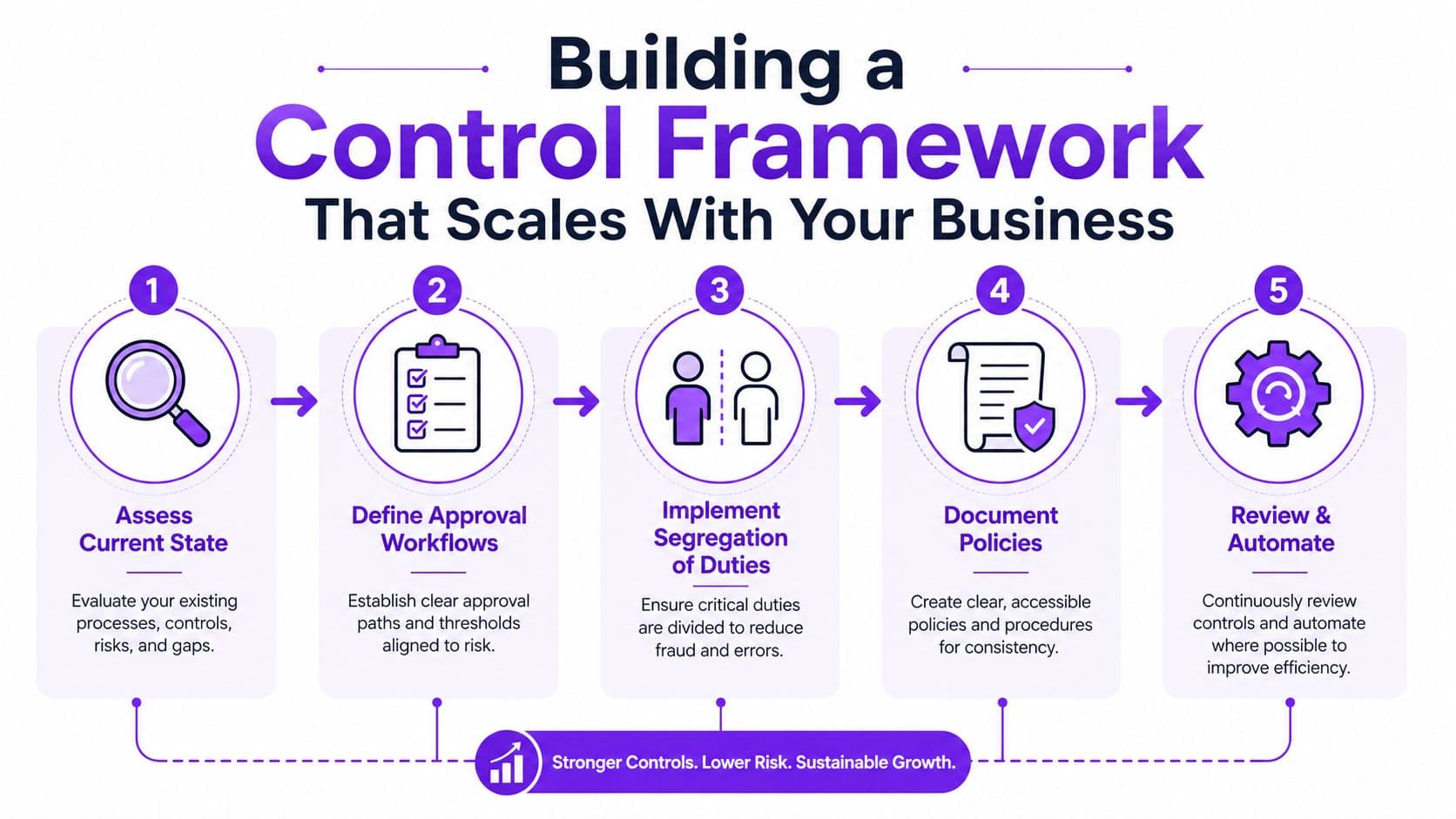
A scalable framework starts with one rule, define controls around the risk, not around the software. COSO is the cleanest structure for that because it forces you to think about the control environment, risk assessment, control activities, information and communication, and monitoring activities. If you want a reference point for that structure, the what is COSO framework explainer is a useful place to anchor your thinking.
Build controls in layers
Start with approval authority. If your team spends money without a clear threshold, your control environment is weak. A practical rule is simple, route anything over a defined approval limit through a named approver and keep the evidence in a system, not in chat. For a finance team that handles recurring spend, this is the difference between a process and a guess.
Then add segregation of duties. The person who initiates a transaction should not be the only person who approves it and records it. That's basic, but founders still skip it because the team is small. Small teams still need separation, they just need thoughtful role design.
Finally, lock down records. SOX-style record management means monitoring, logging, and auditability, not “we have backups.” If a financial record changes, you need to know who changed it and why. That's the standard public-company reviewers expect, and it's the standard investors increasingly want to see in smaller companies too.
Use thresholds to make the workflow real
A good framework turns into action when it has numbers attached to it. If a purchase above $5,000 needs documented approval, your team knows where the line is. If a transaction pattern crosses the $5,000 SAR threshold described in the BSA guide, the finance team knows when to escalate. If a foreign account balance exceeds the $10,000 FBAR test, someone owns the review.
That kind of threshold-based design is what makes the process usable. Without it, everyone “knows” to escalate, and nobody does it consistently.
Control rule: a threshold without an owner is just a number.
Document the month-end process
Month-end close needs a clear trail. Reconciliations, review notes, variance explanations, and approval timestamps all belong in the same control story. If your close is still tribal knowledge, you do not have a scalable financial function.
Use a checklist, a policy, and a retained evidence folder for each close cycle. Keep the structure consistent so the audit trail doesn't depend on who happened to do the work that month. Consistency is what makes review possible.
The what is regulatory compliance risk angle matters more than people think when you serve multilingual customers, because language-access decisions need to be documented, monitored, and defensible. That is another example of controls scaling beyond bookkeeping into business operations.
When to Outsource Compliance to a Controller Service
If you're still handling everything in-house, be honest about the cost. A full-time controller usually means a $120K to $180K salary plus benefits, while outsourced controller services typically run $3K to $8K monthly. That gap matters, but cost alone should not drive the decision. Risk, speed, and evidence quality matter more. (Jumpstart Partners fractional controller services)
Outsource when the control problem outgrows the team
If your finance person is also doing AP, payroll review, revenue recognition, and board prep, you've already crossed the line where the function needs more expertise. Outsourcing makes sense when you need a controller's judgment but not a full-time executive. It's especially useful when the work is cyclical, like month-end close, audit prep, or investor reporting.
Decision rule: outsource the work that needs controller judgment, keep strategic ownership of approvals and cash decisions inside the company.
A controller service should handle close quality, reconciliations, revenue support, documentation standards, and audit prep. You should keep final approval of policy, spending authority, banking access, and board-level decisions in-house. That separation keeps accountability where it belongs.
Red flags that you've outgrown DIY compliance
The warning signs are obvious once you stop rationalizing them.
- Close keeps slipping: If month-end close drifts because one person holds all the knowledge, the process is too fragile.
- Evidence lives in too many places: If support is split across email, spreadsheets, and chat, the audit trail is already degraded.
- Questions take days to answer: If investor or auditor questions require reconstruction, your finance stack is underbuilt.
- Policies exist but aren't followed: If the process in the memo differs from the process in practice, you need outside discipline.
Ask the right questions before you hire
A controller partner should be able to explain how they support audit readiness, revenue recognition, approvals, and documentation. Ask how they handle recurring controls, how they manage close evidence, and what they do when a transaction falls outside the normal policy. If they can't answer clearly, they're a bookkeeping vendor, not a control partner.
Use a provider that can work inside your tools and your growth stage. Jumpstart Partners is one option if you want outsourced controller and bookkeeping support tied to close discipline, revenue workflows, and audit-ready financials. The point is not to buy more software. It's to make the finance function defensible before outside scrutiny arrives.
Your 90-Day Financial Compliance Action Plan
The first 30 days are about exposure. Pull together your account map, approval matrix, revenue workflow, and record-retention process. Then compare what exists to what an investor or auditor would ask to see. If you can't produce the evidence quickly, the gap is real.
In days 31 to 60, write the policies and make them operational. Assign owners for approvals, reconciliations, and exception reviews. Build the retained documentation folder for month-end close, and train the team on where evidence lives. If you operate in a regulated workflow, use the financial close automation resource to tighten repeatable tasks so close evidence is easier to collect and review.
By days 61 to 90, test the process. Pick a transaction sample, follow it from initiation to posting to review, and confirm the evidence is complete. Then fix the weak points, don't wait for an auditor to find them. A good compliance program is the one that gets better before outside scrutiny forces the issue.
The standard is straightforward. If your business can't prove who approved transactions, how records are retained, and how exceptions are escalated, you are not ready for growth capital, acquisition diligence, or an audit. Build the controls now, while you still have room to fix them cleanly.
If you want help turning your books into investor-ready financials with real controls behind them, talk to Jumpstart Partners. They handle outsourced controller and bookkeeping support for growing SaaS, agency, and professional services businesses, including audit prep, revenue workflows, and close processes that stand up to scrutiny.