Financial Operations
Master Your Fund Accounting Services: A Complete Guide
Efficient fund accounting services: Manage restricted funds, design charts of accounts, ensure grant compliance, prepare for audits, and optimize outsourcing
ByJumpstart Partners, CPA, QuickBooks ProAdvisor
··16 min readYour finance team can close the books and still fail the question that matters most: which dollars are available for which purpose? A restricted grant may sit in the same bank account as operating cash, while the general ledger, grant agreement, and program budget tell different stories. The result is familiar: a missed reporting deadline, a delayed program, an uncomfortable board meeting, or a donor asking why money appears to have been spent outside its intended use.
Fund accounting services solve that operational problem by connecting each transaction to its source, restriction, program, and supporting documentation. Instead of treating cash as one interchangeable pool, you build a reporting system that shows what you can spend, what you must reserve, and what has already satisfied a donor or grant requirement.
Table of Contents
- Understanding Fund Accounting Business Impact
- Why Fund Accounting Differs from Standard Accounting
- Designing Chart of Accounts for Restricted Funds
- Required Reports and Benchmarks for Compliance
- Worked Calculation Examples
- Grant Compliance Audit Readiness and Controls
- Red Flags and Common Misconceptions
- Next Steps When to Outsource to a Specialist
Understanding Fund Accounting Business Impact
A nonprofit can have cash in the bank and still face a funding shortage. If a grant is restricted to a defined program, that cash isn't automatically available for payroll, rent, or another initiative. Your finance team needs to know not only how much cash exists, but also how much belongs to each fund and whether the related conditions have been met.
Consider a nonprofit that receives a program grant and records it as general revenue. Months later, the team discovers that the grant requires separate expense reporting. Finance staff then search through spreadsheets, invoices, bank activity, and email approvals to reconstruct the fund's history. The organization may still meet its obligations, but the process consumes management time and weakens confidence in the numbers.
Fund accounting services create a controlled operating model:
- Separate the money: Tag revenue and expenses by source, program, donor restriction, and grant.
- Close with evidence: Tie balances to bank activity, agreements, invoices, payroll records, and approved releases.
- Report clearly: Give executives, boards, donors, grantmakers, and auditors reports that answer different accountability questions.
- Protect liquidity: Distinguish cash that is available for general operations from cash committed to a specific purpose or period.
Practical rule: Treat every restriction as an operating condition, not as a note you'll investigate at year-end.
The business impact extends beyond compliance. Accurate fund reporting helps you plan hiring, schedule programs, assess unrestricted reserves, and explain financial performance without overstating flexibility. It also helps your leadership team identify whether a cash flow problem is genuine or the result of restricted cash being unavailable for general use.
Your technology stack matters because accounting data rarely lives in one place. QuickBooks or NetSuite may hold the ledger, while Stripe, Gusto, banking platforms, grant-management tools, and document storage hold supporting information. For a broader perspective on the infrastructure surrounding financial operations, review Nutmeg Technologies' finance IT guide. The right fund accounting services connect those systems through defined workflows rather than relying on memory and manual rework.
Why Fund Accounting Differs from Standard Accounting
Standard accounting often centers on revenue, expenses, profitability, and owner or shareholder returns. Fund accounting centers on stewardship, meaning whether the organization used resources according to the source's requirements. That distinction changes the chart of accounts, approval process, reports, and month-end review.
Fund accounting separates money by source and restriction. That framework formed the basis for FASB SFAS 116 and SFAS 117, issued in 1994, the first FASB statements to directly govern nonprofit contribution accounting and financial statement presentation. The rules applied to fiscal years beginning after December 15, 1994, and to smaller nonprofits meeting the specified asset and expense thresholds after December 15, 1995, as summarized in this fund administration services market overview.
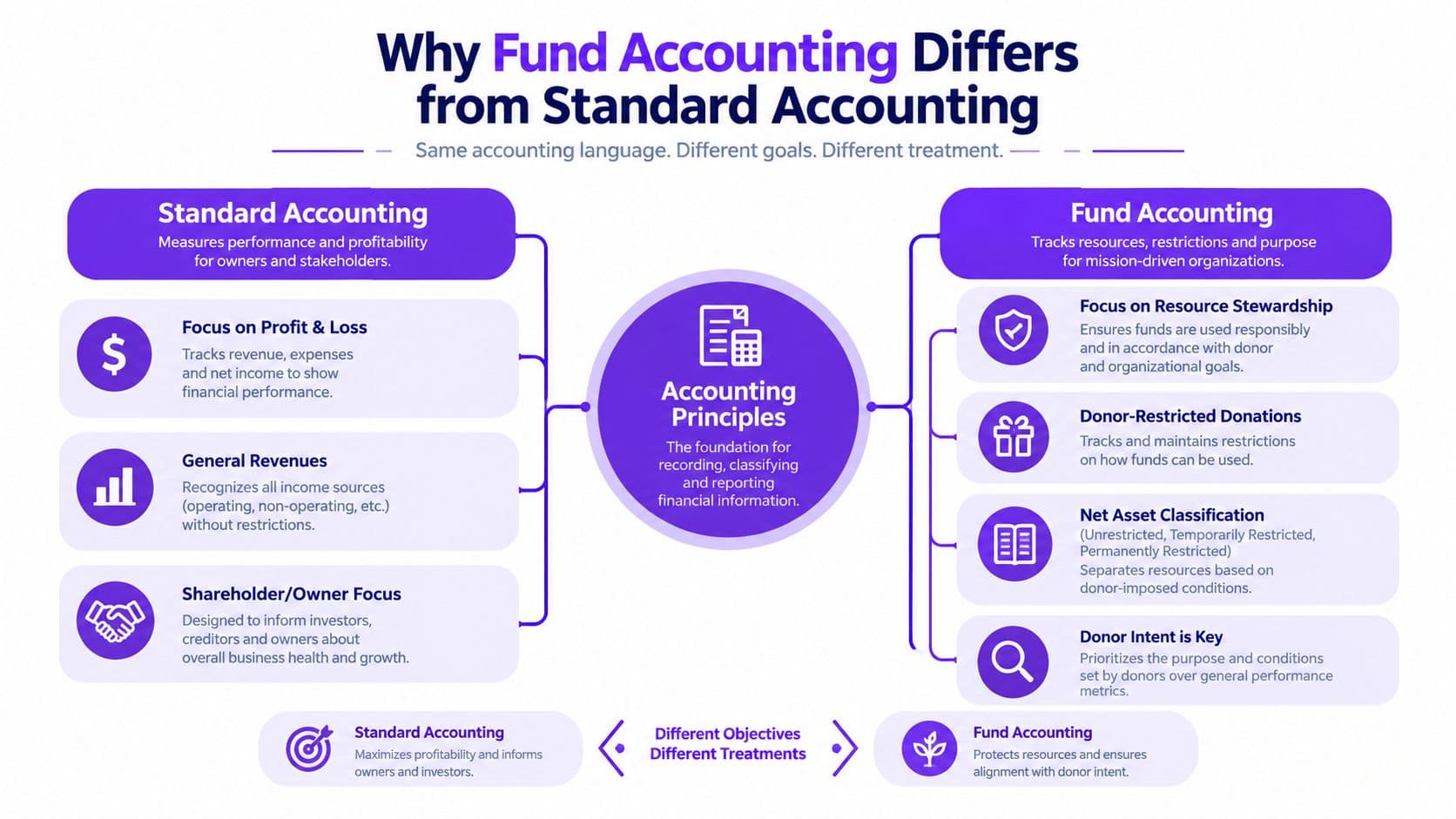
The practical difference is easiest to see side by side:
| Question | Standard accounting | Fund accounting |
|---|---|---|
| What does revenue represent? | Income earned from customers or other sources | Resources received with possible donor or grant conditions |
| What does performance emphasize? | Profitability and operating results | Stewardship, compliance, and mission use |
| How are funds viewed? | Often as part of the overall business | As separately accountable pools |
| What must finance prove? | Transactions are complete and accurate | Transactions are accurate and permitted under the applicable restriction |
| What drives reporting? | Management, owners, lenders, and tax requirements | Boards, donors, grantmakers, regulators, and auditors |
Under U.S. GAAP, nonprofit external reporting uses two net asset classes, not the older three-bucket presentation: net assets without donor restrictions and net assets with donor restrictions. Board-designated reserves remain in the without-donor-restrictions class, even though the board may have earmarked them internally. Donor-imposed purpose, time, and perpetual restrictions require separate tracking within the donor-restricted class.
That distinction is why a general bookkeeping setup often breaks down. A ledger can record the correct bank balance while failing to show whether the organization can spend that balance. For a related explanation of the governing framework, see this guide to nonprofit accounting standards.
Designing Chart of Accounts for Restricted Funds
Your chart of accounts should make the intended classification visible before a transaction reaches the reconciliation stage. Don't create a vague account called “restricted revenue” and expect the finance team to remember the program, grantor, reporting period, or release condition later. Build a structure that captures the restriction at the point of entry.
ASU 2016-14 requires exactly two net asset classes, net assets with donor restrictions and net assets without donor restrictions, as explained in this nonprofit fund accounting financial statement resource. Your internal dimensions can be more detailed, but your external presentation must roll up to those two classes.
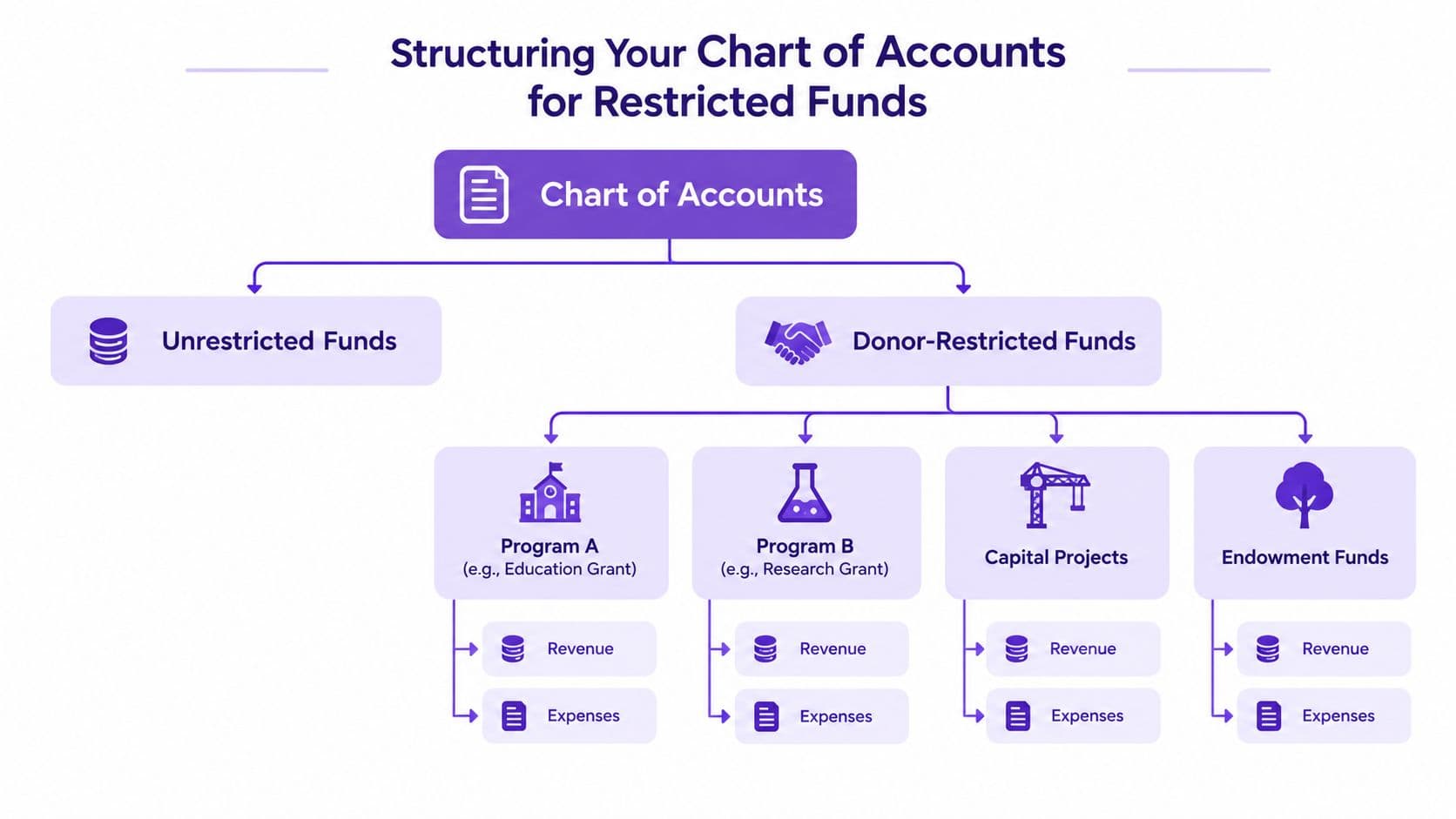
Start with the reporting destination
Create the top-level structure first:
| Level | Example | Purpose |
|---|---|---|
| Net asset class | Without donor restrictions | Captures general resources and board-designated reserves |
| Net asset class | With donor restrictions | Captures donor-imposed purpose, time, or perpetual restrictions |
| Fund or grant | Education Grant | Identifies the source and restriction |
| Program | Program A | Connects spending to the mission activity |
| Account | Revenue, payroll, supplies | Describes the transaction type |
A board-designated reserve belongs within net assets without donor restrictions. Track the designation as an internal class or reporting dimension, but don't label it donor-restricted unless an external donor imposed the condition.
Map each restriction to evidence
For every restricted fund, record the agreement, donor intent, permitted uses, time conditions, reporting deadlines, responsible program owner, and release trigger. The agreement should determine the accounting treatment. The finance team shouldn't infer a restriction from an invoice description or a verbal explanation.
Use consistent naming conventions, such as GRANTOR_PROGRAM_PURPOSE_PERIOD. Keep the name short enough for transaction entry but specific enough for reporting. Then require every related revenue and expense transaction to carry the same fund identifier, with a separate program or department tag where needed.
A chart of accounts alone won't prevent errors. Configure approval rules so a transaction missing the required fund tag can't post without review. For templates and implementation ideas, consult this nonprofit chart of accounts template.
Required Reports and Benchmarks for Compliance
A compliant fund accounting operation produces reports for different audiences, not one oversized workbook that everyone interprets differently. Your board needs a view of financial health and available resources. A grantmaker needs evidence that a specific award supported eligible activity. An auditor needs a traceable path from agreement to entry to report.
Use a reporting calendar with a named owner for each deliverable:
| Report | Timing | Primary audience | Core question |
|---|---|---|---|
| Statement of activities by fund | Monthly or quarterly | Management and board | What revenue and expenses belong to each fund? |
| Statement of financial position | Monthly or quarterly | Management, board, auditors | What assets, liabilities, and net assets does the organization report? |
| Cash flow report by fund | Monthly | Finance leadership | Which cash movements affect available liquidity? |
| Budget versus actual by program | Monthly or quarterly | Program leaders and board | Are spending and funding aligned with the approved plan? |
| Net asset roll-forward | Monthly and annual | Finance, auditors, grantmakers | How did each restriction change during the period? |
| Grant expenditure report | Per agreement | Grantmakers and program owners | Did spending meet the award's conditions? |
The net asset roll-forward deserves special attention. It should explain opening balances, contributions, investment or other activity where applicable, expenses charged to restricted funds, and amounts released from restriction. Reviewers should be able to move from the ending balance to the underlying agreement without asking the bookkeeper to rebuild the calculation.
Don't adopt an unsupported benchmark because another organization uses it. Instead, establish your own baseline for close duration, unreconciled items, late journal entries, missing fund tags, and post-close adjustments. Then set targets that reflect your systems and reporting obligations.
Your month-end package should include sign-offs, reconciliation status, open exceptions, and explanations for material variances. A practical audit preparation checklist can help you organize the evidence before auditors request it, rather than assembling documents under deadline pressure.
Worked Calculation Examples
Worked entries help finance leaders understand the key point: reclassification changes the accounting classification, not the cash balance.
Example one with a restricted grant
Assume your nonprofit receives a $10,000 grant restricted to an eligible education program. At receipt, record the cash and the donor-restricted contribution:
| Account | Debit | Credit |
|---|---|---|
| Cash | $10,000 | |
| Contribution revenue, with donor restrictions | $10,000 |
The money remains in the bank, but the accounting system identifies it as unavailable for general purposes. When the nonprofit incurs eligible program expenses and satisfies the restriction, record the expense according to your normal process. Then record the release:
| Account | Debit | Credit |
|---|---|---|
| Net assets released from restriction, without donor restrictions | $10,000 | |
| Net assets released from restriction, with donor restrictions | $10,000 |
The presentation may vary by accounting system, but the logic remains the same. The restricted balance falls by $10,000, the unrestricted balance increases by $10,000, and cash doesn't change. PwC provides this same $10,000 release illustration in its explanation of donor-imposed restrictions and net assets released from restriction.
Example two with a multi-year pledge
Assume a donor signs a $50,000 pledge restricted to a program delivered over three fiscal years. A simple even allocation is:
- Year one: $50,000 ÷ 3 = $16,666.67
- Year two: $16,666.67
- Year three: $16,666.66
- Total: $50,000.00
If the pledge is unconditional and your accounting policy permits recognition at that point, record the receivable and restricted contribution when the pledge becomes enforceable. During each year, release the amount supported by eligible activity and the agreement's timing conditions. For monthly close, divide the annual allocation into monthly portions:
- Year one monthly amount: $16,666.67 ÷ 12 = $1,388.89
- Year two monthly amount: $1,388.89
- Year three monthly amount: $16,666.66 ÷ 12 = $1,388.89, with a final rounding adjustment
Don't force a release merely because a month ended. Match the release to the restriction satisfied and retain the evidence. No verified source supports the quoted claim in the planning material attributed to CPA Michael Chen, so it shouldn't be presented as an expert quotation.
Grant Compliance Audit Readiness and Controls
Audit readiness starts when you receive the agreement, not when the auditor sends a request list. Store the award document, amendments, budgets, reporting instructions, correspondence, and approval records in a location linked to the fund code. Your accounting system should point reviewers toward evidence instead of leaving them to search across inboxes and shared drives.
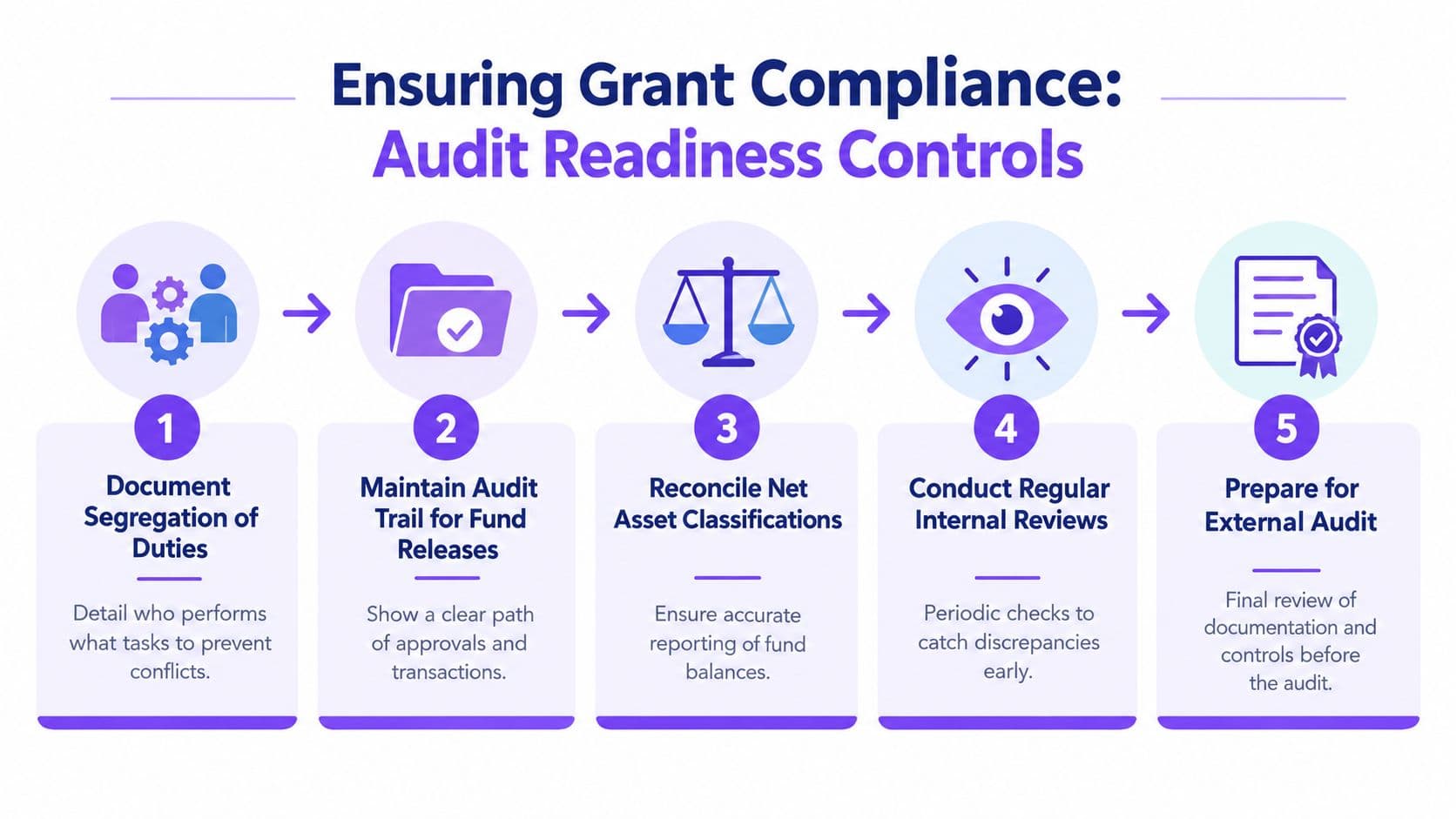
Build the control sequence
- Separate responsibilities: The person who initiates a transaction shouldn't also approve and record it. Assign independent review for bank reconciliations and material journal entries.
- Preserve the release trail: Link each release entry to the eligible expense, agreement clause, calculation, preparer, and reviewer.
- Reconcile classifications: Compare the net asset schedule to donor agreements, grant contracts, and the general ledger every month.
- Review exceptions: Track missing tags, unusual transfers, old receivables, unexplained variances, and unreconciled bank items in an exception log.
- Prepare the audit package: Organize the trial balance, reconciliations, schedules, agreements, approvals, and management explanations before fieldwork.
Independent monthly bank reconciliations and segregation of duties reduce misclassification and fraud risk in fund accounting, according to nonprofit accounting checklist guidance from LISC. The reviewer should examine more than the ending bank balance. They should test whether cash movements landed in the correct fund and whether restricted expenses have appropriate support.
If you use AI to suggest entries, treat the model as an assistant, not an approver. Retain the prompt or instruction used, source documents supplied, generated output, reviewer comments, final entry, and human sign-off. Monitor for hallucinated accounts, unsupported interpretations of grant language, duplicate entries, and releases that lack a satisfied condition.
For broader risk planning, finance leaders can review these strategies for Florida accounting businesses, particularly when designing insurance, access, and continuity controls. An internal controls assessment can also help identify gaps before they become audit findings.
Red Flags and Common Misconceptions
A generic bookkeeping system can record transactions, but it won't automatically understand donor intent. The common misconception is that a single bank account or a familiar accounting platform makes fund accounting unnecessary. The critical aspect is whether your system captures restrictions, links them to evidence, and reports releases correctly.
Watch for these warning signs:
- Late or unstable close: Your team regularly posts corrections after reports reach the board.
- Unexplained net asset variances: Ending balances don't tie to the prior period, agreements, or release schedules.
- Spreadsheet dependence: Staff maintain parallel fund schedules outside the general ledger, with no controlled review.
- Missing restriction tags: Revenue or expenses enter the ledger without a fund, program, or grant identifier.
- Manual workarounds: Someone exports data from the bank, payroll, and accounting system, then combines it by hand.
- AI without review evidence: Staff can't show what an AI tool generated, who reviewed it, or why the final entry was accepted.
Spreadsheets are not wrong. They become dangerous when they act as an ungoverned subledger, especially when multiple people edit formulas or overwrite prior-period logic. Use them for controlled analysis when necessary, but make the accounting system and documented schedules the authoritative record.
AI doesn't eliminate reconciliation bottlenecks by itself. In a 2026 global survey, 66% of fund accountants cited time-consuming reporting and manual data entry or reconciliation as top pain points, while 45% identified lack of integration across financial and fundraising systems as a leading challenge. Those findings from Dynamo's fund accounting research report point to a systems problem. Automation without connected data and review controls moves errors faster.
Next Steps When to Outsource to a Specialist
A finance team may have accurate policies and still lose time because bank, payroll, grant, and accounting data sit in separate systems. Each handoff creates another place for a restriction tag to disappear, a reconciliation to wait, or an AI-generated suggestion to enter the workflow without review evidence. For organizations with complex grants, multiple programs, or limited finance capacity, specialist support can remove that operational bottleneck while keeping financial leadership in-house.
You retain approval authority, policy ownership, and visibility. The provider operates the repeatable workflow, documents the controls, and gives your team a clear review queue.
| Factor | In-House Team | Specialist Provider |
|---|---|---|
| Expertise | Depends on hiring and retaining nonprofit accounting talent | Provides dedicated fund accounting knowledge and documented procedures |
| Cost structure | Includes recruiting, salaries, training, systems, and coverage for absences | Uses a defined service scope and recurring operating model |
| Close process | Vulnerable to individual workload and spreadsheet dependencies | Uses standardized reconciliations, review queues, and close checklists |
| Integration | Requires your team to maintain connections across platforms | Should demonstrate how it connects the ledger, banking, payroll, and grant data |
| Audit readiness | Evidence quality depends on internal discipline | Includes schedules, support files, approvals, and review documentation |
| Scalability | Complexity creates new staffing and control demands | Adds capacity without rebuilding the entire finance function |
Evaluate the provider's operating controls, not only its technical knowledge. Ask who reviews bank reconciliations, how restricted releases are approved, where agreements are stored, and how exceptions are escalated. Ask what happens when the accounting platform and grant system disagree. Request a sample close calendar and a written description of the handoff between both teams.
AI workflows need the same discipline. Require documented prompts or processing steps, system-of-record checks, reviewer sign-off, and an audit trail showing why an output became an approved entry. Automation should shorten review queues, not hide them.
Choose services around the bottleneck you can measure. Manual reconciliation calls for connected systems and exception management. Audit disruption calls for organized support files and reviewer controls. Constantly changing reports call for a flexible fund and dimensional structure.
Start with three actions:
- Map every fund, restriction, reporting deadline, and supporting agreement.
- Export a recent transaction population and identify missing tags, duplicate schedules, and unreconciled balances.
- Schedule a discovery call with a specialist and request a controlled transition plan covering cleanup, reporting redesign, system connections, and review ownership.
For guidance on staffing and outsourced workflows, review outsourced accounting services for nonprofits. Jumpstart Partners also offers outsourced bookkeeping and controller services for nonprofits, including fund accounting workflow support, reporting structure cleanup, and audit-ready financial operations. Visit Jumpstart Partners to discuss your fund structure, reconciliation bottlenecks, and the controls your finance team needs to scale with confidence.