Financial Operations
How to Do Month End Close
How to do month end close. Learn how to do month-end close in 5 business days with a proven playbook for SaaS and SMBs. Includes checklists, reconciliations
ByJumpstart Partners, CPA, QuickBooks ProAdvisor
··18 min readA practical month-end close target is 5 business days, compared with APQC's 6.4-calendar-day median across approximately 2,300 organizations. A five-day close is materially faster than the typical SMB close, but speed without cross-functional ownership only produces errors faster instead of giving you reliable insight.
If you're a founder or CEO waiting for revenue clarity, the accounting team usually isn't the only reason you're waiting. The delay starts when Sales hasn't confirmed contract changes, department heads haven't submitted expenses, contractors haven't sent invoices, payroll data arrives late, or payment processors haven't been matched to the bank. Accounting then spends the close window collecting evidence instead of reviewing completed records.
A month-end close is a controlled cycle that converts transaction-level records into a completed trial balance and consolidated financial statements. For a growing SaaS company, agency, or professional services firm, it should also produce a defensible view of cash, revenue, deferred revenue, gross margin, MRR, ARR, and operating variances.
The right way to do month end close is to move predictable work earlier, assign every dependency to a named owner, automate low-risk matching, and reserve the final days for judgment and review.
Table of Contents
- Why Most Month-End Closes Run Longer Than They Should
- The 5-Day Close Calendar and Pre-Close Cutoff
- Reconciliations That Actually Catch Errors
- ASC 606 Revenue Recognition for SaaS
- Tie the Close to MRR, ARR, and Cash KPIs
- Automate the Right Tasks and Keep Judgment Where It Matters
- Red Flags That Break a Close and Your 30-Day Action Plan
Why Most Month-End Closes Run Longer Than They Should
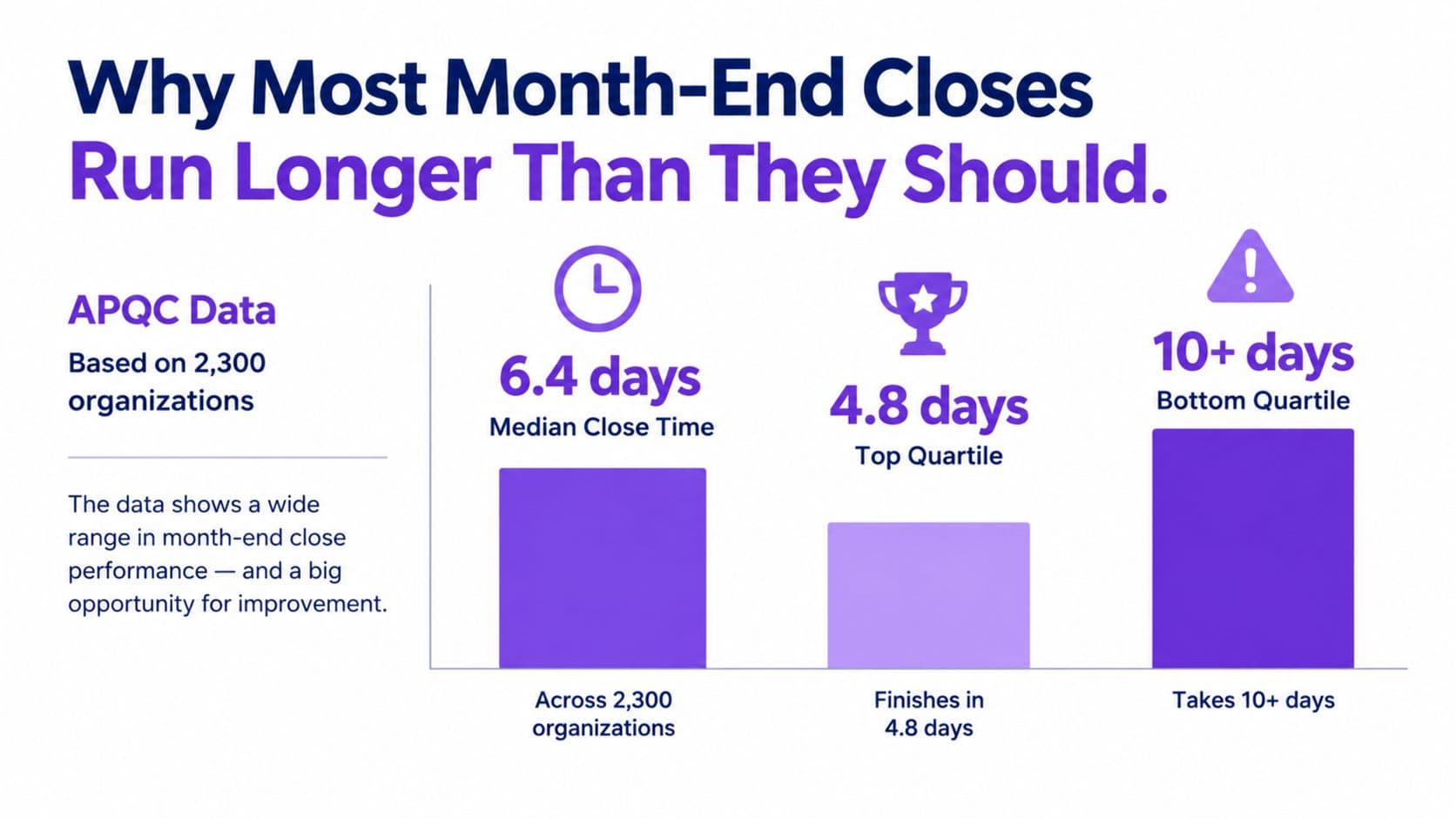
According to APQC benchmarking summarized by Orb, approximately 2,300 organizations reported a 6.4-calendar-day median monthly close. Top-quartile organizations completed the cycle in 4.8 calendar days or fewer, while the bottom quartile needed at least 10 calendar days.
That spread matters. A five-day target isn't unrealistic. It places your business close to stronger performers, provided you stop treating the close as an accounting-only project.
The bottleneck starts before month-end
A founder often sees the same pattern every month. The finance team is chasing bank statements, Stripe payouts, contractor invoices, card receipts, and payroll details while leadership asks why the income statement isn't ready. The accounting work itself is rarely mysterious. The problem is that upstream teams haven't delivered complete, period-specific information.
A 2025 benchmark found that 50% of finance teams needed six or more business days to close. The same benchmark identified cross-team dependencies as an obstacle for 56% of teams, Excel-driven processes for 50%, legacy systems for 40%, and staffing gaps for 37% (SAPinsider research).
Those numbers point to an operating-model failure, not a lack of effort. If the marketing team submits expenses after the cutoff, accounting can't reconcile the period cleanly. If RevOps changes a contract without updating the revenue schedule, the deferred-revenue balance is unreliable. If a payment processor report doesn't tie to deposits and fees, the bank reconciliation becomes detective work.
Practical rule: Accounting owns the close process, but every department owns the completeness and timing of its source data.
Measure before you redesign
Record your current close duration for three consecutive months. Track the date of the last completed reconciliation, the date of final management review, and the date financial statements are distributed. Don't use the date someone says “books are closed” unless every required sign-off is complete.
Then identify the four levers that usually create the largest improvement:
- Cutoff discipline: Move expense reports, invoices, payroll inputs, and contract updates before the close begins.
- Risk-based reconciliation: Give high-volume and judgmental accounts the review they need.
- ASC 606 mechanics: Reconcile contract-level billing, performance obligations, recognized revenue, and deferred revenue.
- Selective automation: Automate repeatable matching and postings, not accounting judgment.
A faster close doesn't sacrifice accuracy when the team moves recurring work earlier and concentrates human review on exceptions. It sacrifices accuracy when leaders remove controls, accept unsupported entries, or reopen the books repeatedly to compensate for missing information.
The 5-Day Close Calendar and Pre-Close Cutoff
A five-day close is realistic only when the business stops treating close work as something accounting can rescue at month-end. The bottleneck is usually handoffs. RevOps updates a contract late, payroll changes arrive after cutoff, procurement sits on invoices, and accounting spends Day 1 chasing missing inputs instead of reviewing booked activity.
Build the calendar around dependencies and cutoff enforcement. Use Asana, ClickUp, Monday, or your accounting close tool, but make every task visible by owner, due date, required support, and escalation path. A structured financial close process works because everyone can see who is late, what is blocked, and what cannot move forward until the source data is complete.
| Day | Owner | Key Tasks | Deliverable |
|---|---|---|---|
| Days -5 to -3 | Department heads, People team, Procurement, RevOps | Submit card spend, contractor invoices, expense reports, payroll hours, inventory receipts, contract changes, and open purchase-order information | Complete source-data package with supporting documents |
| Days -2 to -1 | Accounting, billing, AP, AR | Confirm system feeds, issue or identify missing invoices, review cutoff items, prepare recurring entries, update billing and deferred-revenue inputs | Pre-close exception list and ready-to-post schedules |
| Day 1 | Accounting and account owners | Close bank and credit-card feeds, match cash activity, reconcile payment processors, review AR and AP subledgers | Cash and subledger reconciliations substantially complete |
| Day 2 | Accounting, payroll, and department owners | Post payroll journal, AP accruals, prepaid amortization, depreciation, and other adjusting entries | Adjusted trial balance with evidence attached |
| Day 3 | Revenue owner, accounting, controller | Complete recurring-billing checks, deferred-revenue rollforward, contract review, intercompany checks, and balance-sheet reconciliations | Revenue and balance-sheet schedules tied to the general ledger |
| Day 4 | Controller and finance leadership | Review material journal entries, unusual variances, margin movements, unreconciled items, and estimate changes | Documented review queue and variance commentary |
| Day 5 | Controller, CEO, finance leadership | Approve final statements, refresh KPI reporting, archive support, and distribute the management package | Signed-off financial package and close report |
The rule is simple. If a task is predictable, move it out of the final five days.
That means pushing these items into the pre-close window:
- Employee expenses: Require submission and manager approval before the cutoff.
- Contractor costs: Collect invoices, timesheets, and statements of work before month-end.
- Payroll: Confirm payroll dates, bonuses, commissions, benefits, and new hires before the payroll journal is posted.
- Revenue inputs: Review new contracts, upgrades, cancellations, discounts, implementation work, and usage-based billing before the deferred-revenue schedule is finalized.
- Recurring entries: Prepare standing accruals, depreciation, prepaid amortization, and recurring allocations before Day 1.
- Payment activity: Match bank and payment-processor transactions on a rolling basis rather than allowing unidentified deposits to accumulate.
Watch the exception list closely. If it gets longer each month, your cutoff discipline is failing. Close speed is not the problem.
Teams that automate less of the routine data collection work end up using the close window to gather files, clean exports, and chase approvals. That is wasted effort. The final five days should be reserved for reconciliations, review, and judgment, not clerical follow-up that could have been finished before the month ended.
Set a hard cutoff, publish it, and escalate missed submissions to the department head the same day. If accounting keeps absorbing late inputs, every other function learns the deadline is optional, and your five-day close turns back into an open-ended cleanup exercise.
Reconciliations That Actually Catch Errors
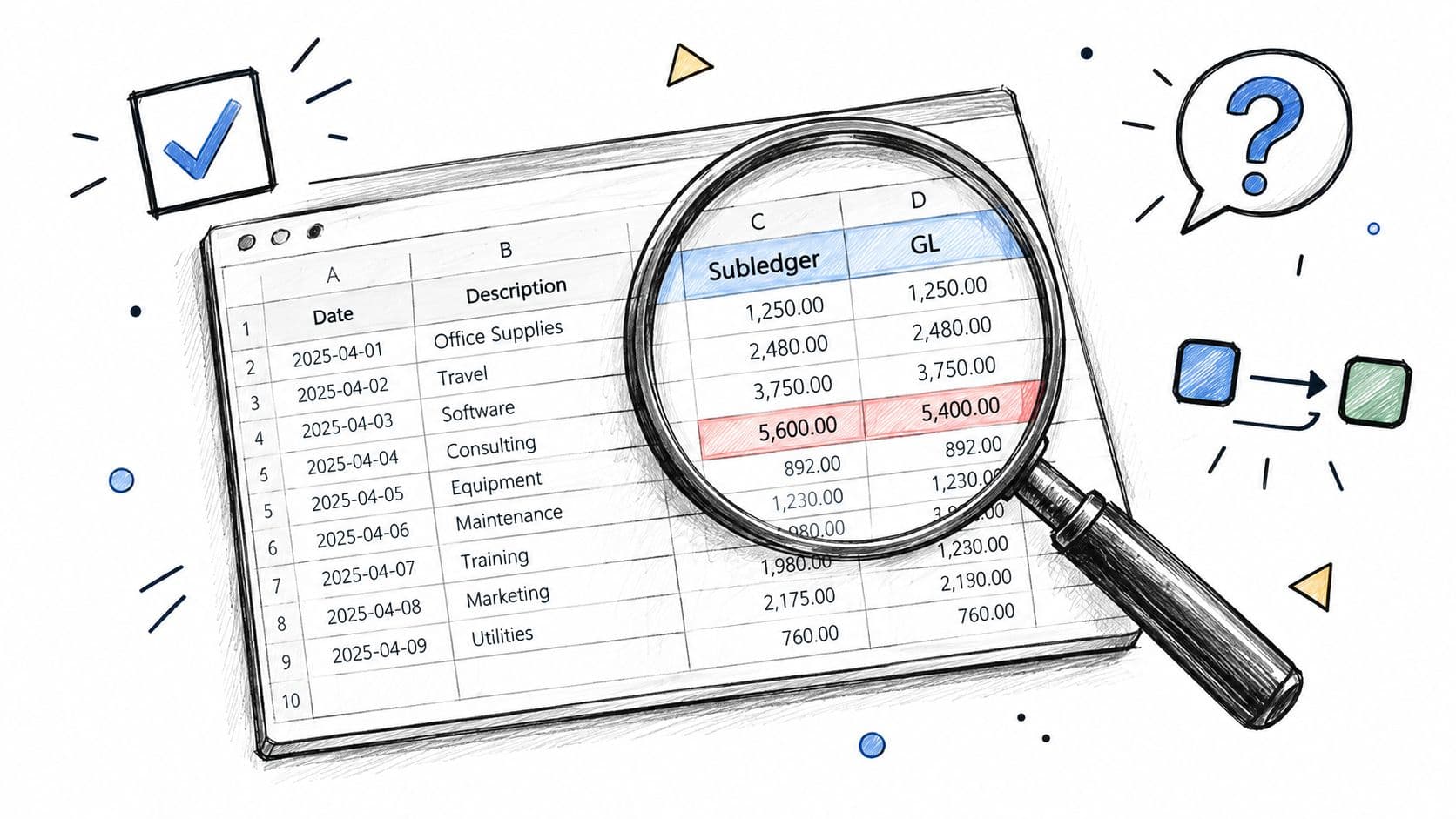
A reconciliation isn't complete because someone clicked “match” in QuickBooks or Xero. It's complete when the source record ties to the general ledger, every exception has a documented explanation, and a reviewer confirms the conclusion.
Start with the accounts that create noise
For bank accounts and credit cards in QuickBooks or Xero, import the complete statement period, match ordinary transactions, and separate timing differences from actual errors. Don't force-match an item just to make the reconciliation screen show zero.
Payment processors deserve separate treatment. Stripe, PayPal, Square, and Shopify often combine gross customer receipts, refunds, processing fees, reserves, and transfers. A net deposit in the bank won't necessarily equal the gross sales report. Tie the processor clearing account to the processor statement, then tie the resulting transfer to the bank.
Use the same discipline for:
- Accounts receivable: Tie the AR aging report to the AR control account, investigate unapplied cash, and review old balances by customer.
- Accounts payable: Tie the AP aging to the AP control account, identify missing bills, and confirm credits and payments were posted to the correct vendor.
- Payroll: Compare the payroll register, payroll provider report, and general-ledger posting. Confirm taxes, benefits, commissions, and accruals.
- Intercompany and owner activity: Match both sides of intercompany entries and separately review shareholder distributions, loans, reimbursements, and personal charges.
For software teams dealing with billing complexity, Creem's guide to revenue reconciliation is a useful reference for connecting payment data, billing records, and accounting balances.
Use a risk queue instead of equal effort
Gartner's July 2023 survey of 497 controllership professionals found that 18% reported financial errors at least daily, 33% reported several errors each week, and 59% reported several errors per month. The reported causes included manual-work mistakes, insufficient review, and volume or complexity overload (Gartner survey results).
Classify each account as recurring, high-volume, judgmental, or material. Then assign a preparer and an independent reviewer. Rolling bank and payment-processor matching can happen throughout the month. Revenue adjustments, unusual accruals, intercompany entries, and material balance-sheet movements need full evidence and review at close.
A reconciliation automation system can help with matching and exception routing, but it won't replace the accounting conclusion. Use reconciliation automation tools to reduce manual comparison, not to bypass review.
ASC 606 Revenue Recognition for SaaS
SaaS teams get into trouble when they treat invoicing as revenue recognition. ASC 606 requires you to identify the contract, identify distinct performance obligations, determine the transaction price, allocate that price to the obligations, and recognize revenue as each obligation is satisfied.
For a straightforward annual cloud-access contract, Stripe's worked example uses a $12,000 upfront payment. On day one, revenue is $0 and deferred revenue, a contract liability, is $12,000. If service is delivered evenly, you recognize $1,000 per month and reduce deferred revenue by the same amount (Stripe's SaaS revenue-recognition guide).
The entries are simple:
- At invoicing or collection: Debit cash or accounts receivable $12,000, credit deferred revenue $12,000.
- At the end of month 1: Debit deferred revenue $1,000, credit subscription revenue $1,000.
- At the end of month 6: Cumulative revenue is $6,000 and deferred revenue is $6,000.
- At the end of month 12: Cumulative revenue is $12,000 and deferred revenue is $0.
Your close schedule should show the invoice amount, service period, recognized revenue, remaining liability, contract changes, and general-ledger balance. The invoice date tells you when billing occurred. It doesn't determine the revenue month.
Separate obligations that release differently
Consider a $36,000 arrangement allocated by standalone selling prices to:
- Platform access: $30,000, recognized over 12 months at $2,500 per month.
- Implementation: $4,000, recognized at go-live as a point-in-time obligation.
- Premium support: $2,000, recognized over 12 months at approximately $167 per month.
A blended monthly entry would misstate the timing. The correct schedule looks like this:
| Month | Platform ($2,500) | Implementation | Support (~$167) | Total Revenue |
|---|---|---|---|---|
| Month 1 | $2,500 | $4,000 | $166.67 | $6,666.67 |
| Month 2 | $2,500 | $0 | $166.67 | $2,666.67 |
| Month 3 | $2,500 | $0 | $166.67 | $2,666.67 |
| Month 4 | $2,500 | $0 | $166.67 | $2,666.67 |
| Month 5 | $2,500 | $0 | $166.67 | $2,666.67 |
| Month 6 | $2,500 | $0 | $166.67 | $2,666.67 |
| Month 7 | $2,500 | $0 | $166.67 | $2,666.67 |
| Month 8 | $2,500 | $0 | $166.67 | $2,666.67 |
| Month 9 | $2,500 | $0 | $166.67 | $2,666.67 |
| Month 10 | $2,500 | $0 | $166.67 | $2,666.67 |
| Month 11 | $2,500 | $0 | $166.67 | $2,666.67 |
| Month 12 | $2,500 | $0 | $166.67 | $2,666.67 |
The month-1 entry recognizes $6,666.67 before rounding. Months 2 through 12 recognize approximately $2,666.67 each, subject to final rounding, and the arrangement totals $36,000. For a deeper treatment of schedules and performance obligations, use this ASC 606 accounting guide.
When reviewing SaaS contracts, flag cancellations, upgrades, discounts, usage-based fees, implementation, migration, training, and premium support. These terms change the schedule. They also create evidence requirements that a single monthly percentage entry won't satisfy.
If your business sells through online channels, revenue reconciliation should also connect refunds, disputes, and chargebacks to the contract and payment records. A resource on Shopify chargeback fraud prevention can help operational teams understand why gross payment activity and collectible revenue shouldn't be treated as identical.
Tie the Close to MRR, ARR, and Cash KPIs
Financial statements tell you what happened. Operating KPIs tell you what changed in the business and whether the change will persist.
For SaaS, connect the close to MRR movement, ARR, deferred revenue, gross margin, CAC payback, runway, and cash conversion. For agencies and professional services firms, connect it to contracted backlog, utilization, billable revenue, collections, project margin, and unbilled work.

Build one reporting spine
Don't maintain one spreadsheet for accounting, another for the board, and a third for fundraising diligence. The close should produce a trusted actuals layer that feeds the management package and KPI dashboard.
Use the close to answer:
- MRR movement: What came from new customers, expansion, contraction, or churn?
- ARR: Does the annualized recurring-revenue view agree with the contract and billing records?
- Deferred revenue: What contracted service remains to be delivered, and does the balance reconcile to the general ledger?
- Cash and runway: How much cash is available, what obligations are due, and how does actual burn compare with the plan?
- Gross margin: Did delivery costs, contractors, hosting, payment fees, or support costs move in a way that needs action?
A useful monthly recurring revenue reference can help standardize definitions, but your company still needs a written KPI policy. Decide whether MRR includes discounts, usage, implementation, support, or only recurring subscription obligations. Then apply the definition consistently.
Review MRR and ARR during the close because contract changes and recognized revenue are already under examination. Keep forecasting, scenario planning, and dashboard visualization in a separate reporting layer so accounting doesn't become responsible for every operating analysis.
This explainer provides a visual overview of how finance teams connect reporting activity to operating decisions.
Finish with a one-page executive summary containing the income statement, balance sheet, cash flow statement, and the four KPIs your board or lender asks about most. Add concise commentary for the largest changes, open exceptions, and decisions required from leadership.
Automate the Right Tasks and Keep Judgment Where It Matters
Automation is valuable when it removes repetitive comparison. It's dangerous when it hides incomplete data or posts an unsupported conclusion.
A 2025 finance-operations study found that only 30% of respondents had automated 75% to 100% of financial-recording tasks, while 43% had automated less than half. 55% identified reducing manual, repetitive accounting work as a leading priority (CFO finance-operations coverage).
Use this decision framework:
| Task Type | Treatment | Rationale | Example |
|---|---|---|---|
| Recurring, low-risk | Automate | Rules are stable and evidence is predictable | Depreciation, recurring prepaid amortization, scheduled allocations |
| High-volume, objective | Automate matching, review exceptions | Human review adds little value to ordinary matches | Bank, card, Stripe, PayPal, Square, or Shopify activity |
| Judgmental | Prepare with evidence, require review | The accounting conclusion depends on facts and interpretation | Contract modifications, usage-based billing, deferred-revenue releases |
| Material or unusual | Escalate and document | A wrong entry could change management decisions | Large accrual, unusual margin movement, related-party entry |
| Spreadsheet-heavy accrual | Standardize and lock | Formula and version-control failures can spread silently | Accrual template with locked formulas, evidence links, and sign-off |
For example, if monthly revenue is $400,000 and management chooses 1% of revenue as a review threshold, an unexplained variance or proposed adjustment above $4,000 receives documented review. That is a management-control example, not a universal accounting rule. Align the threshold with your auditor, lender, and reporting requirements.
Run two lanes
The first lane handles high-volume, recurring work throughout the month. Reconcile bank and processor activity on a rolling basis, generate recurring entries under controlled rules, and route exceptions to an owner.
The second lane handles judgment. Review contract modifications, usage estimates, refunds, credits, deferred-revenue releases, unusual accruals, and material variances. Keep the evidence attached to the entry and prohibit period reopening without controller approval.
A faster close doesn't require less control. It requires fewer manual touches on routine work and stronger review where the financial statement could change decisions. A close platform or financial close automation workflow can support that split, but the controller still owns the accounting judgment.
Red Flags That Break a Close and Your 30-Day Action Plan
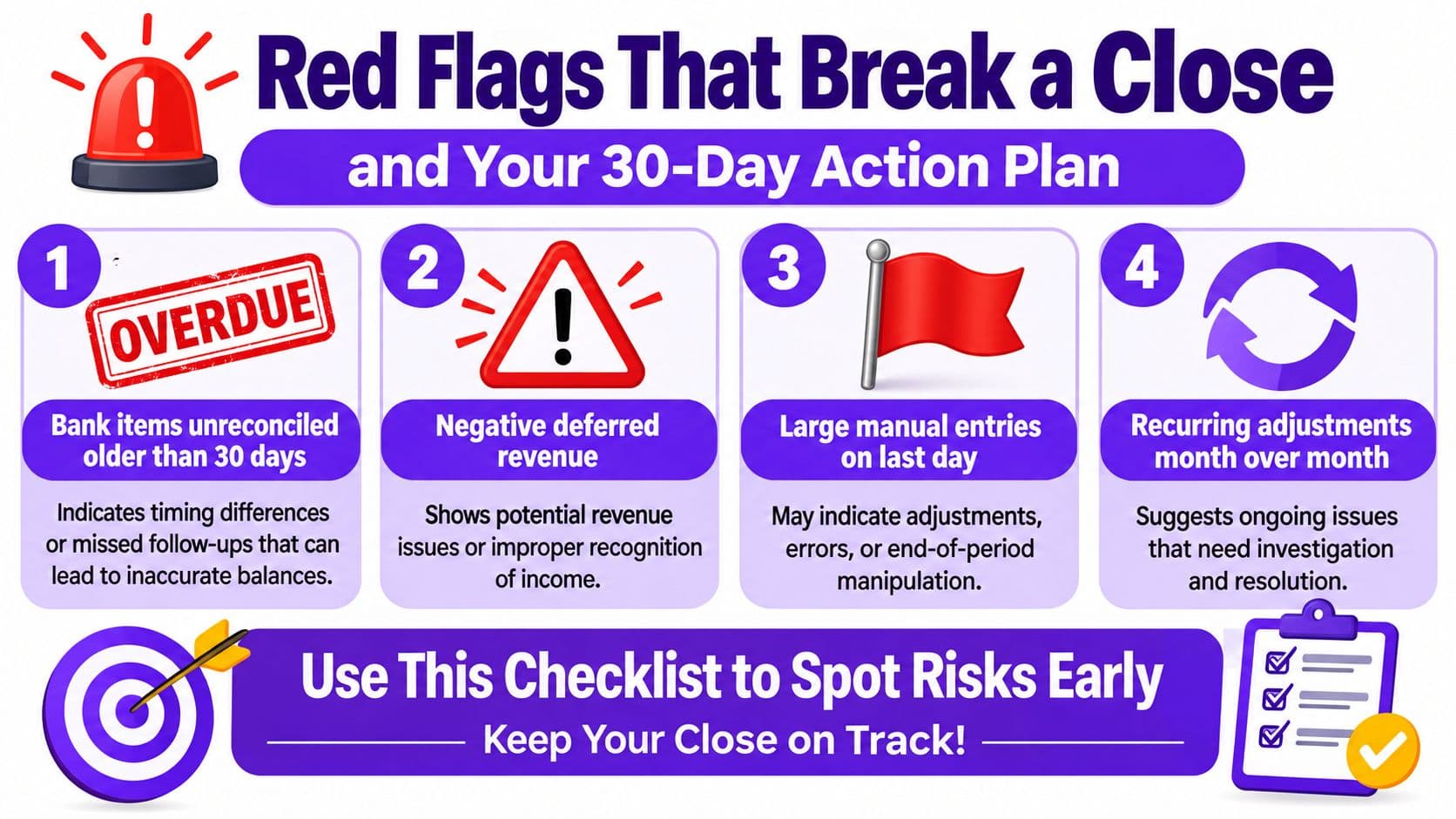
A red flag isn't merely an untidy account. It shows that your process lacks a clear owner, cutoff, source document, or review rule.
| Red Flag | Diagnostic Question | Corrective Action |
|---|---|---|
| Bank items unreconciled for more than 30 days | Is this a timing difference, missing transaction, duplicate, or coding error? | Assign an owner, obtain the source statement, and resolve or document every item |
| Negative deferred revenue | Did the schedule release more revenue than the contract liability supports? | Rebuild the contract schedule and tie ending deferred revenue to the general ledger |
| Large manual entries on the last day | Why did the entry arrive late, and who independently reviewed it? | Require evidence, controller approval, and a root-cause fix for the late input |
| Recurring accruals that never reverse | Is the expense still owed, or is the estimate rolling forward indefinitely? | Confirm the underlying obligation and reverse or replace the accrual |
| Unexplained gross-margin change | Did pricing, delivery cost, contractor expense, hosting, or classification change? | Trace the movement to source transactions and document the explanation |
| Stale AR or AP aging | Which balances need collection, credit review, vendor confirmation, or write-off analysis? | Assign customer and vendor owners and clear unsupported balances |
Your next 30 days should be practical:
- Record the close duration for three consecutive months.
- Identify the latest-finishing accounts and the dependencies delaying them.
- Assign a named owner and deadline to every account and source-data submission.
- Require pre-close data owners to submit inputs by Day -3.
- Automate rolling bank and payment-processor matching.
- Document materiality thresholds and the evidence required for sign-off.
- Adopt a five-business-day target only after the control package is defined.
If your team keeps reopening the books, missing revenue cutoffs, or chasing the same invoices every month, bring in an outsourced controller for a close assessment rather than asking the existing team to work longer hours.
Jumpstart Partners provides outsourced controller and bookkeeping support for SaaS, agencies, professional services firms, and other businesses generating $500K to $20M in revenue, including close calendars, reconciliations, revenue schedules, KPI reporting, and control documentation. Visit Jumpstart Partners to assess your current close and build a documented five-day workflow with investor-ready financials.