Financial Operations
Liquidity Analysis for SaaS and Agency Leaders
Master liquidity analysis for your SaaS or agency. Learn key ratios, run stress tests, and avoid the cash traps that stall growing businesses.
ByJumpstart Partners, CPA, QuickBooks ProAdvisor
··19 min readA profitable P&L and a healthy bank balance don't prove that your company is safe. They prove only that your accounting records and your bank account look acceptable at a particular moment.
Cash timing determines survival. Payroll leaves on a fixed schedule. Cloud infrastructure charges arrive whether customers have paid or not. Advertising spend often precedes revenue. Enterprise customers can delay payment while your team continues delivering work. A company can report profit while funding a widening gap between outgoing cash and incoming cash.
That's why liquidity analysis needs to move beyond a balance-sheet snapshot. You need a forward-looking view of when cash arrives, when it leaves, how quickly it can disappear, and which assumptions fail under stress. The objective is simple: know whether you can meet obligations over the next 12 months, then manage the next several weeks with enough precision to act before a shortfall becomes a crisis.
Table of Contents
- Why Profitable SaaS Companies Still Run Out of Cash
- The Core Metrics of Liquidity Analysis
- Building a 13-Week Cash Flow Forecast
- Liquidity Profiles by Business Model
- Red Flags and Warning Signs of a Liquidity Crisis
- When to Outsource Your Controller and Bookkeeping
- Your Immediate Action Plan for Cash Visibility
Why Profitable SaaS Companies Still Run Out of Cash
The most dangerous liquidity myth is that profit eventually becomes cash automatically. It doesn't. Revenue recognition, customer collections, supplier terms, payroll timing, and growth investments all operate on different clocks.
A SaaS company may sign annual contracts and record revenue over the service period while paying sales commissions, onboarding costs, developers, and infrastructure expenses earlier. An agency may invoice after completing a milestone while paying employees throughout the project. A professional services firm can show strong billings while carrying a growing balance of unbilled work and receivables.
The bank balance hides this timing problem until it becomes urgent. By then, the founder is asking whether to delay hiring, draw on a credit facility, postpone taxes, or call investors. Those are financing decisions, not operating decisions, and they're much more expensive when made under pressure.
Practical rule: Treat liquidity analysis as a forward operating system, not a monthly compliance exercise.
Growth can create a funding gap
Growth consumes cash when you have to spend before you collect. More customers can mean more implementation work, more support staff, more infrastructure, and larger commission payments. If collections lag behind those commitments, revenue growth increases the amount of cash tied up in the operating cycle.
The Journal of Accountancy explains the difference between liquidity ratios and the cash conversion cycle. Ratios show the relationship between assets and liabilities at a point in time. The cash conversion cycle focuses on the time between paying for inputs and collecting customer cash.
That distinction matters for a founder deciding whether to accelerate sales hiring or open another delivery team. A healthy-looking balance sheet can coexist with a cash gap if receivables, work in progress, or prepaid costs grow faster than collections.
Bank balance is not available liquidity
You need to separate cash that is immediately spendable from cash that is restricted, committed, or dependent on future events. Customer prepayments may support the bank balance but create future delivery obligations. Accounts receivable may appear as a current asset but still require collection effort and customer cooperation. Inventory may be valuable in theory but difficult to convert into cash quickly.
The historical development of liquidity analysis reflects this problem. Bankers in the nineteenth century began comparing current assets with current liabilities instead of relying only on informal judgment and collateral inspection. Alexander Wall later helped popularize ratio-based benchmarks, including the historical 2:1 current ratio rule of thumb for many manufacturing firms. During the Great Depression, analysts also recognized that inventory could become illiquid quickly, which led to the quick ratio, a more conservative measure that excludes inventory from the numerator. The history is summarized in this overview of liquidity ratios and their development.
For a growing SaaS business, the practical lesson is clear. Don't ask only, “How much cash do we have?” Ask, “How much of that cash can we use without creating a new operating obligation, and how long until the next reliable inflow?”
Founders evaluating a financing round should also examine investor fit alongside runway. A resource that helps you compare US SaaS investors can support that process, but investor outreach shouldn't replace a cash-timing model. You need to know the size and timing of the funding gap before you decide whom to approach.
For a focused explanation of why cash matters even when the P&L looks healthy, review why cash flow is important. Your next twelve months should be managed from expected cash movements, not from profit alone.
The Core Metrics of Liquidity Analysis
Liquidity analysis starts with ratios, but it shouldn't end there. Use each ratio to answer a different question, then add a cash-timing metric that shows how long operating cash remains trapped.
Start with the balance-sheet ratios
The current ratio is current assets divided by current liabilities. It asks whether assets expected to turn into cash within the operating cycle can cover obligations due within that same period. A ratio greater than 1.0x generally indicates that current assets exceed current liabilities, but the composition of those assets matters more than the headline number. Wall Street Prep defines the current ratio and explains why a ratio above 1.0x is commonly viewed as a basic liquidity threshold.
The quick ratio removes inventory from current assets. For a SaaS company, inventory is usually less relevant than receivables, so you should focus on whether collectible invoices and cash can cover short-term obligations. The cash ratio goes further by considering only cash and cash equivalents against current liabilities.
| Metric | Formula | Target benchmark | What it tells you |
|---|---|---|---|
| Current ratio | Current assets ÷ current liabilities | Below 1.0x is a warning sign. 1.0x to 2.0x is commonly acceptable, but industry context matters. | Whether total current assets can cover near-term obligations |
| Quick ratio | Cash and receivables ÷ current liabilities | Keep it above 1.0x when your business depends on fast settlement and has limited borrowing capacity. | Whether more liquid assets can cover obligations without relying on inventory |
| Cash ratio | Cash and cash equivalents ÷ current liabilities | Use as a conservative internal measure rather than a universal target. | Whether cash on hand alone can meet near-term liabilities |
| Current ratio history | Current assets ÷ current liabilities | The historical 2:1 rule of thumb is not a universal modern target. | How much cushion the traditional benchmark implied |
The historical 2:1 benchmark implied that current assets could fall by as much as 50 percent and still cover current liabilities, but later practice treated it as industry-specific rather than universal. IMF research discusses the use of current, quick, and cash ratios across liquidity analysis and regulatory history.
Measure the time your cash stays trapped
The cash conversion cycle, or CCC, measures the days between paying for operating inputs and collecting customer cash. The formula is:
CCC = days inventory outstanding + days sales outstanding − days payables outstanding
Suppose an agency carries work in progress for 30 days, collects invoices in 45 days, and pays suppliers in 25 days. Its CCC is:
30 + 45 − 25 = 50 days
That means the business finances 50 days of operating activity before customer cash returns. The calculation and formula are described by AnalystPrep's explanation of activity, liquidity, solvency, and profitability ratios.
SaaS companies should adapt the components. Replace inventory days with implementation time, onboarding effort, or other work performed before collection. Track days sales outstanding for billed but unpaid contracts. For agencies, measure unbilled work and approved-but-uninvoiced milestones. For subscription businesses, monitor the gap between upfront vendor commitments and customer collections.
A ratio tells you whether assets exceed liabilities. CCC tells you how long your cash is unavailable. You need both. A business can pass a ratio test and still face a cash squeeze if the operating cycle keeps lengthening.
A practical way to improve the underlying records is to rally through your accounting, especially when reconciliations and receivables data aren't reliable enough for a forecast. For a broader operating dashboard, see SaaS financial metrics, but keep liquidity metrics connected to actual collection dates.
Building a 13-Week Cash Flow Forecast
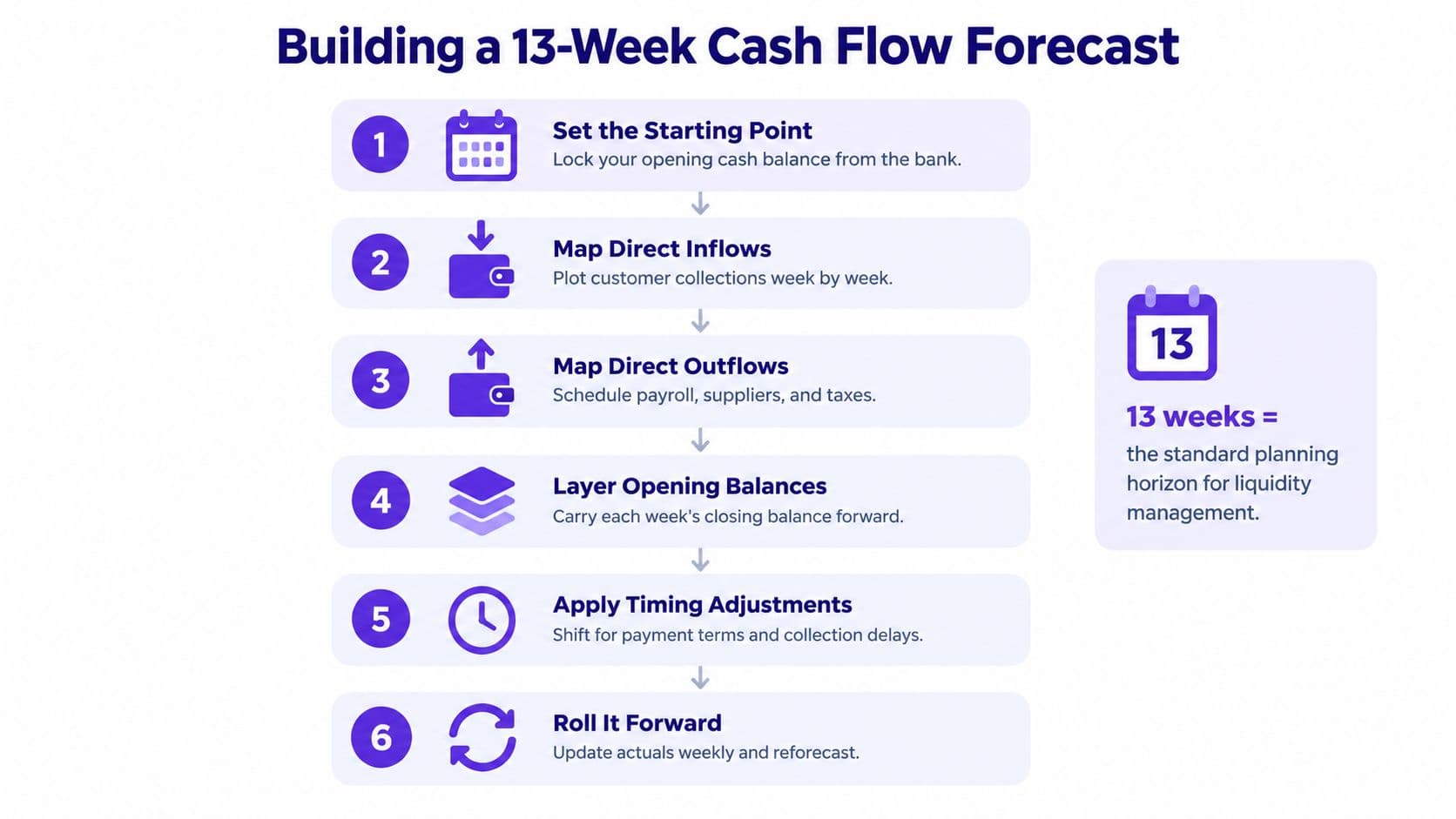
Static ratios tell you where the business stood. A rolling 13-week cash flow forecast tells you whether the business can meet obligations as they arrive. Build it in direct cash terms, not accrual revenue.
Build the base case from evidence
Use one column for each week and begin with the actual bank balance. Then separate cash inflows from cash outflows.
- Lock the opening balance. Reconcile the starting cash figure to your bank accounts. Exclude funds you can't use for ordinary operations.
- Map customer collections. Enter the week you realistically expect cash to arrive, not the invoice date. Review open receivables, customer payment behavior, promised dates, and disputed invoices.
- Schedule committed outflows. Include payroll, taxes, rent, software, contractors, debt payments, supplier bills, and recurring infrastructure costs. Use the contractual payment date where it exists.
- Carry the balance forward. Each week's closing balance becomes the next week's opening balance. This exposes the exact week in which cash falls below your operating minimum.
- Adjust for timing risk. Shift collections when a customer has a history of late payment. Separate committed payments from discretionary spending so you know what can be moved.
- Update weekly. Replace forecast figures with actual cash movements and extend the model by another week. A forecast that isn't refreshed becomes a historical report.
The 13-week cash flow framework is useful because it creates a short planning horizon without losing sight of the immediate payment calendar. Keep the model simple enough that your team updates it consistently.
Stress-test the assumptions
Don't build one forecast and call it a plan. Create a base case, a downside case, and a severe case. The stress scenarios should reflect your business model:
- A major customer pays materially later than promised.
- New sales slow while payroll and infrastructure commitments remain fixed.
- A cloud provider, contractor, or payment processor increases costs unexpectedly.
- A concentrated customer relationship ends or enters a dispute.
- A funding round closes later than expected.
The point isn't to predict the exact shock. The point is to identify the first decision you'll need to make when collections weaken. Define actions in advance, such as freezing nonessential hiring, reducing discretionary acquisition spend, renegotiating supplier terms, accelerating collections, or opening a financing conversation.
A forecast becomes useful when every low-cash week has an owner and a response. If the model shows a shortfall but nobody knows which costs can move, you have produced a spreadsheet, not a contingency funding plan.
Watch the accompanying walkthrough after you've built your first version:
Liquidity Profiles by Business Model
Liquidity analysis should follow the way your business earns and spends cash. A SaaS company, agency, and e-commerce brand can report similar revenue while carrying completely different liquidity risks.
| Business model | Typical cash signature | Main liquidity trap | Best operating focus |
|---|---|---|---|
| SaaS | Customer billing may arrive before delivery, while revenue is recognized over the service period. | Treating deferred revenue as unrestricted profit or spending all upfront cash before future delivery costs arrive. | Separate cash collected from earned revenue, then reserve for delivery, support, and renewals. |
| Digital agency | Payroll and contractor costs accumulate while work progresses and invoices depend on milestones or approval. | Scope creep, unbilled work, and delayed enterprise collections. | Track work in progress, billing status, approval dates, and expected collection dates. |
| E-commerce | Cash leaves for inventory and fulfillment before the customer purchase cycle fully replenishes it. | Buying too much stock, carrying slow-moving products, and funding returns or supplier commitments. | Connect purchasing decisions to sell-through, reorder timing, and available cash. |
SaaS requires a deferred-revenue discipline
Upfront customer cash improves immediate liquidity, but it also creates a delivery obligation. Don't treat every dollar collected on an annual subscription as available for hiring or expansion. Match the cash reserve to implementation, service, support, hosting, and renewal risk.
The question isn't whether annual billing is good. The question is whether your operating plan respects the obligation created by the billing structure.
Agencies need project-level cash visibility
Agency leaders often look at total receivables and miss the project causing the problem. A single large engagement can show healthy gross margin while consuming cash because staff worked ahead of approved milestones. Track hours delivered, work completed but not billed, invoice approval status, and the person responsible for collection.
Net payment terms also matter less than actual behavior. If a customer is contractually due to pay on one date but routinely pays later, your forecast should use the observed collection pattern until the account changes.
E-commerce turns purchasing into a liquidity decision
Inventory is not cash. It can become cash, but only through a sale, fulfillment, settlement, and the absence of costly returns or disputes. A purchasing plan that looks efficient on a margin report can still drain the bank account if the business buys ahead of demand.
For all three models, the same principle applies: model the cash event, not the accounting label. “Revenue,” “inventory,” and “deferred revenue” don't tell you when money is available to pay the next obligation.
Red Flags and Warning Signs of a Liquidity Crisis
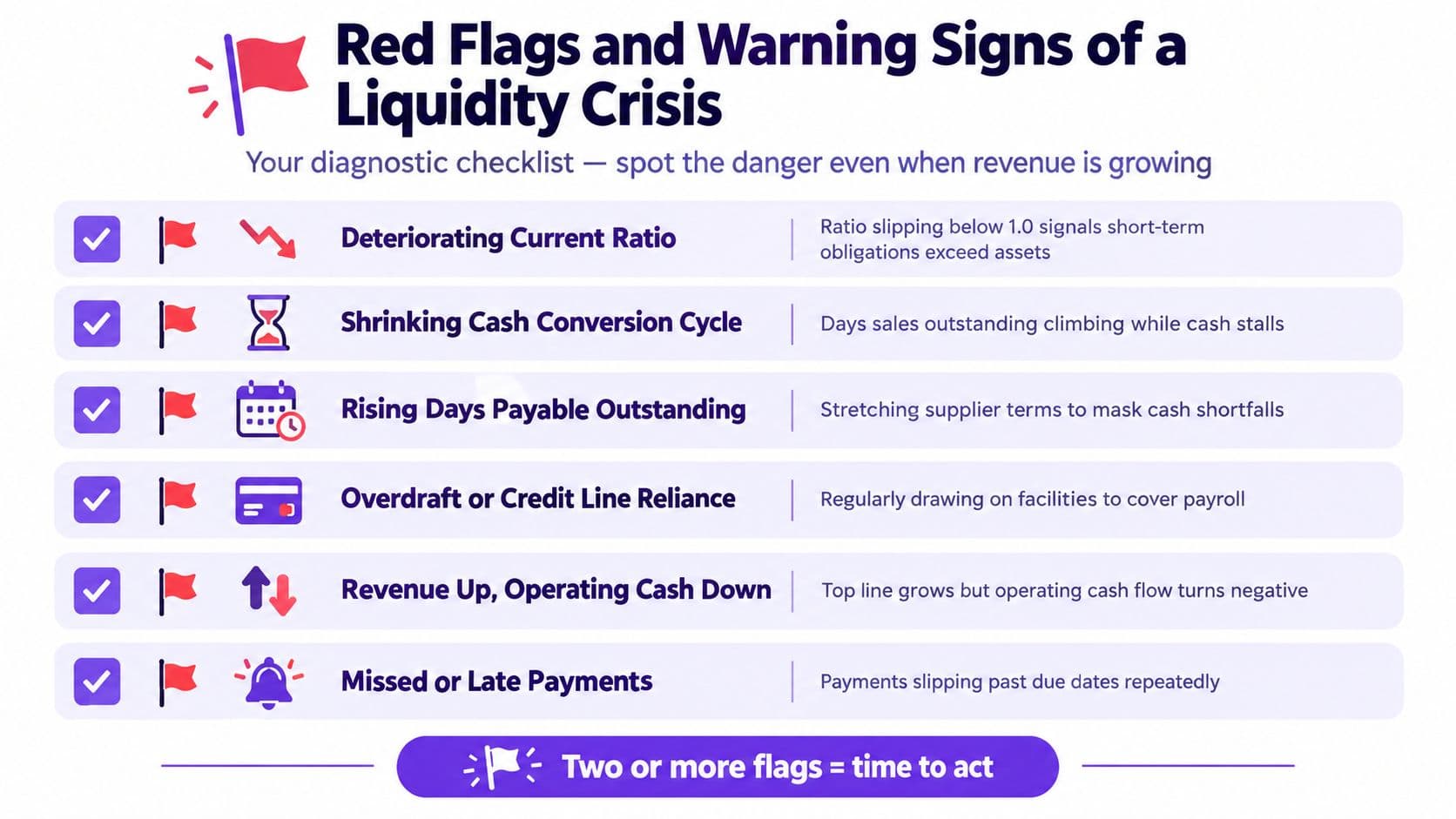
A liquidity crisis rarely begins with an empty bank account. It begins with deteriorating timing, growing dependence on exceptions, and management reports that explain yesterday instead of exposing next week.
Watch for operational deterioration
- A weakening current or quick ratio: A ratio moving toward or below 1.0x deserves immediate investigation because near-term obligations can exceed readily available assets. The threshold is a warning signal, not proof of failure.
- A lengthening cash conversion cycle: Collections slow, work stays unbilled, or suppliers demand earlier payment. The business needs more funding to support the same level of activity.
- Growing reliance on short-term credit: Drawing a line to fund a recurring payroll gap is not a financing strategy. It's evidence that the operating model is consuming cash faster than it replenishes it.
- Revenue growth with weaker operating cash: New contracts don't help if delivery costs arrive first and collections remain uncertain.
- Repeated late payments: Missed tax, supplier, or payroll deadlines indicate that management is already using timing decisions to preserve cash.
- Concentration exposure: One customer, payment processor, bank, or funding source can become a single point of failure when cash movement accelerates.
Review how to calculate cash burn with these warning signs, but don't reduce the diagnosis to a single burn figure. Burn tells you the rate of cash use. It doesn't tell you whether a customer will pay, whether a supplier will tighten terms, or whether a contractual obligation arrives before the next collection.
Static liquidity can hide rapid cash loss
Static balance-sheet ratios miss the speed of liquidity loss during stress, particularly after digital banking and social media changed how quickly depositors can move money. Regulatory commentary notes that digital banking and social media can accelerate deposit runs. The 2026 EBA report projects EU and EEA banks' LCR to drop to 155% as high-quality liquid assets decline and net outflows rise, a projection that shows headline liquidity can weaken before solvency problems appear. The regulatory commentary provides that projection and its context.
Your company isn't a bank, but the management lesson transfers. Customer prepayments, marketplace settlements, payment processors, and short-term lenders can all create concentrated liquidity exposure. A static report may show enough assets while a sudden change in payment behavior creates an immediate funding problem.
“Runs can accelerate failure and worsen the damage, but by the time depositors head for the exit, the deeper problem is usually baked into bank balance sheets.”
Sergio Correia, Stephan Luck, and Emil Verner, Federal Reserve Bank of New York research
For a founder, the translation is direct: don't wait for the cash account to expose weak fundamentals. Investigate declining collections, deteriorating margins, customer concentration, and repeated dependence on emergency funding while you still have choices.
When to Outsource Your Controller and Bookkeeping
DIY bookkeeping works until the business has too many accounts, entities, payment systems, contracts, and timing differences for one person to reconcile reliably. At that point, the issue isn't that the spreadsheet is ugly. The issue is that nobody trusts the numbers enough to make a decision.
A bookkeeper records and reconciles activity. A controller builds the control system around it. That system should connect bank activity, accounts receivable, accounts payable, payroll, revenue recognition, cash forecasting, and management reporting.
The transition point is decision quality
Outsource controller support when you see several of these conditions:
- Month-end reports arrive too late to change decisions.
- The bank balance and accounting ledger don't agree without manual investigation.
- Revenue recognition for subscription or contract work requires recurring judgment.
- Receivables aging exists, but no one owns collection dates.
- The founder still approves payments from a personal spreadsheet.
- Investors, lenders, or auditors request schedules your team can't produce quickly.
- The 13-week forecast changes materially whenever the books are updated.
A 5-day month-end close and ASC 606 revenue recognition workflows are useful operating targets when your reporting needs to support investors, lenders, and internal decisions. The objective isn't a faster close for its own sake. It's to give you reliable information while the information can still influence hiring, spending, collections, and financing.
Choose control before adding complexity
Don't hire a full-time CFO to compensate for unreliable transaction processing. First establish clean reconciliations, consistent close procedures, documented revenue treatment, and a cash model that someone updates every week. Then add strategic finance support when the company needs pricing analysis, fundraising preparation, acquisition planning, or capital allocation.
An outsourced controller can coordinate those layers without forcing the founder to become the accounting department. Use bookkeeper versus controller as a practical distinction when deciding what your business actually needs.
The right partner should connect to the systems you already use, such as QuickBooks, Xero, NetSuite, Stripe, Shopify, Square, Gusto, or BambooHR. The tool stack matters less than the discipline: every cash movement needs an owner, a date, and a clear place in the forecast.
Your Immediate Action Plan for Cash Visibility
You don't need a perfect finance function to start. You need a reliable baseline and a short list of actions that expose the next cash constraint.
Complete these actions this week
- Reconcile every bank account. Start with actual available cash, then identify restricted balances, pending transfers, and payments already committed.
- Export aging reports. Pull accounts receivable and accounts payable aging. Mark each customer invoice with a realistic collection date, not just its contractual due date.
- List near-term commitments. Include payroll, taxes, rent, contractors, software, infrastructure, debt, and supplier payments. Separate fixed obligations from spending you can pause.
- Calculate your CCC. Use inventory or work-in-progress days, receivable days, and payable days. For a services business, define precisely what counts as work completed but not yet collectible.
- Build the 13-week model. Start with the opening bank balance, map direct inflows and outflows by week, and carry each closing balance into the next period.
- Run downside scenarios. Delay a major collection, reduce expected new sales, and increase a material operating cost. Focus on the first week in which your cash position becomes unacceptable.
- Assign owners. Give one person responsibility for collections, one for payment scheduling, and one for updating the forecast. A metric without an owner won't change behavior.
- Set a weekly review. Compare forecast against actual cash, explain variances, and extend the model forward. Don't wait for month-end.
Search for leakage as well as revenue. Unclaimed customer credits, duplicate subscriptions, unused software, unbilled work, and missed collections can all distort the cash picture. A practical resource on how to find money you're owed online can help you look for recoverable value, but your primary control remains a disciplined receivables and payables process.
Use the forecast to make decisions
Your forecast should answer five questions every week:
- When does cash reach its lowest point?
- Which inflows are dependable, and which depend on customer promises?
- Which outflows are mandatory?
- What action protects liquidity without damaging delivery?
- When must you start a financing or restructuring conversation?
Don't use a current ratio as permission to spend. Don't use profit as proof that growth is self-funding. Don't use a cash forecast as a static file that sits untouched after the first build.
Liquidity analysis earns its place in your operating rhythm when it changes decisions before the bank balance forces them. Start with clean dates, realistic collections, committed outflows, and a forecast that your team updates every week.
Jumpstart Partners provides outsourced bookkeeping and controller support for growing SaaS, agency, and professional services businesses, including reconciliations, cash-flow visibility, revenue recognition workflows, and investor-ready reporting. Visit Jumpstart Partners to request a consultation and build a liquidity process that supports your next stage of growth.