Financial Operations
List of Company Expenses: Categories with Examples
Use this list of company expenses to classify COGS, SG&A, payroll, SaaS tools and merchant fees, with examples and bookkeeping rules for 2026.
ByJumpstart Partners, CPA, QuickBooks ProAdvisor
··20 min readA longer list of company expenses does not make your books safer. It often makes them worse. When every payment lands in one operating-expense bucket, you cannot tell whether margin slipped because delivery got expensive, payroll outran revenue, or nine unused tools renewed on a card nobody reviews.
The useful list does three jobs at once. It puts each cost on the right statement line, names how the cash behaves, and keeps the evidence an auditor or investor will ask for. Founders at $500K to $20M in SaaS, agencies, and professional services usually do not fail because a category is missing. They fail because the same vendor is coded two ways, a prepaid contract is expensed in January, and gross margin is a guess.
Table of Contents
- Why Expense Classification Drives Margin and Cash
- Expense Categories at a Glance
- Cost of Revenue by Business Model
- Payroll, Contractors and Benefits Split
- Operating Expenses That Quietly Grow
- Depreciation, Prepaids and Capitalized Costs
- Classifying Mixed-Use and Borderline Spending
- Cash Behavior and the Metrics Each Expense Drives
- Red Flags and the One-Week Expense Map Check
Why Expense Classification Drives Margin and Cash
One undifferentiated expense total hides the cause of a margin problem. You see that spending rose. You do not see whether delivery, people, or software caused it, and those three have completely different fixes.
The U.S. Securities and Exchange Commission describes the income statement in a fixed order. Revenue for the period comes first, with the costs of earning it. Subtract cost of revenue and you have gross profit. Subtract operating expenses and you have operating profit before interest and income taxes. Interest sits below that line because it is the cost of borrowed money, not the cost of running the business. Income tax sits there too. That ordering is the mechanism: gross margin tells you whether delivery economics work, operating margin tells you whether the business works after overhead, and the lines below tell you what the capital structure costs. A single "expenses" figure separates none of those answers.
Say last quarter you booked $180,000 of revenue and $145,000 of total expenses. Net margin looks like about 19%. Pull $62,000 of delivery labor into cost of revenue and gross profit is $118,000, a gross margin of about 66%. The business did not get more profitable. You can finally see where the profit is made, and you can argue about whether 66% is the right target for the model. The same SEC guidance says shared costs may need allocation, and the method is disclosed when it is material. That disclosure is a decision you make at coding time, not at audit time.
Every line needs six fields: amount, date, vendor, department, customer or project, and a tag for direct, shared, recurring, capitalizable, or period-based. Drop the customer or project field and you cannot build a margin by segment. Drop the tag and a prepaid annual contract lands in the month it was paid. Those fields are what let a gross profit versus operating profit comparison hold up month to month instead of drifting with whoever coded the invoice.
Export last quarter's expenses before going further and tag each line to cost of revenue, operating expense, or below operating profit. The lines you cannot place are the ones that will cost you the most to defend later.
Expense Categories at a Glance
Read this table in the order a profit and loss statement is built. Cost of revenue comes before gross profit. Operating lines come next. Interest and income tax come after operating profit. Each row also names the cash behavior, so you get statement placement and payment timing in one pass.
| Category | What It Covers | Income Statement Placement | Cash Behavior | Worked Example |
|---|---|---|---|---|
| Cost of revenue | Hosting, delivery labor, product inventory, fulfillment | Cost of revenue, above gross profit | Variable with volume | $4,000 monthly hosting tied to paying customers |
| Payroll and benefits | Wages, employer taxes, health benefits, bonuses | Operating expenses, or cost of revenue for delivery staff | Fixed and committed | $7,500 monthly wages for a support hire |
| Contractors | Freelancers and outsourced delivery work | Cost of revenue or operating expenses, by role | Variable | $3,200 invoice for design on a client project |
| Sales and marketing | Paid advertising, agency fees, commissions, events | Operating expenses | Discretionary, commissions variable | $2,500 campaign plus commission on closed deals |
| SaaS subscriptions | Software tools billed monthly or annually | Operating expenses | Committed until renewal | $85 per seat, billed monthly |
| Rent and occupancy | Office rent, utilities, coworking | Operating expenses | Fixed and committed | Lease payment of $6,000 per month |
| Professional fees | Accounting, legal and consulting services | Operating expenses | Fixed retainer | Monthly controller retainer |
| General and administrative | Insurance, office supplies, bank fees | Operating expenses | Mostly fixed | $420 monthly business insurance premium |
| Merchant fees | Card and platform processing charges | Cost of revenue for e-commerce, operating expenses for SaaS | Variable with sales | 2.9% plus $0.30 on each collected card charge |
| Depreciation and amortization | Allocated cost of fixed and capitalized assets | Operating expenses | Non-cash | $417 a month on a $15,000 asset over 3 years |
| Interest expense | Cost of borrowed money | Below operating profit | Fixed by loan terms | $500 monthly interest on a term loan |
| Income tax expense | Federal and state tax on taxable profit | Below operating profit | Paid on taxable income | Calculated on taxable income, not on book profit |
Two rows that move with the model
Merchant fees and contractors are the rows people misplace. An e-commerce brand treats card fees, pick-and-pack labor, and freight-out as cost of revenue, because the sale does not happen without them. A SaaS company usually keeps Stripe fees and a brand freelancer in operating expenses, and keeps only hosting plus customer-serving support above gross profit. An agency puts the freelancer who built the deliverable in cost of revenue and the business-development contractor in operating expenses.
Use the table in three moves. Match the invoice to a category. Confirm the statement layer for your model. Check the example against that vendor. Then map the category into your chart of accounts once, not once per month.
A category is only as useful as its consistency. The same vendor never lands in two rows across months. If AWS is cost of revenue in January and "software" in February, both margins are fiction.
Cost of Revenue by Business Model
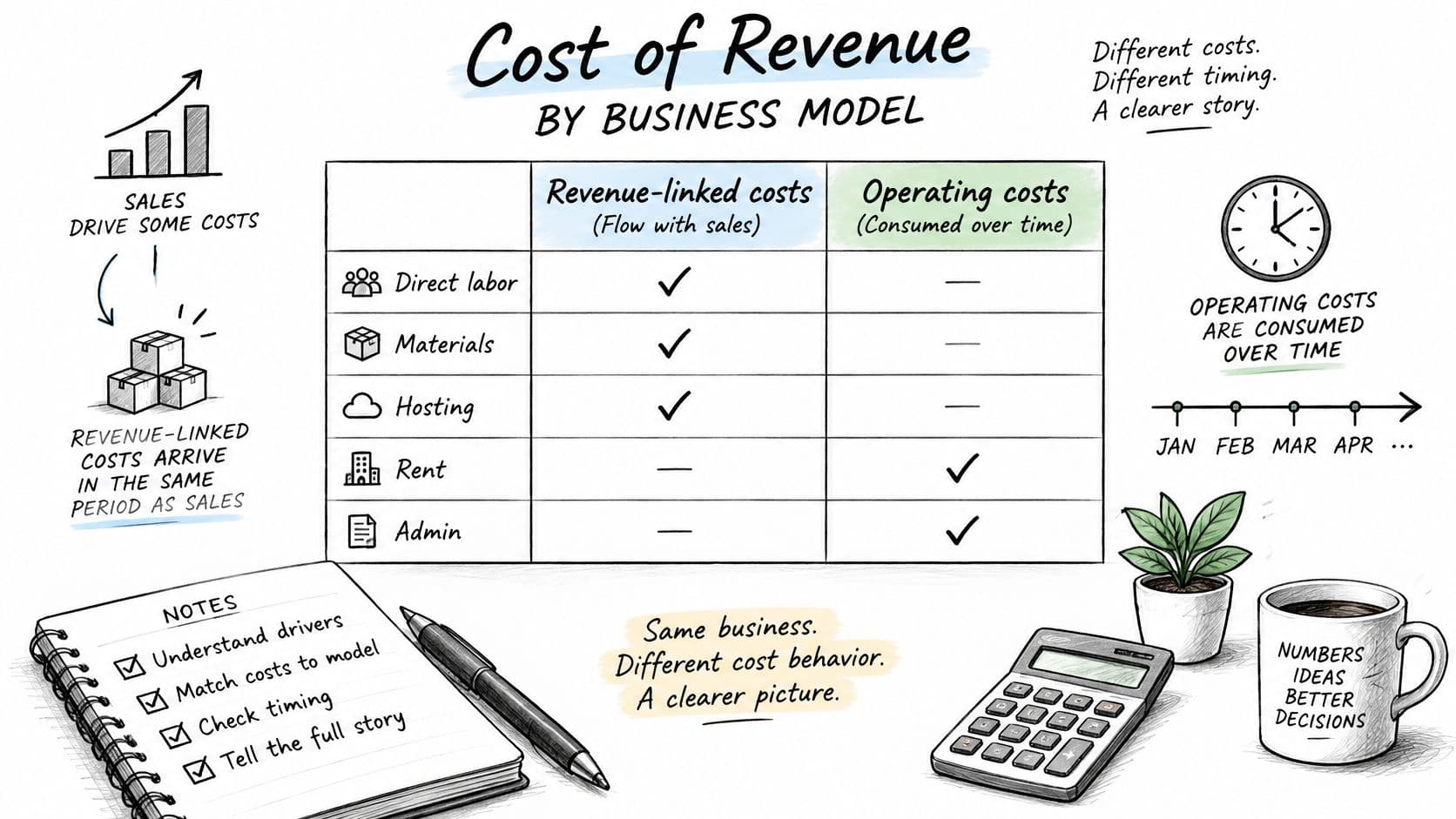
Costs tied directly to revenue are recognized when that revenue is recognized. Other operating costs are expensed when you consume the benefit. That is the FASB conceptual framework.pdf) rule, and it is the whole point of separating cost of goods sold from operating expenses, asset purchases, and liabilities.
What belongs above gross profit
SaaS. Cost of revenue is hosting, third-party model or API usage, and the support staff who serve paying customers. Product marketing, the sales team, and the internal wiki tool stay in operating expenses.
Agencies. Salaries and freelancers working on client deliverables sit in cost of revenue. Account management and business development do not.
E-commerce. Product cost, inbound freight, packaging, and fulfillment sit in cost of revenue. Brand ads and the Shopify app stack generally do not.
Take a SaaS company with $400,000 of annual revenue, $48,000 of hosting, and $60,000 of support salaries. Cost of revenue is $108,000. Gross profit is $292,000. Gross margin is 73%. If that margin falls under 60%, review delivery cost before you add growth spend. Hosting that scales with usage, or support headcount that scaled with a launch, will show up here before it shows up in cash.
The same logic is what a clean cost of goods sold calculation forces you to write down. Each transaction also needs department, customer or project, product line, location, and a recurring versus one-time flag so the management report ties to the ledger.
Practical rule: If you cannot name the customer, product, or delivery task a cost serves, it does not belong in cost of revenue.
Prepaid expenses, capitalized software, accounts payable, and accrued liabilities stay off the expense list until the period that consumes them. Expensing a prepaid contract on the day you pay it inflates this month's cost and flatters the next eleven.
Payroll, Contractors and Benefits Split
Payroll is not one line, and "overhead" is not an analysis. The Bureau of Labor Statistics treats labor cost and unit labor cost as core measures of how business costs move. Unit labor cost is the labor input required to produce one unit of output, nominal labor cost divided by real output. On your books, that means loaded cost divided by billable or delivered output.
Split labor into five lines.
- Gross wages: the salary or hourly pay on the offer.
- Employer payroll taxes: Social Security, Medicare, and state unemployment from the payroll-provider report.
- Benefits: health, retirement match, and stipends you pay.
- Bonuses and commissions: variable pay, coded apart from base.
- Contractor payments: 1099 work, never buried in wages.
A $90,000 salary carries employer Social Security and Medicare of 7.65%, which is $6,885. Add benefits at 12%, or $10,800. Fully loaded cost is $107,685, about 20% above the salary. State unemployment and other payroll taxes differ by state. Add them from Gusto, Rippling, or whichever provider files the returns. Do not estimate them in a spreadsheet and call it done.
The efficiency test
An agency designer at that $107,685 loaded cost who bills 1,400 hours costs $76.92 per billable hour. Rising payroll is not automatically bad if billable output grows faster. Flat payroll still hurts margin if billable hours fall. That is the same unit-labor idea, applied to one role instead of an industry index.
Teams that want a standing view of rate, utilization, and loaded cost can manage labor costs with AnchOps alongside the general ledger, then bring the result back to the five lines above.
This quarter, calculate loaded cost and billable or delivered hours for each role. If you only have one payroll total, you cannot tell compensation pressure from an idle bench.
Operating Expenses That Quietly Grow
Software creep is the largest hidden operating cost in a SaaS or agency stack. Say you pay for 42 tools and 9 of them have no user. At $85 a month each, that is $765 a month, or $9,180 a year, for no output.
Build a subscription register before you touch anything else. Columns are vendor, owner, seat count, renewal date, and whether the cost is discretionary. Cancel or downgrade anything without a named owner before the renewal date, not after the receipt hits the close.
The other lines that grow without a decision
Sales and marketing covers paid ads, agency retainers, and commissions. Incremental costs of obtaining a contract, including many sales commissions under ASC 340-40, may be capitalized and amortized over the expected customer life. Confirm that treatment against each contract with your accountant. Expensing every commission on the close date makes a strong sales month look like a weak one.
Occupancy is the $6,000 monthly lease plus utilities and coworking days. The check is whether the space is used. Before you sign or renew, understanding the office leasing process keeps the commitment matched to headcount, not to a floor plan you liked last year.
General and administrative covers insurance renewals, bank fees, and travel. The check is an approval threshold, not a longer category list. A practical map of these lines sits in what SG&A includes.
Every recurring operating expense needs a named owner and a review date on the calendar before the next renewal. No owner means the charge is a candidate to cut.
Depreciation, Prepaids and Capitalized Costs
A cost can be deductible for tax and still belong on the balance sheet. The IRS Publication 463 standard is not "business-related." A deductible expense generally must be ordinary (common and accepted in the trade) and necessary (helpful and appropriate), and it cannot be lavish or extravagant under the circumstances. The reporting question is different. Does the benefit extend past the current period?
If it does, you do not dump the whole amount into this month's list of company expenses.
- A purchase that lasts several years is a fixed asset and is depreciated.
- Internal-use software is capitalized and then amortized.
- A prepaid annual subscription is a prepaid asset and is expensed monthly.
A $12,000 annual software contract paid in January is $1,000 of expense each month. The unexpired balance stays a prepaid asset until you use it. Booking all $12,000 in January understates profit now and overstates it later.
What a $15,000 purchase costs you each year
| Asset or Cost | Typical Life or Term | Treatment |
|---|---|---|
| Laptops and servers | 3 to 5 years | Fixed asset, straight-line depreciation, about $3,000 to $5,000 a year |
| Office furniture | 7 years | Fixed asset, straight-line depreciation, about $2,143 a year |
| Internal-use software | 3 years | Capitalized, then amortized, $5,000 a year |
| Annual software prepayment | 12 months | Prepaid asset, expensed monthly, about $1,250 a month |
| Leasehold improvements | Remaining lease term, for example 5 years | Fixed asset, amortized over the shorter of life or lease, $3,000 a year |
Set a written capitalization threshold, for example $2,500 per item, and apply it to every purchase. A longer category list increases risk when it pushes you to expense everything. The aim is a defensible class, not a longer chart. Section 179 or bonus depreciation can accelerate the tax deduction. That is a decision for your tax advisor, and it does not change the book treatment.
Set the threshold this month. Tag every asset purchase above it, and stop expensing those items in full on the card statement.
Classifying Mixed-Use and Borderline Spending
More categories do not mean better records. They mean more places to hide a personal day, a gift over the limit, or a contractor with no contract. Defensible classification beats a 40-line chart you cannot explain.
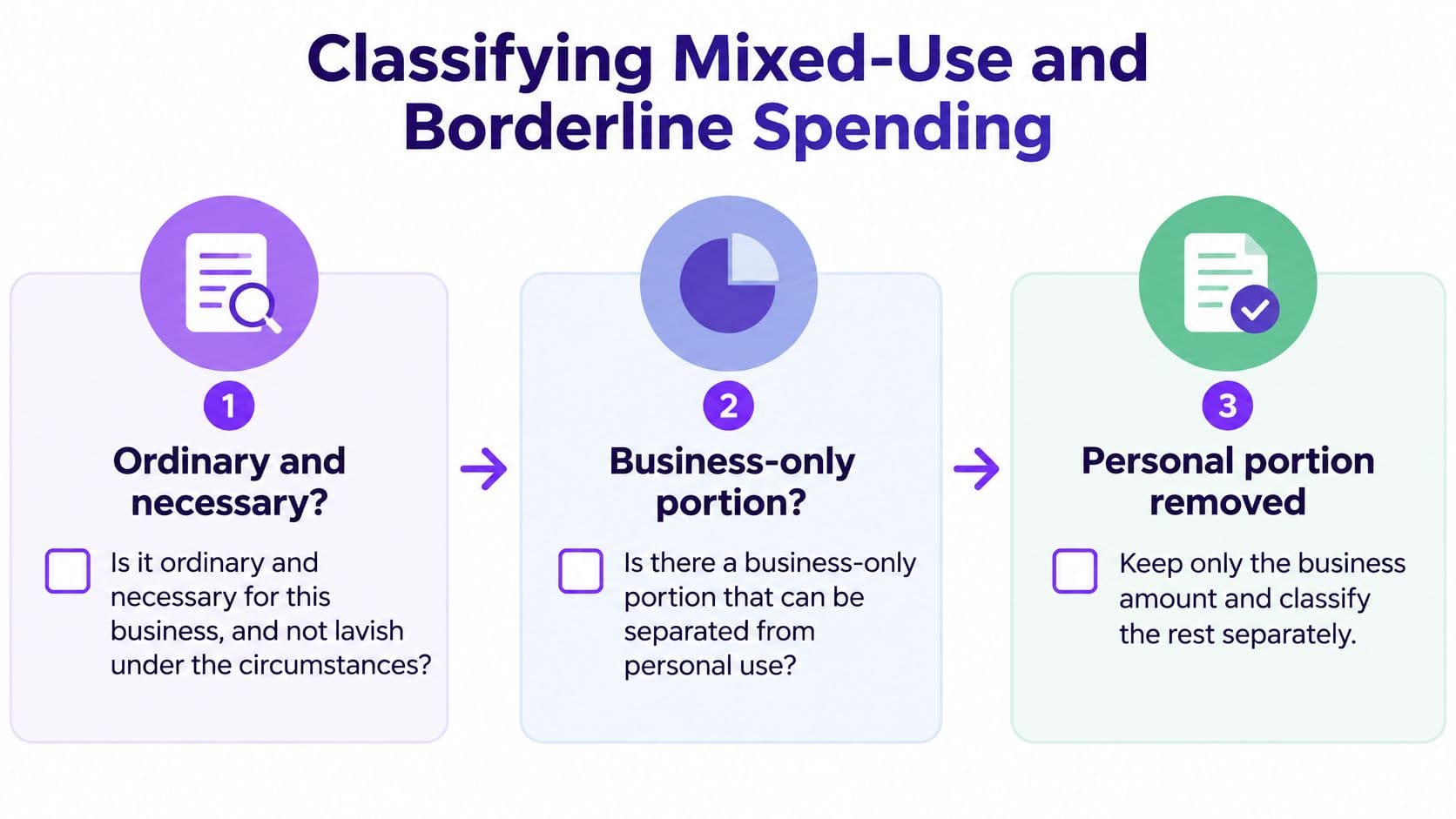
Apply this order to any unclear charge.
- Ordinary and necessary? Is it common in your trade, helpful for this business, and not lavish under the circumstances?
- Business-only portion? Split out personal days, personal miles, or home use before you code anything.
- Which account and department? Put the business portion on one statement line and one owner.
- What evidence proves it? Attach it the same day, not at close.
The IRS recordkeeping guidance says a deductible business expense is both ordinary and necessary, and the register should show the payee, amount, date, payment evidence, and a description of business purpose. Support can be an invoice, receipt, account statement, card record, canceled check, or electronic-transfer record. Travel needs dates, destination, and purpose. Track non-entertainment meals on their own line. You choose the system, as long as it shows income and expenses and you keep the documents.
How five messy charges actually land
| Scenario | Deductible Portion | Accounting Treatment | Evidence to Keep |
|---|---|---|---|
| Founder trip with two personal days | Business days only | Travel expense, split by days | Itinerary and business purpose memo |
| Client dinner | Business meals limited to 50% | Meals and entertainment account | Attendee names and business topic |
| Home office internet | Business-use percentage only | Shared expense allocated by usage | Usage method and monthly bill |
| Contractor paid on invoice | Full amount if genuinely a contractor | Contract labor, cost of revenue or operating expense | Invoice, signed contract and W-9 |
| Customer gift | Up to $25 per recipient per year | Marketing or gifts account | Recipient name and business reason |
A three-way review is transaction, document, and approval. That is what keeps QuickBooks, Xero, NetSuite, the card platform, payroll, and accounts payable telling the same story. Duplicate charges and personal spend fail that review fast.
Write a one-page classification policy this week. Name an approver for each category. Require a business-purpose memo for anything ambiguous. If the memo is hard to write, the charge probably does not belong on the company card.
Cash Behavior and the Metrics Each Expense Drives
Sorting costs by cash behavior matters more this year than adding another category. Chase found that about 55% of surveyed U.S. businesses saw total expense increases of at least 5%, including 24% with increases of 6% to 10% and 16% with increases of 11% to 15%. A static checklist does not tell you which of those increases you can stop.
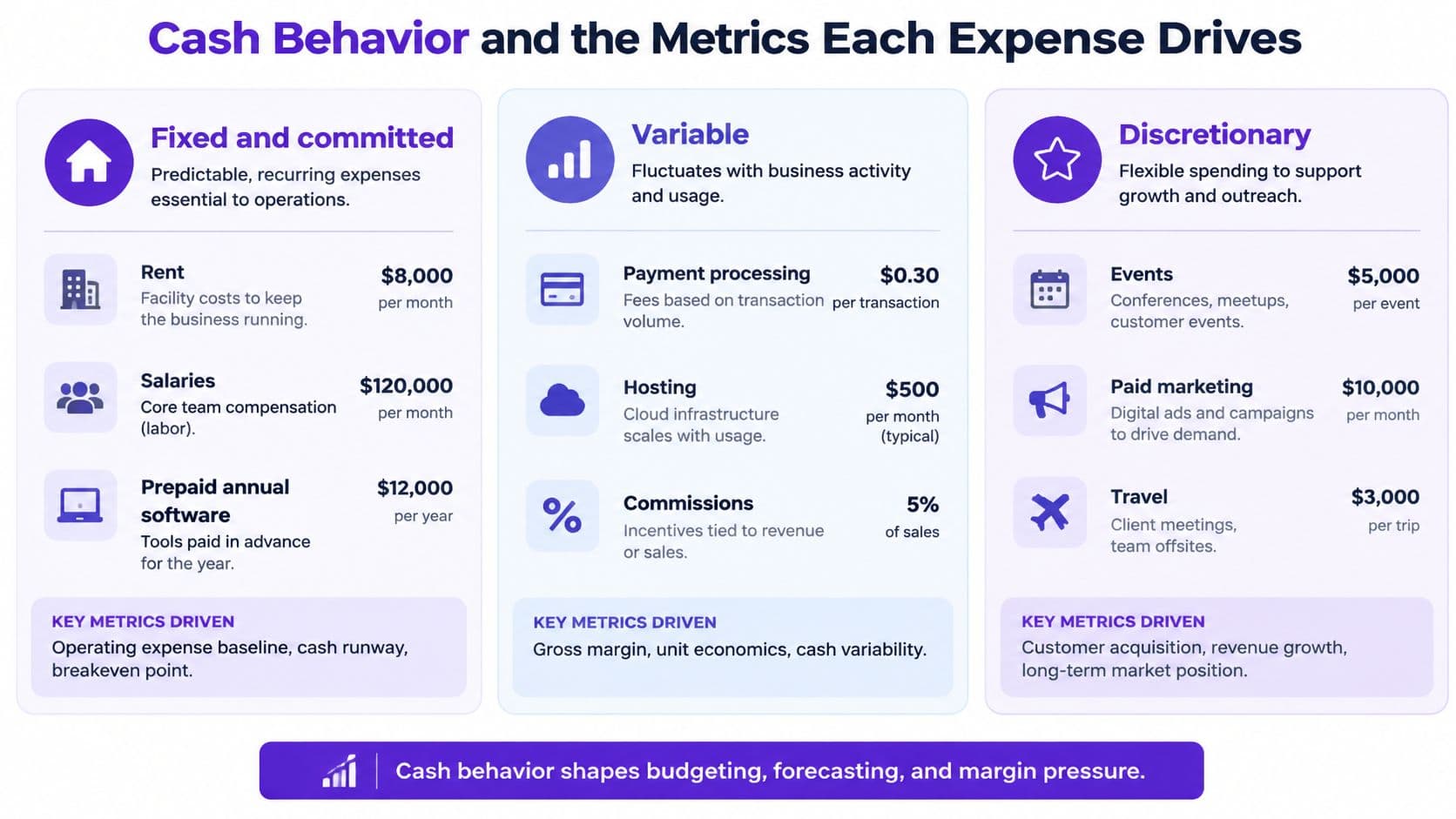
Put every category into one of three behaviors.
- Fixed and committed: rent, salaries, prepaid annual software.
- Variable: payment processing, hosting, commissions.
- Discretionary: events, paid campaigns, training, and most travel.
The profit swing in one slow month
Monthly revenue is $100,000. Variable costs run at 20% of revenue, so $20,000. Fixed costs are $70,000. Profit is $10,000.
Revenue drops 15% to $85,000. Variable costs fall to $17,000. Profit becomes negative $2,000. You did not add a single new bill. The fixed layer did not shrink.
Cut $8,000 of discretionary marketing and profit returns to $6,000. That is why discretionary spend is cut before service-capacity costs. Cutting the support team or the host that delivers the product saves cash and also cuts the revenue you are trying to protect. Separate 2026 survey reporting in that same Chase note found 34% of small businesses hit by rising supply costs, 34% that reduced expenses during 2025, and 63% that expected to seek more capital by early 2026. Runway is a timing problem, not a missing-category problem.
| Expense Category | Cash Behavior | Metric It Moves | First Lever |
|---|---|---|---|
| Cost of revenue, hosting and delivery labor | Variable with volume | Gross margin | Usage limits and vendor rate reviews |
| Payment processing and commissions | Variable with sales | Gross margin and CAC payback | Renegotiate rates and tie commissions to collected revenue |
| Salaries and rent | Fixed and committed | Operating margin and runway | Hiring plan and lease timing |
| Prepaid annual software | Committed, paid upfront | Runway | Renewal review before auto-renewal |
| Paid campaigns and events | Discretionary | CAC payback and operating margin | Pause first |
| Training and travel | Discretionary | Operating margin | Approval threshold |
Cost of revenue moves gross margin. Sales and marketing moves CAC payback. The fixed layer moves operating margin and months of runway. Read those three against operating cash flow, not against the bank balance alone.
Build a rolling 13-week cash forecast and scenario-test payroll, hosting, contractors, and marketing. Protect revenue-generating and compliance-critical spend. Trim discretionary items first.
Red Flags and the One-Week Expense Map Check
The most common flag is the same vendor coded to two categories in one quarter. Fix it with one account rule for that vendor, then reclass the quarter so the trend is real.
Work the rest of the list the same way. Each flag has one fix.
- Suspense or miscellaneous above 5% of monthly spend. Assign an owner and clear it before close.
- Subscriptions with no owner or renewal date. Build the register and cancel what nobody owns.
- Contractors paid with no W-9 or signed contract. Stop the next payment until both exist.
- Payroll taxes and benefits buried in salaries. Split them onto their own lines.
- Cost of revenue equal to total expenses. Operating expenses were never mapped. Rebuild the statement layers.
- Assets expensed above your capitalization threshold. Reclassify and depreciate or amortize.
- Personal charges on company cards. Move them to owner draws or shareholder distributions. Do not "reclass to meals" and hope.
Founders who still run the books themselves can start with keeping track of solo business costs, then hand a clean export to the close. Close, reporting, review points, and owner responsibilities should be explicit before the monthly cadence starts.
The five-day pass
- Export the last 90 days from every bank, card, and payroll account.
- Tag each transaction to one row of the category table, then to a statement layer.
- Assign an owner and a renewal date to every recurring vendor.
- Set the capitalization threshold and reclassify anything above it.
- Recalculate quarterly gross margin using only cost of revenue, and compare it with the model you use for your business type.
Every flag gets an owner and a date. An unowned flag is still open.
Run the free three-question Finance Ops Scorecard today. It names your likely first finance break, and no email is required. If you want the full review, the Finance Ops Diagnostic is a $3,500 fixed-fee project delivered in 5 business days. Complimentary ROI assessments show whether controller support pays for itself before you commit to a monthly retainer. Fixed-fee work is also available for accounts-payable setup, cash-flow optimization, and books cleanup when the ledger is the thing in the way.
Jumpstart Partners runs controller-led close, reporting, and margin review for SaaS, agencies, and other companies in the $500K to $20M range, so the list of company expenses you just mapped becomes a monthly operating view instead of a one-time cleanup. Engagements are CPA-led, and monthly finance help starts from $2,500 per month after scope is confirmed. If you want that classification held through the close, visit Jumpstart Partners.