Financial Operations
Month End Close QuickBooks: The 5-Day System That Works
Month End Close QuickBooks. Run a fast, accurate month end close in QuickBooks. Includes the exact 5-day workflow, reconciliation checklist, and common fixes
ByJumpstart Partners, CPA, QuickBooks ProAdvisor
··17 min readA five-day month-end close isn't an abstract finance ideal. APQC benchmarking based on more than 10,000 organizations found that top-performing companies complete consolidated financial statements in 5 days or less, while the median performer takes 6 days (QuickBooks' month-end close guidance). For a $500K to $20M SaaS, agency, or professional services business, the difference between finalized numbers and provisional numbers affects hiring, cash decisions, board reporting, and revenue accountability.
QuickBooks can support that pace. It won't do it by itself, and it won't compensate for unclear ownership, spreadsheet-heavy revenue schedules, or late journal entries. The close has to run as a controlled operating process, with routine work completed early and judgment reserved for the exceptions that need a controller.
Table of Contents
- What a Slow QuickBooks Close Actually Costs
- The Five-Day QuickBooks Close Workflow
- Reconciliation and Tie-Out Checks That Catch Errors
- How the Close Breaks for SaaS Agencies and E-Commerce
- In-House Versus Outsourced Controller on a QuickBooks Close
- Red Flags and Common QuickBooks Close Errors
- Your 30-Day Plan to a Faster Closer
What a Slow QuickBooks Close Actually Costs
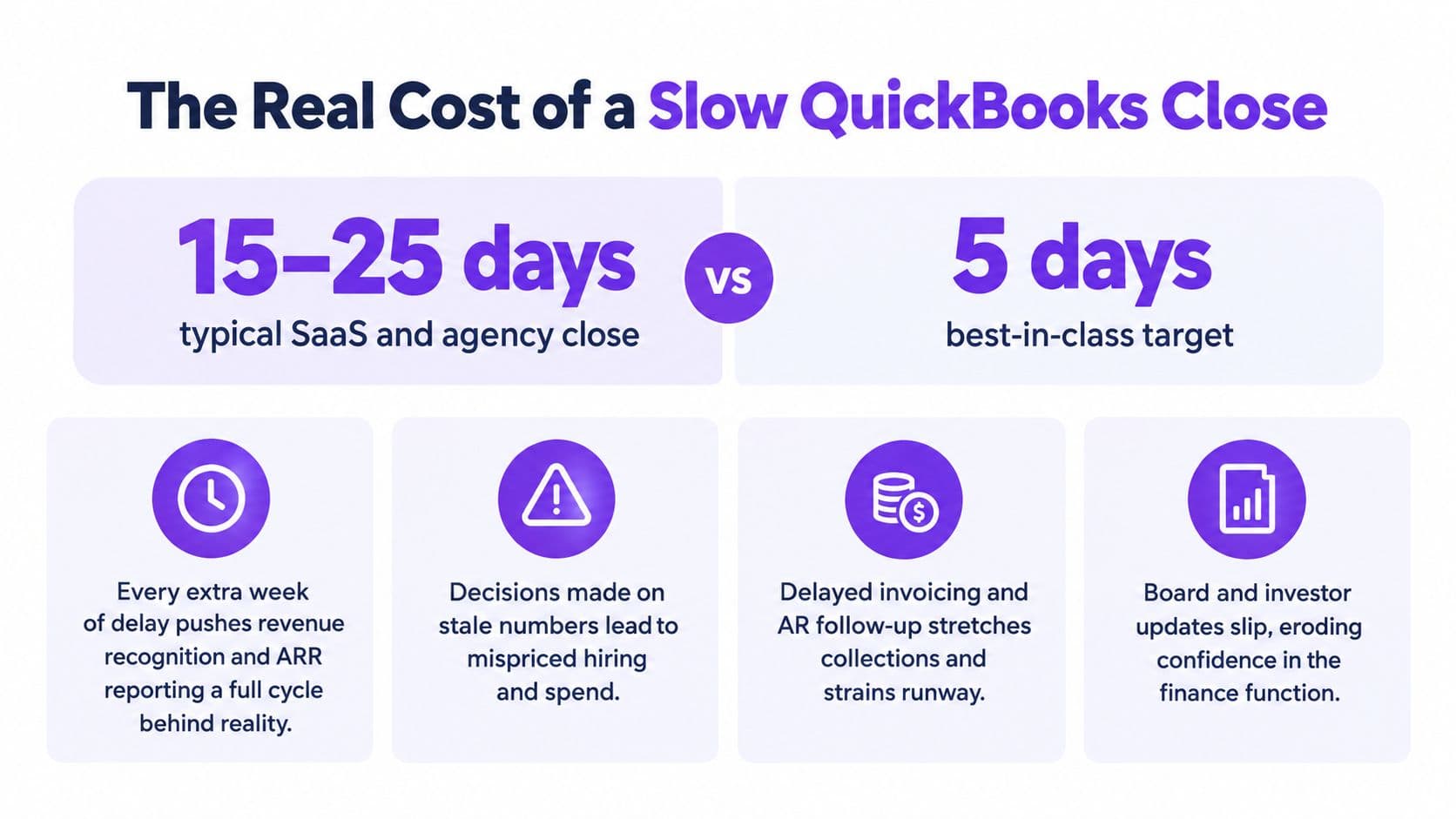
A slow close creates a reporting gap between what the business is doing and what leadership can prove. Growing SaaS and agency teams may describe a 15 to 25 day close as normal, but normal is not the same as acceptable. A March board package that arrives on April 20 can miss the hiring, pricing, and spending decisions made earlier in April.
The cost is operational, not cosmetic. Until the prior period is supported, revenue, expenses, cash flow, and balance-sheet positions remain provisional. Leadership may approve hiring from an overstated cash view, delay collections because receivables are incomplete, or question a margin change that came from a late journal entry rather than business performance.
Where the delay shows up
Three costs appear repeatedly in practice:
- Investor and board reporting slips. The board package arrives after the discussion has moved to the next period. Leadership spends its time explaining changed numbers instead of deciding what to do.
- Revenue anomalies stay hidden. A missed Stripe payout, incorrect contract schedule, or unusual refund can remain unresolved while management relies on an incomplete ARR or margin view.
- Adjustments compound. A misclassified expense or unreconciled liability affects later reporting, creates more journal entries, and weakens the audit trail when someone investigates it.
A delayed close also pushes collections and cash forecasting behind reality. The remedy is controlled ownership. Days 1 through 3 should absorb routine reconciliation and data collection, while Days 4 and 5 handle review, variance analysis, approval, and period protection. QuickBooks can hold the ledger, but it cannot decide who owns an exception or whether a revenue schedule has adequate evidence.
Controller's rule: A five-day close is a workflow design problem, not a late-night effort problem.
The cost of accounting inefficiency becomes visible when finance staff spend the first half of the month reconstructing activity that should have been captured during the close window. For recurring SaaS billing, processor settlements, and agency project work, the process needs deadlines, named owners, supporting evidence, and escalation rules. Once exceptions outnumber routine entries, move the work into an orchestrated workflow around QuickBooks rather than forcing the ledger to manage the entire close.
The Five-Day QuickBooks Close Workflow
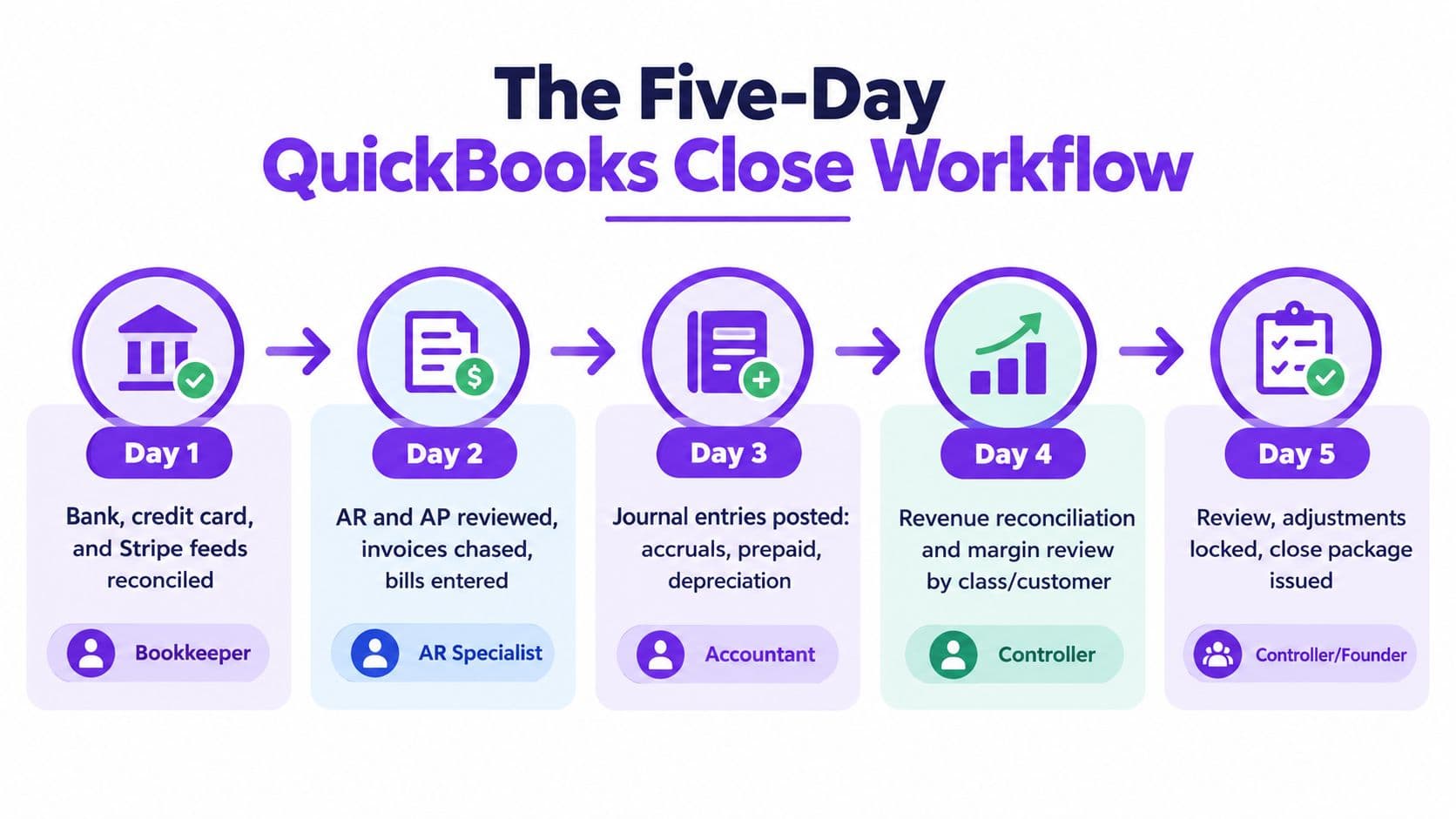
A reliable month end close in QuickBooks uses parallel work streams. The bookkeeper shouldn't wait for the controller to finish reviewing the trial balance before reconciling routine accounts. The controller should receive completed work with exceptions clearly marked, not a folder of unexplained balances.
Day 1 belongs to transaction completeness
The bookkeeper reconciles bank accounts, credit cards, and Stripe feeds against the relevant statements and processor records. The objective isn't just to make the reconciliation screen show zero. It's to confirm that transactions are present, dated correctly, categorized consistently, and supported by the right source.
Use QuickBooks Reconciliation Reports to preserve the detail behind each reconciliation. Review unmatched feed items immediately, because a missing payout or duplicate transaction will distort several later checks. The bookkeeper owns execution. The controller only needs to intervene when the exception affects cutoff, classification, or a material balance.
Day 2 focuses on receivables and revenue timing
The AR specialist reviews the AR aging, identifies invoices that need collection follow-up, and pushes overdue items into the collections process. The same owner updates deferred revenue schedules and confirms that invoices align with service periods.
QuickBooks Recurring Transactions can prepare routine invoices and entries, but they don't replace review of contract terms. SaaS contracts, annual retainers, and usage-based arrangements still require a person to confirm that billing and recognition follow the accounting policy.
For a recurring external reference, the Allied Tax Advisors monthly checklist offers a practical list of routine bookkeeping activities that can support this preparation.
Day 3 clears operating liabilities
The accountant runs the AP process, enters outstanding bills, reconciles vendor statements, posts prepaid amortization, and reviews fixed-asset depreciation. QuickBooks' own closing checklist emphasizes that the close includes pending invoices and payments, vendor statements, loans, accrued expenses, deferred revenue, and equipment, not only bank-feed activity (QuickBooks' month-end close checklist).
Use Workflow Rules or equivalent approval controls for journal and bill review. Routine entries can move quickly, but unusual accruals should route to the controller with documentation attached before posting.
Day 4 is judgment and review
The controller reviews accruals, the payroll tie-out, intercompany eliminations, and the trial balance. This is also the right day for revenue reconciliation and margin review by class, customer, or service line.
The controller owns judgment. A bookkeeper can prepare a payroll reconciliation or recurring entry, but shouldn't decide whether a contract liability is recognized, whether an unusual cost belongs in the current period, or whether an intercompany balance requires elimination.
A five-day close should feel like exception review, not transaction hunting. The QuickBooks month-end close automation guide is useful when recurring work has outgrown manual task assignment.
Day 5 locks the result
The controller performs flux analysis, documents material movements, signs off on the close package, and distributes management or board reporting. Once entries, reconciliations, and adjustments are complete, set the closing date and password in QuickBooks. Intuit explains that transactions dated on or before the closing date trigger a warning when someone attempts to change them, which protects the integrity of the finalized period (Rand Group's month-end close benchmarks and controls).
The close isn't finished when the trial balance balances. It's finished when the numbers are reviewed, supported, approved, communicated, and protected.
Reconciliation and Tie-Out Checks That Catch Errors
Reconciliations prove that the general ledger agrees with an external record or subledger. Tie-outs prove that related accounting systems agree with each other. Both are necessary, and each needs an owner, a frequency, and a defined variance threshold.
Start with bank and credit-card accounts. Match the QuickBooks balance to the statement using the Reconciliation Detail report, then investigate any discrepancy older than three days. A difference can represent a timing issue, but an unexplained old difference is a control failure.
AR requires a stricter test. The AR aging total should match the balance-sheet Accounts Receivable control account with a zero tolerance. If it doesn't, inspect unapplied cash, credit memos, duplicate invoices, and entries posted directly to the control account. QuickBooks guidance also stresses that AP aging should tie to the balance-sheet AP account and payroll month-to-date earnings should tie to gross wages expense (QuickBooks' Desktop close and report guidance).
Worked deferred revenue example
Assume a $120,000 annual contract billed upfront. Monthly straight-line recognition is:
$120,000 ÷ 12 months = $10,000 recognized per month
If the opening deferred revenue balance is $120,000 and the month includes no new billing, the rollforward is:
$120,000 opening balance + $0 billings − $10,000 recognized revenue = $110,000 ending deferred revenue
If you post $9,000 or $11,000 instead, the schedule doesn't tie. The controller should resolve that variance before closing, not bury it in a general revenue adjustment.
Stripe and other payment processors require a separate payout tie-out. Match gross charges, fees, refunds, reserves, and payouts to deposits. A payout can arrive after the sale date, so the reconciliation needs to distinguish timing from missing activity. Payroll works the same way. Tie the payroll register to Payroll Clearing, then confirm gross pay, taxes, and employer contributions clear by the fifth business day.
| Account | Source Document | Owner | Variance Threshold |
|---|---|---|---|
| Bank and credit card | Statement and Reconciliation Detail report | Bookkeeper | Investigate discrepancies older than three days |
| Accounts receivable | AR aging and balance sheet | AR specialist | Zero |
| Accounts payable | AP aging, vendor statements, and balance sheet | AP specialist | Zero |
| Deferred revenue | Contract schedule and billing report | Accountant | Zero against the rollforward |
| Stripe or processor clearing | Processor payout report and bank deposit | Accountant | Explain every timing difference |
| Payroll clearing | Payroll register and payroll liability reports | Accountant | Clear by the fifth business day |
The QuickBooks Online bank reconciliation process is a useful reference for standardizing the bank portion, but your close policy still needs to define who investigates exceptions and when escalation occurs.
How the Close Breaks for SaaS Agencies and E-Commerce
QuickBooks records the ledger. It doesn't automatically understand every commercial event that created the ledger entry. That distinction becomes critical when revenue, fulfillment, or cash settlement happens in systems outside QuickBooks.
SaaS businesses
SaaS finance teams need to separate deferred revenue, contract liabilities, and recognized MRR. An invoice date isn't the same as the service period. Annual contracts, multi-year deals, upgrades, cancellations, and usage-based billing require schedules that explain why the recognized amount belongs in the period.
Stripe, Chargebee, and Recurly integrations can simplify data transfer, but a native connection doesn't guarantee a complete revenue tie-out. Some workflows post net revenue or summarized activity, leaving finance to reconcile gross billings, refunds, fees, taxes, and deferred revenue outside the general ledger. ASC 606 review therefore belongs in the close governance model, not as an afterthought.
Agencies and professional services firms
Agencies have a different problem. Retainer billing can happen before delivery, while project work can be delivered before invoicing. You need to reconcile project tracking data, work in progress, unbilled receivables, and the AR aging.
A clean close asks whether delivered work has been billed, whether billed retainers remain deferred, and whether project costs are assigned to the right client or class. QuickBooks won't infer that from a bank feed. Someone with access to project and contract data has to own the reconciliation.
E-commerce businesses
Shopify and Amazon settlements introduce gross-to-net complexity. Your close has to account for marketplace fees, refunds, chargebacks, sales tax, inventory movement, multi-currency payouts, and the date funds reach the bank. Inventory systems such as SOS Inventory may supply the COGS and stock data, but the controller still has to tie that data to the QuickBooks accounts.
Three areas repeatedly need explicit controls:
- Merchant fees: QuickBooks won't enforce whether processor fees are classified consistently across channels.
- Sales tax payable: The software won't ensure every marketplace liability clears to the correct tax account.
- Refunds: QuickBooks won't decide whether a refund is treated as contra-revenue, an expense, or a reduction of a specific transaction stream.
| Business Model | Top Break Points | Required Tie-Out | QuickBooks Limitation |
|---|---|---|---|
| SaaS | Contract timing, deferred revenue, processor summaries | Billing, contract schedule, recognized revenue, and GL | Doesn't enforce ASC 606 schedules |
| Agency | Retainers, WIP, unbilled work, delivery timing | Project system, unbilled AR, invoices, and aging | Doesn't know whether work has been delivered |
| E-commerce | Settlements, fees, refunds, tax, inventory | Platform reports, processor payouts, inventory, and deposits | Doesn't determine correct gross-to-net treatment |
A specialist controller earns value here. If the supporting systems don't reconcile, no amount of QuickBooks cleanup alone will produce a defensible close. Businesses deciding whether to clean up QuickBooks should map these non-GL systems before rebuilding the chart of accounts.
In-House Versus Outsourced Controller on a QuickBooks Close
The choice isn't just between hiring someone and buying a service. It's a choice between a person executing tasks and a finance function owning the close calendar, review standard, and reporting package.
An in-house bookkeeper can handle routine transaction processing efficiently when the chart of accounts is stable and the business model is simple. The risk appears when the same person is expected to interpret revenue schedules, review unusual accruals, explain flux, prepare audit support, and maintain process documentation without senior review.
| Dimension | In-House Bookkeeper | Outsourced Controller | Verdict |
|---|---|---|---|
| Cost | Salary, software, training, benefits, and review time | Flat monthly fee, usually with defined scope | Compare total operating cost, not hourly pay alone |
| Speed | Often a 10 to 15 day close when tasks depend on one person | A coordinated workflow can target 5 days | Outsourcing wins when deadlines are fixed |
| Accuracy | Depends heavily on one operator's experience and review access | Adds controller review and standardized tie-outs | External review reduces single-person dependency |
| Audit readiness | Documentation often gets added after the close | Support schedules and approvals can be built into the process | Outsourcing is stronger when an audit or review is approaching |
The appropriate model depends on transaction volume, business complexity, and reporting cadence. A founder with straightforward activity may not need controller-level outsourcing. A SaaS company managing contract schedules, or an agency with substantial WIP, needs more than reconciled bank feeds.
The inflection point often appears around $1.5M to $5M in revenue, 500 to 2,000 monthly transactions, or the first audit. Those figures are operating decision criteria, not universal rules. At that stage, fractional controller services can provide review and governance without requiring a full internal controller structure.
Red Flags and Common QuickBooks Close Errors
A balanced trial balance doesn't prove that the close is healthy. It only proves that debits equal credits. A reliable close leaves evidence showing what was reviewed, who approved it, and why exceptions were resolved.
Run this self-audit in QuickBooks:
| Error | Detection screen or report | One-line fix |
|---|---|---|
| Recurring journal entries post after the period lock | Recurring Transactions and Audit Log | Assign an owner, review the template, and restrict posting dates |
| Credit-card payments are misclassified as expenses | Credit Card account register and Profit and Loss | Reclassify the payment as a transfer to the card liability |
| Sales tax posts to the wrong liability account | Sales Tax Liability report | Map the tax agency and clearing account correctly |
| Opening Balance Equity remains uncleared | Balance Sheet and account register | Trace the original setup entries and reclassify them to the proper equity account |
| Undeposited Funds carries forward without support | Undeposited Funds register and Deposit Detail | Match receipts to deposits and clear only supported items |
| Bank reconciliation differences age without resolution | Reconciliation report and account register | Identify duplicates, omissions, or timing items and document the resolution |
| AR aging doesn't match the GL control account | AR Aging Summary and Balance Sheet | Investigate unapplied credits, direct postings, and duplicate invoices |
| 1099 vendor mapping is inconsistent | Vendor list and 1099 Transaction Detail | Correct vendor tax settings and re-run the mapping review |
Some warning signs deserve immediate escalation:
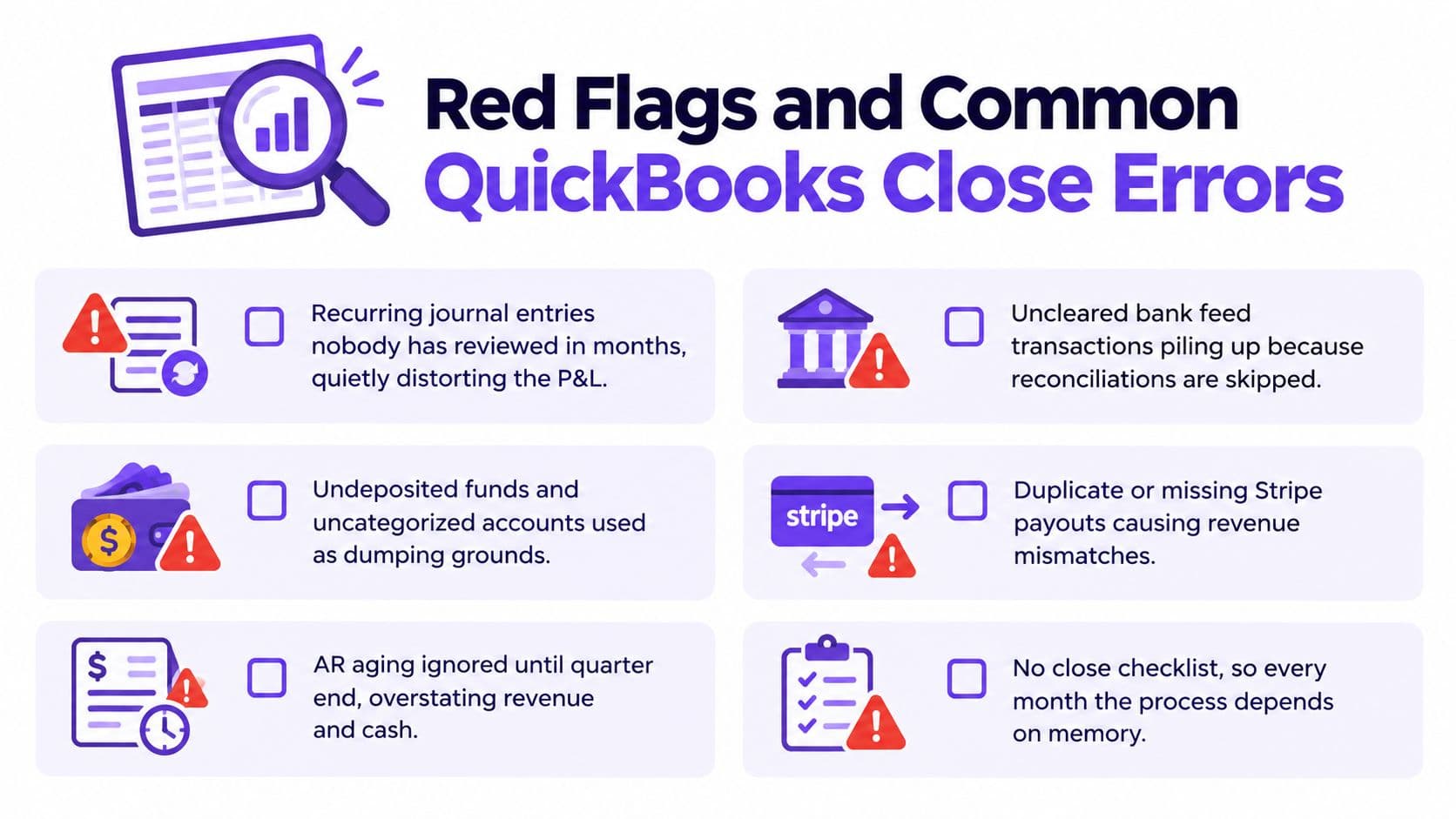
- Recurring entries appear after the closing date. That means your lock is being bypassed or the close owner isn't reviewing changes.
- Balance-sheet accounts never clear at year-end. A persistent balance may be valid, but an unexplained balance is not.
- Uncleared bank items accumulate. Old differences conceal missing or duplicated transactions.
- AR aging and the general ledger disagree. The business may be reporting revenue, cash, or collections from incompatible data.
The best control is a documented paper trail. Attach support to journal entries, retain reconciliation reports, record explanations for variances, and keep approval evidence with the close package. A close that only balances the trial balance is incomplete.
Your 30-Day Plan to a Faster Closer
Treat the close as a system upgrade. A sprint can get one month over the line, but it won't prevent the same bottleneck from returning. Your first month should produce a repeatable workflow, clear ownership, and a short list of constraints to remove.
Week 1 establishes control
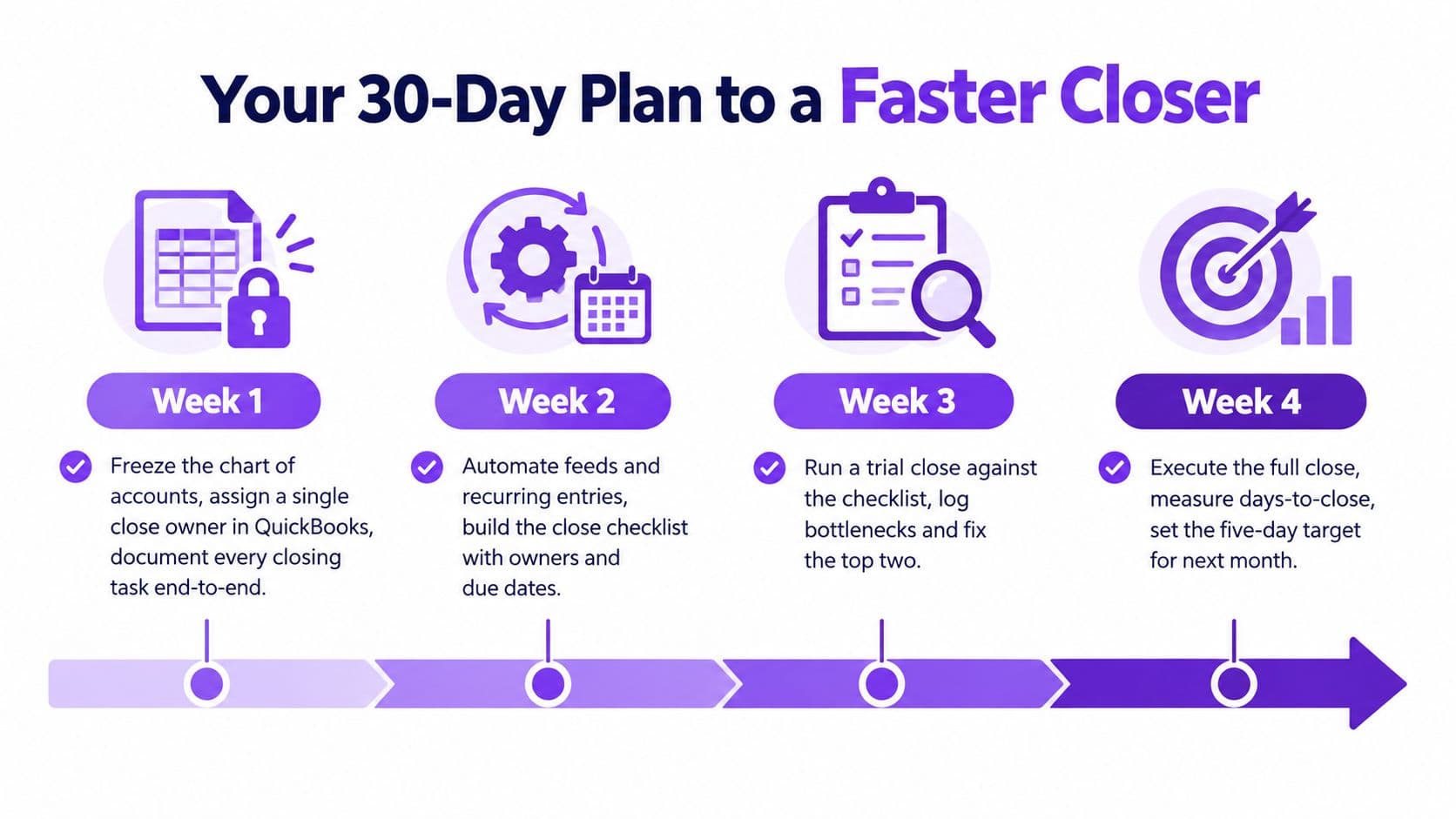
Freeze unnecessary chart-of-accounts changes. Assign one close owner in QuickBooks, then document every current task from source-data collection through final reporting. Record the owner, dependency, evidence, and actual time required. Don't optimize a process you haven't mapped.
Week 2 builds the operating template
Create saved reconciliation reports, review bank rules, and configure recurring entries. Build a close checklist with owners and due dates. Use QuickBooks Recurring Transactions for predictable activity, but route entries requiring judgment for approval rather than allowing automation to post them without review.
Week 3 tests automation safely
Automate the highest-volume work first, including bank-feed matching, recurring journal entries, deferred revenue amortization, and intercompany transfers. Run a parallel close against the existing process and compare balances, exceptions, and supporting schedules before retiring the old method.
Week 4 measures the bottleneck
Execute the full close, lock the prior month on Day 5, and compare actual completion time with the five-day target. Fix the top three causes of delay, whether they involve missing source data, approval queues, processor settlements, or spreadsheet schedules. Independent finance benchmark research reports that 59% of companies close within six business days and 46% within four business days, making a sub-six-business-day close a widely used target rather than an unusual result (ISG's faster-close benchmark research).
Book a five-day close consultation if your team needs a file-specific assessment. The right review should map your QuickBooks workflow, integrations, revenue model, team size, and approval points, then leave you with an executable calendar rather than another generic checklist.
Jumpstart Partners provides outsourced controller and bookkeeping support for SaaS, agencies, and other growing businesses using QuickBooks, with services covering reconciliations, revenue recognition, close checklists, and investor-ready reporting. Visit Jumpstart Partners to discuss a five-day close consultation customized to your QuickBooks file, business model, and finance team.