Financial Operations
Outsourced Accounts Payable Services: A 2026 Guide
Streamline your finances with outsourced accounts payable services. Discover how our 2026 guide helps growing businesses save time and reduce costs.
ByJumpstart Partners, CPA, QuickBooks ProAdvisor
··15 min readAt $2 to $6 per invoice for outsourced AP versus $10 to $30 for manual in-house handling, the economics are already brutal enough to force a decision for a growing business. The mistake founders make is treating accounts payable as a clerical task instead of a control system, because the cost of a bad process shows up later as late fees, vendor friction, duplicate payments, and a messy close. If you run a SaaS company, agency, or professional services firm in the $500K to $20M range, AP isn't a back-office nuisance. It's a cash-flow and governance problem you either own deliberately or outsource badly.
The market confirms that AP has moved from niche service to mainstream operating model. One independent report estimated the accounts payable outsourcing services market at USD 624.05 million in 2024, with a projection to USD 914.25 million by 2030 and a 6.47% CAGR; another forecast puts it at USD 6.85 billion in 2024 and USD 15.27 billion by 2030 with a 14.3% CAGR (GII Research market report). The gap between estimates comes from different definitions, but the direction is the same. AP outsourcing is growing because manual AP breaks under volume, complexity, and compliance pressure.
Table of Contents
- Why Outsourced Accounts Payable Services Matter Now
- What Outsourced Accounts Payable Services Cover
- Pricing Models and Real Cost Calculations
- Security Controls and Compliance Requirements
- How to Evaluate and Select an AP Outsourcing Provider
- Implementation Timeline and Onboarding Process
- Making the Decision and Next Steps
Why Outsourced Accounts Payable Services Matter Now
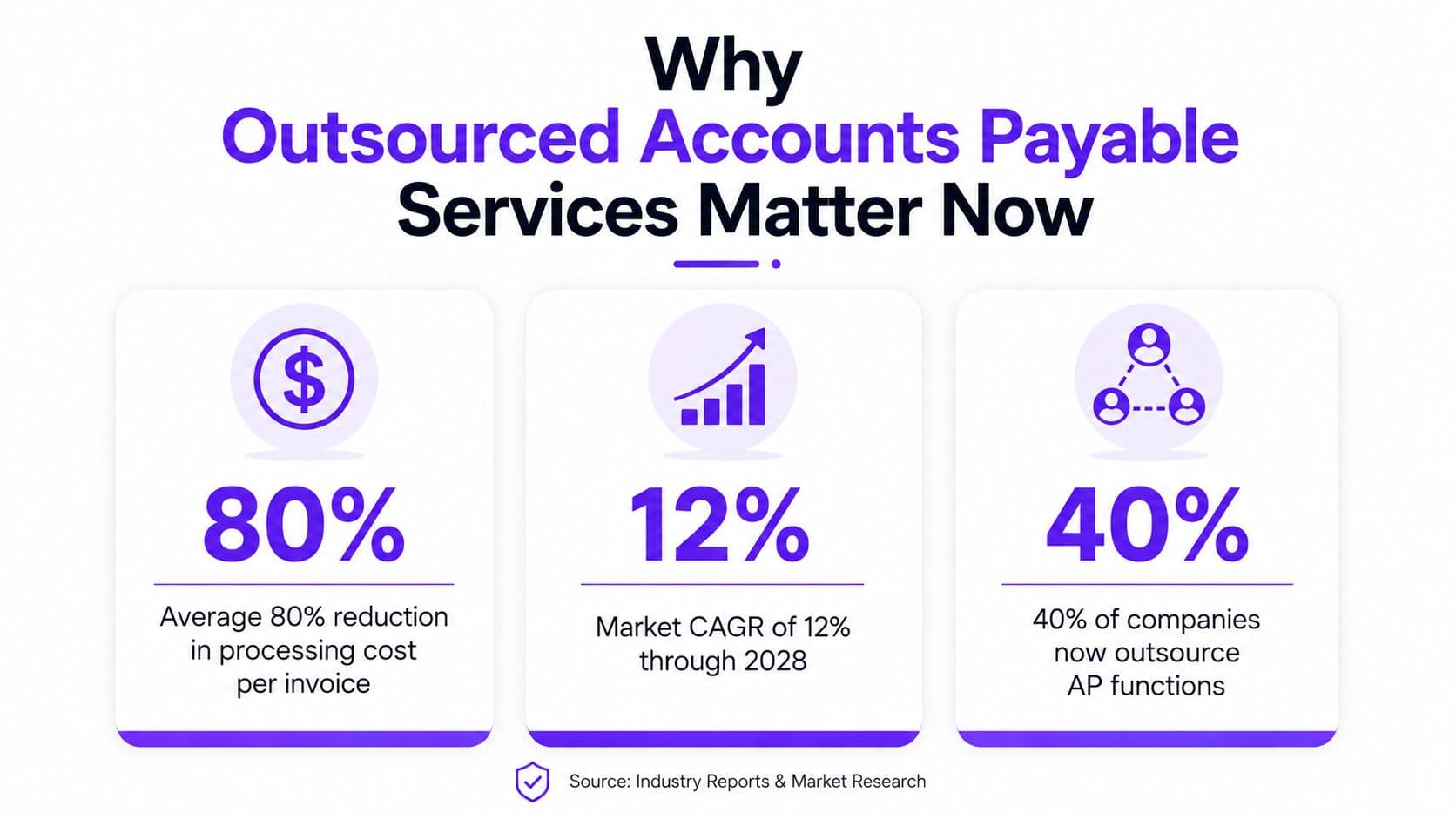
The strongest case for outsourced AP is not headcount reduction, it is lower cost per invoice and tighter control over a fragile workflow. Companies that outsource finance and accounting functions report average cost savings of 30% to 40% versus equivalent in-house operations, with AP and AR processing generating the largest savings (finance-and-accounting outsourcing analysis). That matters because AP is not just paying bills. It determines whether invoices move cleanly through intake, coding, approval, and payment without turning month-end into a fire drill.
AP has become a standard finance operating decision
A strong outsourced AP setup gives you a measured workflow instead of a pile of inbox chaos. The same research source notes that 54% of companies that outsource any finance work outsource accounts payable processing. AP is no longer an edge case. It is one of the default finance functions businesses hand off when they want consistency and savings.
For founders, the issue is control. AP gets harder to run internally as vendor counts rise, approvals multiply, and compliance tasks expand. If you run a digital agency or services firm, your finance team spends too much time chasing approvals and matching invoices instead of managing cash. If you are in SaaS, the pain shows up when vendor bills stack up during growth and the close slows down.
Practical rule: if AP is regularly causing vendor complaints or close delays, you do not have a staffing issue. You have a process design issue.
This also belongs in the cash discipline conversation. The contractor cash flow playbook shows how payment timing and receivables timing often collide in the same month. You cannot manage one side of working capital well while ignoring the other.
The broader outsourcing market reinforces the shift. Finance and accounting outsourcing reached USD 58.4 billion in 2025 and is projected to reach USD 78.9 billion by 2029. AP sits inside that move. It is part of how modern finance teams buy operating efficiency.
For a practical view of how AP fits into outsourced finance workflows, see the Jumpstart Partners finance and accounts outsourcing overview.
What Outsourced Accounts Payable Services Cover
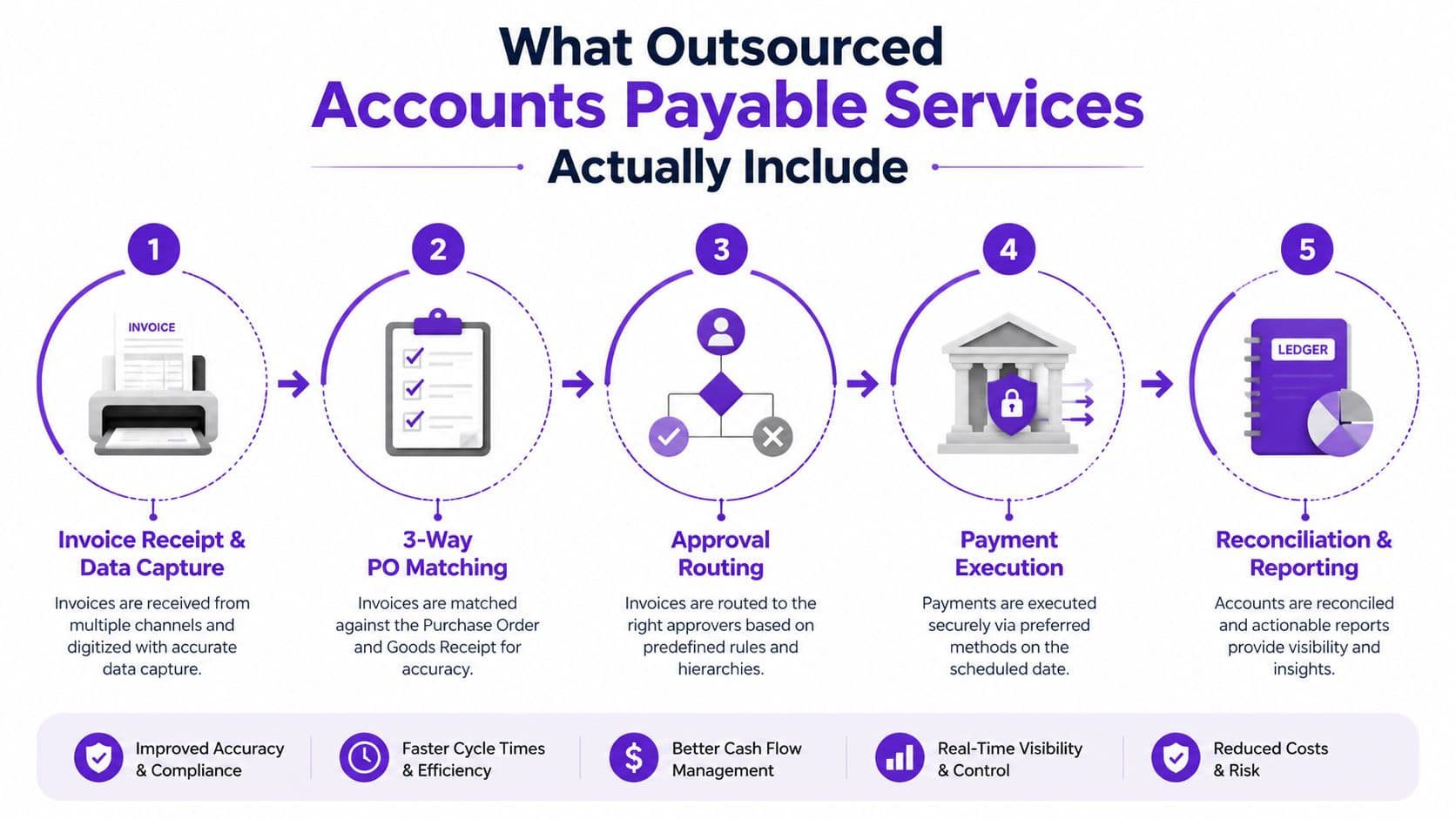
Most buyers think AP outsourcing means “someone else pays the bills.” That is too shallow. A real provider takes over the full payable workflow, from invoice intake to reporting, and that is where control either improves or breaks. If you process 500 invoices per month, the difference between a partial model and end-to-end coverage is the difference between moving one bottleneck and outsourcing only the last step.
The workflow starts before any payment is made
Invoice intake usually starts with email parsing, secure portal uploads, or OCR scanning. From there, the provider extracts key fields, validates the invoice, and routes it for coding and approval. Bad intake is where errors begin, and errors at the front of the process ripple into every downstream step.
A mature provider also handles PO matching, exception handling, and approval escalation. That is where internal controls often fail. When coding is inconsistent or approvers sit on invoices, AP creates a backlog that distorts your close and your cash forecast.
Operational truth: AP does not fail at payment. It fails at handoff.
Vendor setup is part of the service too. That includes vendor master maintenance, W-9 collection, and support for 1099 preparation where relevant. Payment execution then happens through ACH, check, or virtual card, depending on your policy and supplier mix. If you want a concrete comparison of payment approaches in another workflow-heavy business model, the real estate syndication payment methods guide from Homebase shows why payment method choice matters when multiple stakeholders and timing constraints are involved.
The back end matters as much as intake and payment. Providers should reconcile payments, maintain reporting, and give you visibility into aging, exceptions, and workflow status. That is the difference between a vendor service and a finance operation. It is also why AP outsourcing is not the same as basic bookkeeping.
For a broader automation lens, compare this to the accounts payable automation benefits overview. The core point is simple. If your provider does not own the workflow end to end, you still carry the risk internally, with another team doing part of the work.
Pricing Models and Real Cost Calculations
The right way to price AP outsourcing is to ignore the headline fee and focus on total cost per processed invoice. Providers usually use one of three models, a per-invoice fee, a monthly tiered plan, or a hybrid approach. That structure reflects volume, complexity, and how much of the AP lifecycle the provider owns.
Delivery location drives the fee range
Indicative 2026 pricing places offshore delivery at about $0.50 to $2.00 per invoice, nearshore at $1.25 to $3.50, and onshore U.S. delivery at $3.00 to $8.00+ (accounts payable services pricing guide). The same guidance also places outsourced AP at roughly $2 to $6 per invoice or $500 to $3,000 per month, depending on volume and scope. Scope matters because payment execution, vendor communication, 1099s, and reporting all add labor.
| Monthly Invoice Volume | Offshore ($0.50-$2.00) | Nearshore ($1.25-$3.50) | Onshore US ($3.00-$8.00) | In-House Manual ($10-$30) |
|---|---|---|---|---|
| 250 | $125-$500 | $312.50-$875 | $750-$2,000 | $2,500-$7,500 |
| 500 | $250-$1,000 | $625-$1,750 | $1,500-$4,000 | $5,000-$15,000 |
| 1,000 | $500-$2,000 | $1,250-$3,500 | $3,000-$8,000 | $10,000-$30,000 |
| 2,500 | $1,250-$5,000 | $3,125-$8,750 | $7,500-$20,000 | $25,000-$75,000 |
The most useful benchmark for a mid-market business comes from Sage, which says outsourced AP typically costs $2 to $6 per invoice, versus $10 to $30 for manual in-house handling (Sage AP outsourcing guide). If your company processes 1,000 invoices per month, outsourced AP costs $24,000 to $72,000 per year, while manual in-house processing costs $120,000 to $360,000 per year. That's a difference of $96,000 to $288,000 annually. Those are the numbers founders should use when they judge the proposal.
Don't compare sticker price, compare the all-in invoice cost
A cheap rate can be expensive if the provider charges extra for vendor setup, statement reconciliation, audit support, or payment runs. A low base fee also hides control gaps when approval steps, exception handling, and payment authority sit outside the contract. The right question is not “What's your per-invoice fee?” It's “What is my all-in cost per invoice after exceptions, add-ons, and oversight work?”
Simple filter: if a proposal hides add-ons behind vague language, the pricing is incomplete by design.
For pricing frameworks and packaging differences across outsourced finance work, the outsourced accounting services pricing guide is useful context. One practical option in this market is Jumpstart Partners, which offers AP and payments system setup as a fixed-fee project within a broader outsourced accounting model. That matters because fixed-fee implementation often makes more sense than piling setup costs into your recurring AP rate.
Security Controls and Compliance Requirements
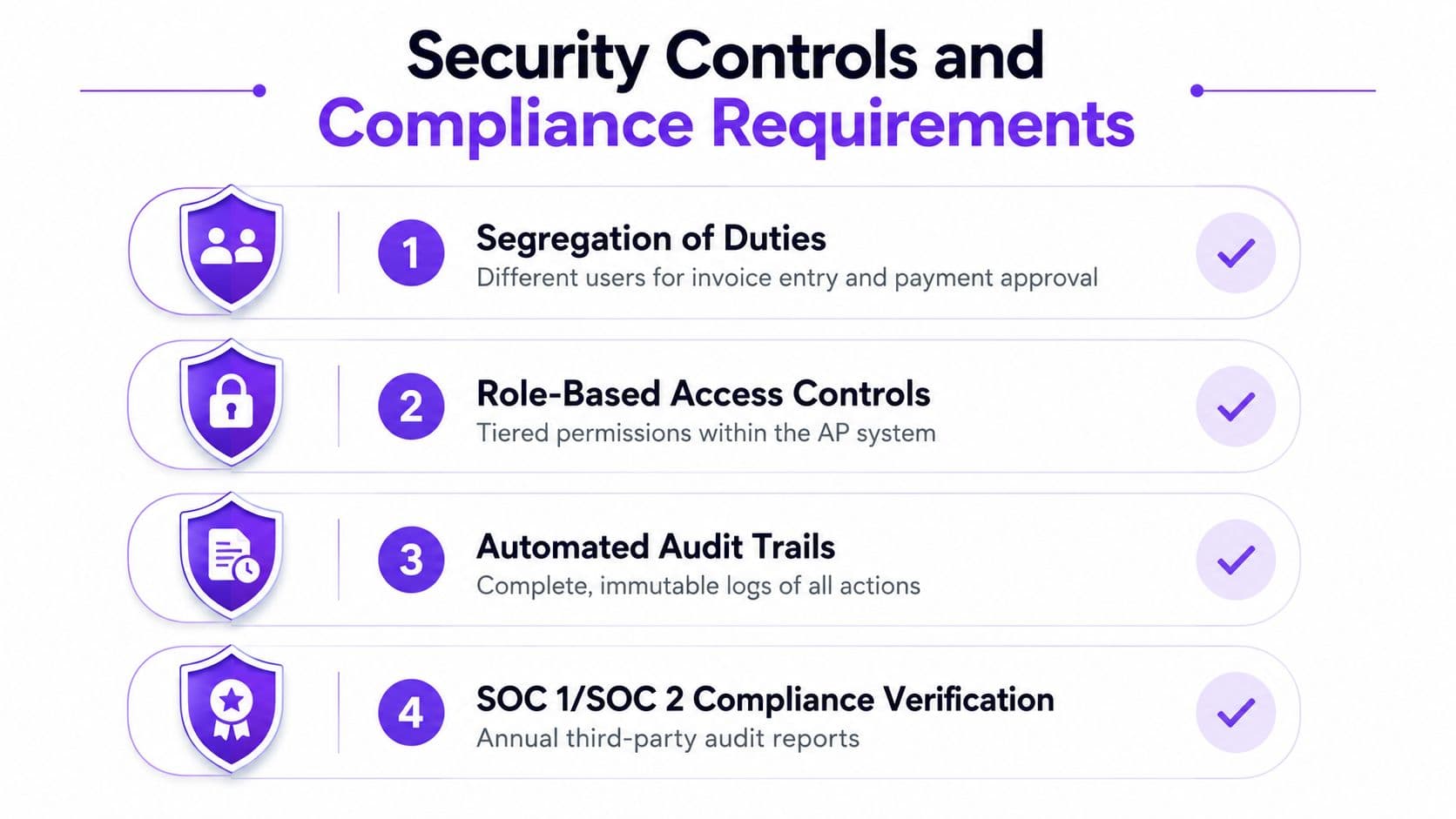
Outsourcing AP without a control framework is how companies create invisible audit risk. The service may save labor, but if you don't define who can enter invoices, who can approve them, and who can release payments, you've just moved a weak process outside your office. That's not governance. That's abdication.
The controls that actually matter
The basics are not optional. You need documented SOPs for invoice intake, coding, approval routing, and exception handling, plus least-privilege access so no one can touch more of the system than their role requires (AP outsourcing governance guide). You also need explicit handoff and termination procedures so vendor data, approvals, and payment authority don't become a mess when staff or providers change.
Strong SLAs make the process measurable. Practical thresholds include standard inquiries answered within four hours, urgent items within one hour, bills coded within one business day, and payments executed within one business day of approval (AP controls guidance). Without those thresholds, you can't tell whether the provider is performing or staying busy.
Control rule: if the workflow isn't measurable, the SLA isn't enforceable.
You should also demand reporting that shows AP aging, DSO trends, and payment-cycle data. That gives you the feedback loop to separate invoice-quality issues from approval delays and vendor-master problems. If a provider can't show that visibility, you won't know whether exceptions are getting better or just being hidden.
Compliance evidence should be part of vendor due diligence
SOC 2 Type II is the right baseline to ask about because it tests whether a provider's controls operate consistently over time, not just on paper. Ask how they encrypt data, how they manage privileged access, how they log activity, and what their incident response process looks like. If they answer vaguely, they don't have a mature control environment.
For a deeper checklist on operational and data safeguards, the data security compliance guide is worth reviewing before you send access to any outside team. The key point is blunt. If your AP provider can't explain segregation of duties, audit trails, and termination procedures in plain language, they aren't ready to handle your payables.
How to Evaluate and Select an AP Outsourcing Provider
The best provider is not the cheapest one. It's the one that can fit your stack, explain its workflow, and prove it can handle exceptions without losing control. Start with integration, then move to operating maturity, then ask for industry relevance.
Ask the questions that expose weak operators
A serious AP provider should answer these directly:
- How do you handle multi-entity operations? If they stumble here, they're not built for growing firms with multiple books or locations.
- What's your exception rate, and how do you track it? You want a provider that measures exceptions instead of hand-waving them away.
- Can you provide AP health reporting? Ask for aging analysis, DSO trends, and cycle-time reporting.
- How do you prevent duplicate payments and vendor disputes? Mature workflow discipline shows up here.
- What systems do you integrate with? QuickBooks, Xero, NetSuite, Stripe, and Shopify are the practical tests for modern finance stacks.
- What's your AI roadmap? Recent market guidance now expects buyers to evaluate automation maturity, touchless-processing levels, ERP integration sophistication, and compliance-grade reporting (AI-enabled AP outsourcing guidance).
A provider that can't describe its approval workflow in detail is a data-entry shop, not a finance partner.
Red flags should end the process fast
Vague SLAs are a problem. So are the absence of documented SOPs, reluctance to provide industry references, and generic claims about “full service” without showing how invoices move from intake to approval. If a provider can't explain who handles vendor setup, how disputes are escalated, and where payments are released, keep looking.
Client fit matters too. For SaaS, agencies, and professional services firms, you want someone who understands recurring vendor patterns, project-based spend, and close discipline. If you want a broader market map of AP and accounting providers, the best outsourced accounting services guide is a useful short list for framing your review.
Implementation Timeline and Onboarding Process
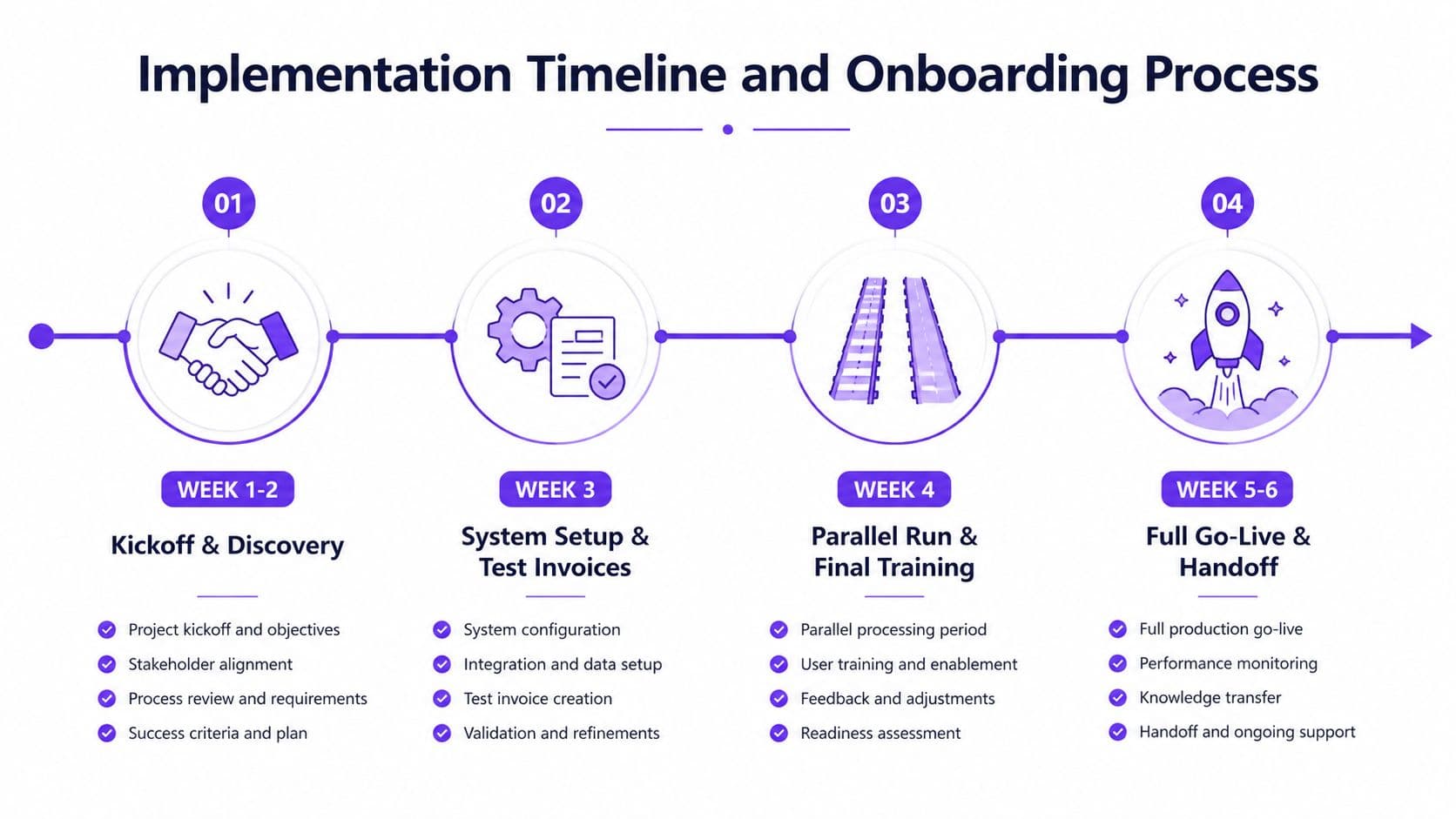
The cleanest AP transitions happen in 4 to 6 weeks when the client treats onboarding like a controlled finance project, not a handoff email. The mistake founders make is waiting until the AP function is already breaking before they define the workflow. By then, vendor trust is thinner and approvals are already messy.
Week-by-week work needs to be explicit
Week 1 is setup. That means system access, vendor master migration, and approval workflow configuration. Week 2 and 3 are for parallel processing, exception-handling training, and SLA baseline measurement. Week 4 and 5 cover full handoff with monitoring and first month-end close support. Week 6 is where you review performance and tighten the process.
Manual AP typically takes 15 to 30 days from invoice receipt to payment, while outsourced invoice processing reduces that to 2 to 5 days (AP productivity guide). That speed difference isn't just convenient. It changes vendor relations, late-fee risk, and the reliability of your accruals.
A good transition plan includes clear communication to suppliers, approval authority mapping, and a reporting cadence for leadership. You should also define who owns exceptions during the overlap period. If nobody owns them, they don't get resolved cleanly.
A disciplined handoff avoids control loss
Here's the simplest operating sequence.
- Map the current process. List every invoice source, approver, payment method, and exception path.
- Load vendor data cleanly. Bad master data creates avoidable disputes later.
- Run parallel processing. Use the overlap to catch coding errors and approval bottlenecks.
- Cut over with monitoring. Full go-live should include weekly review of exceptions, backlog, and payment timing.
If your AP cycle routinely stretches beyond a workweek, outsourcing is no longer a convenience choice. It's a process fix. The point of the transition is not to make AP look outsourced. It's to make it reliable.
Making the Decision and Next Steps
Start with your own numbers. Add AP staff costs, software, error correction, and any external support, then divide by monthly invoice volume to get your current cost per invoice. If that number is close to manual in-house processing and your team still suffers from late approvals or duplicate handling, you're paying a premium for friction.
The common objections don't hold up under scrutiny. “We'll lose control” is only true if you skip the controls section above. “Our vendors won't like it” is usually false if payment timing improves. “Transitioning is too complex” is what teams say when the current process is already too broken to document cleanly.
Use a blunt decision rule. If AP is delaying close, creating vendor complaints, or forcing your finance team to chase approvals instead of managing cash, you've outgrown the in-house model. Build a short list of providers, ask for their SOPs, SLAs, security evidence, and workflow examples, then compare them against your real invoice volume and exception load.
Jumpstart Partners helps growing businesses set up outsourced AP and broader finance workflows with a focus on control, reporting, and clean handoffs. If you want a practical review of your current AP process and a plan for fixing it, visit Jumpstart Partners and schedule a conversation about the workflow you're running today.