Financial Operations
Prior Period Adjustment: What It Means and How to Fix It
Learn what a prior period adjustment is, when to record one, and how it affects retained earnings, audits, and your books under GAAP and IFRS.
ByJumpstart Partners, CPA, QuickBooks ProAdvisor
··17 min readYou signed off on last year's financials, closed the books, and moved on. Then an analyst finds a revenue entry that belongs in the prior year, payroll taxes don't reconcile, or an invoice was capitalized incorrectly. The temptation is to post a quiet current-period journal entry and keep the issue out of sight.
That's the wrong instinct. A prior period adjustment affects more than one account. It can change comparative financial statements, retained earnings, revenue metrics, tax filings, audit procedures, and the credibility of the numbers you show investors. For a business generating $1M to $5M ARR in revenue, the correct response is a documented materiality decision, not a cleanup entry chosen for convenience.
Table of Contents
- When Last Year's Books Come Back to Haunt You
- Defining Prior Period Adjustment Under ASC 250 and IAS 8
- Journal Entries and the Retained Earnings Impact
- A Materiality Framework for Deciding the Right Fix
- Two Worked Examples at Different Scales
- Red Flags and Common Misconceptions That Cost You
- How an Outsourced Controller Handles the Fix
When Last Year's Books Come Back to Haunt You
A Series B SaaS founder signs off on Q4 financials in February. In May, the sales operations analyst discovers that $45,000 of annual contracts was double-booked against the wrong period. The general ledger shows more revenue than the company earned, ARR reporting is inflated, and the board deck referenced the wrong number.
Then the second-order problems surface. The audit is approaching. Bonus calculations used overstated revenue. Payroll taxes tied to those bonuses may also need review. The founder now has to decide whether to reopen the prior period, restate comparative figures, or treat the error as immaterial.
The worst choice is to bury the amount in the current period without documenting why. That approach leaves the prior-period metrics wrong and creates an unexplained movement in current-period revenue or expense. It also makes the audit trail harder to defend when the auditor asks why the correction appeared months after the original transaction.
Practical rule: Don't choose the journal entry until you've quantified the error, identified the affected reporting periods, and assessed who relied on the original numbers.
The first operational step is to preserve the evidence. Export the original transaction, contract, invoice, revenue schedule, payroll calculation, and relevant bank or payment records before changing anything. If your QuickBooks file contains several years of inconsistent activity, start with a structured QuickBooks cleanup process, not an isolated adjustment.
Your decision affects three audiences at once:
- Investors and the board: They need reliable ARR, revenue, margin, and cash information.
- Auditors and lenders: They need comparative statements that follow the applicable reporting framework.
- Tax authorities and payroll agencies: They need filings that agree with the corrected accounting records.
A prior period adjustment isn't merely an accounting label. It determines whether the old financial statements remain usable, whether opening equity changes, and whether tax and payroll workflows require correction. The amount matters, but so does the story the amount tells. An error that changes a growth trend, hides a loss, or affects a covenant deserves more attention than an isolated amount of the same size.
Defining Prior Period Adjustment Under ASC 250 and IAS 8
A prior period adjustment corrects a material error in previously issued financial statements. Under U.S. GAAP, ASC 250 is the authoritative source for accounting changes and error corrections. Under IFRS, IAS 8 governs the retrospective correction of material prior-period errors.
The core treatment is direct. You adjust each affected prior period presented, then reflect the cumulative effect in the opening retained earnings balance, or in another appropriate equity component. The correction doesn't flow through current-year net income because you discovered it today.
IAS 8 requires material prior-period errors to be corrected retrospectively in the first financial statements authorized for issue after discovery. The standard requires comparative amounts for affected prior periods to be restated. If the error occurred before the earliest prior period presented, opening balances of assets, liabilities, and equity are restated for that earliest period. The correction is excluded from profit or loss in the period of discovery. See the IAS 8 requirements for retrospective restatement.
ASC 250 follows the same central principle for material errors. Contemporary U.S. GAAP requires the financial statements for each individual prior period presented to be adjusted, with cumulative effects reflected in beginning retained earnings or other equity components. Historical U.S. guidance evolved through Accounting Research Bulletins, Accounting Principles Board work on the all-inclusive income concept, and FASB Statement No. 16, which narrowed prior period adjustments largely to error corrections and certain tax items. A practical summary of that development appears in this ASC 250 prior-period error correction overview.
Three treatments founders commonly confuse
Material prior-period error: Correct retrospectively, restate comparative information, and adjust opening equity as required.
Immaterial out-of-period correction: Record the correction in the current period when the error clearly doesn't affect users' decisions or distort current reporting. Document the conclusion.
Change in accounting principle: This isn't the same as discovering that an old transaction was recorded incorrectly. A policy change follows its own transition requirements and should not be disguised as an error correction.
| Standard | Scope | Retained Earnings Treatment | Disclosure Requirement |
|---|---|---|---|
| ASC 250 | Material errors in previously issued financial statements and accounting changes | Reflect cumulative prior-period effects in beginning retained earnings or another appropriate equity component | Explain the nature of the error, affected periods, and line-item effects |
| IAS 8 | Material prior-period errors requiring retrospective correction | Restate opening balances for the earliest practicable period when required | Explain the error, affected comparative amounts, and the basis for any impracticability |
The technical trigger isn't whether the books are closed. It's materiality and the effect on comparative reporting. IAS 8 also addresses situations where period-specific effects can't be determined reliably. In that case, the entity restates opening balances for the earliest period for which retrospective restatement is practicable, which can be the current period. That makes transaction traceability a control issue, not a clerical detail. For presentation mechanics, use a disciplined financial statement presentation review.
Journal Entries and the Retained Earnings Impact
The journal entry should mirror the original economic event and show exactly which balance sheet and income statement accounts were misstated. Don't use an unrelated expense account as a hiding place.

Scenario one, overstated SaaS revenue
Assume the prior-period books recorded $45,000 of revenue that should have remained deferred revenue. The correction removes revenue from the affected comparative period and establishes the liability.
| Account | Debit | Credit |
|---|---|---|
| Revenue | $45,000 | |
| Deferred revenue | $45,000 |
If the prior financial statements are being restated, the comparative income statement shows revenue reduced by $45,000 in the affected period. The opening retained earnings rollforward also decreases by $45,000 before considering any related tax effect. Current-year revenue isn't reduced because the error was discovered this year.
If the original transaction was posted to cash or accounts receivable, those accounts may already be correct. The correction should target the misclassified revenue and the liability that should have been recorded. Your controller should trace the entry to the contract, invoice, billing schedule, and revenue-recognition support.
Scenario two, understated payroll tax liability
Assume the prior-period books omitted $12,500 of accrued payroll tax liability and related payroll tax expense. The correcting entry is:
| Account | Debit | Credit |
|---|---|---|
| Retained earnings, or prior-period adjustment account during the correction workflow | $12,500 | |
| Accrued payroll tax liability | $12,500 |
The affected comparative period should show payroll tax expense increased by $12,500 and the liability increased by the same amount. The opening retained earnings balance decreases by $12,500, before any tax benefit that the applicable tax framework permits and supports.
Don't invent a deferred tax adjustment. Calculate it using the applicable enacted tax rate and the tax basis of the corrected asset, liability, revenue, or expense. If the rate or tax treatment isn't established, leave the tax effect open in the workpaper and have the tax adviser determine it.
A disclosure should identify the nature of the error and the affected line items. For example:
“The company identified an error in the prior-period recognition of customer contract revenue. Comparative revenue was overstated by $45,000, deferred revenue was understated by $45,000, and opening retained earnings was reduced by the cumulative after-tax effect of the correction.”
The final wording must match the actual facts, tax treatment, and reporting framework. The same discipline applies when preparing statements for Australian stakeholders. A resource on financial statement preparation Australia can help clarify presentation expectations outside a U.S.-only reporting process.
Whether you use QuickBooks or NetSuite, preserve the original transaction and post a clearly labeled correcting entry. A sound double-entry bookkeeping process should let another reviewer trace the correction from the ledger to the source document and then to the financial statement.
A Materiality Framework for Deciding the Right Fix
Materiality is a decision about users, not a magic dollar threshold. Start with the amount, but don't stop there. Ask whether the error changes a growth trend, turns a profit into a loss, affects a covenant, changes a key SaaS metric, or conceals a control failure.
For U.S. GAAP reporting, SEC Staff Accounting Bulletin No. 99 is commonly discussed alongside quantitative benchmarks around 5%, but the existence of a percentage doesn't eliminate qualitative analysis. The practical conclusion should consider both the size of the misstatement and its context. IAS 8 likewise focuses on whether an omission or misstatement could influence users' decisions, then requires retrospective correction for material errors. The IAS 8 discussion of impracticable retrospective restatement reinforces why incomplete records complicate the answer.
| Criterion | GAAP, ASC 250 plus SAB 99 and SAB 108 | IFRS, IAS 8 |
|---|---|---|
| Quantify the error | Compare the amount with relevant income statement and balance sheet measures | Assess the amount and whether it could influence users' decisions |
| Qualitative effect | Consider trends, management compensation, covenants, fraud indicators, and key metrics | Consider whether the error changes users' understanding of performance or position |
| Immaterial result | Current-period correction may be appropriate if it doesn't distort current reporting | Current-period correction may be appropriate when clearly immaterial |
| Material result | Restate each affected comparative period and adjust opening equity | Restate affected comparative periods and opening balances retrospectively |
| Records incomplete | Use available evidence, document assumptions, and assess cumulative effects | Restate the earliest practicable period when period-specific effects can't be determined |
| Audit reaction | Expect focused testing and disclosure evaluation | Expect focused testing, comparability analysis, and disclosure evaluation |
Use this sequence:
- Quantify the gross error. Separate revenue, expense, asset, liability, equity, payroll, and tax effects.
- Measure the qualitative impact. Determine whether the error changes a trend or KPI that management, investors, or lenders used.
- Evaluate the reporting status. Identify whether statements were issued to the board, investors, lenders, or auditors.
- Select the treatment. Choose current-period correction, prior-period adjustment, or full retrospective restatement.
- Document the conclusion. Your memo should explain why the treatment follows the applicable framework.
A proper quality of earnings review is useful here because it tests whether the error affects recurring revenue, normalized expenses, or the earnings story presented to outside parties.
Two Worked Examples at Different Scales
The boundary becomes clearer when you compare the accounting mechanics rather than the company size. A small agency can have a material error, and a larger SaaS company can have an immaterial one. The amounts below illustrate two different conclusions based on the stated facts.
Example A, immaterial capitalization error
A seven-person digital agency discovers that $4,800 of a prior-period expenditure was capitalized even though it should have been expensed. Management documents that the amount doesn't change the agency's reported trend, financing compliance, or decisions made from the statements. The agency records a current-period correction and explains the treatment in its close memo.
| Dimension | Example A: Immaterial Fix | Example B: Prior Period Adjustment |
|---|---|---|
| Error | $4,800 capitalization error | $180,000 revenue cut-off failure |
| Business context | Seven-person agency | Series B SaaS company |
| Decision | Current-period correction | Retrospective correction |
| Income statement effect | Record the remaining current-period expense or depreciation correction | Restate prior-period revenue |
| Equity effect | No prior-period restatement | Adjust opening retained earnings for the cumulative effect |
| Comparative statements | No restatement | Restate affected comparative statements |
| Disclosure | One-line internal accounting memo, with external disclosure if required | Footnote describing nature, periods, and affected line items |
| Governance | Management review | Audit committee notification and auditor review |
The current-period entry for Example A depends on the asset history. If the asset was recorded at $4,800 and no valid capitalization basis exists, a simple correction could be:
| Account | Debit | Credit |
|---|---|---|
| Current-period expense | $4,800 | |
| Fixed asset | $4,800 |
That entry is appropriate only if management's documented materiality analysis supports current-period treatment and the asset balance needs to be removed. The controller should also check depreciation already recorded and avoid duplicating the expense.
Example B, material revenue cut-off failure
The SaaS company discovers $180,000 of revenue was recorded in the wrong reporting period. The amount affects reported growth and the information presented to the board. The correction requires a prior-period adjustment, comparative statement restatement, audit committee notification, and footnote disclosure under the applicable ASC 250 or IAS 8 process.
The revenue correction follows the same structure as the earlier revenue example:
| Account | Debit | Credit |
|---|---|---|
| Revenue | $180,000 | |
| Deferred revenue | $180,000 |
The central distinction is not that one business is an agency and the other is SaaS. It's that the second error changes the users' understanding of reported performance. Treating both entries as ordinary current-period cleanup would make the comparative statements tell the wrong story.
Red Flags and Common Misconceptions That Cost You
The first red flag is a journal entry with an account description such as “miscellaneous cleanup” and no attached explanation. That label tells the reviewer nothing about the original transaction, the reporting period, or the materiality conclusion.
The second is a current-period operating expense used to absorb a prior-period revenue error. That move shifts the problem into the wrong period and distorts current margins. It also creates a reconciliation question when the income statement, deferred revenue schedule, contract system, and board reporting no longer agree.
Watch for these shortcuts:
- Burying the amount in expenses: This hides the nature of the error and can distort current-period operating performance.
- Calling it non-recurring: A “one-time” label doesn't make an incorrect prior-period entry accurate. It can also mislead buyers evaluating normalized earnings.
- Netting against unrelated revenue: Offsetting unrelated transactions destroys the audit trail and obscures gross revenue and liability balances.
- Deleting the original entry: Overwriting history prevents reviewers from seeing what happened and why the correction was posted.
- Assuming small businesses don't restate: Reporting size doesn't eliminate the need to assess materiality, comparative statements, or tax consequences.
“Disclosure is almost always cheaper than discovery.”
That's an editorial rule, not a quoted claim from an external expert. Explain the issue before an auditor, investor, or lender finds it through a different reconciliation. A transparent memo gives management control over the facts. A late discovery forces management to explain why the accounting team concealed, delayed, or misclassified the correction.
SOX 404 considerations become relevant for companies subject to that framework, particularly when the error points to a control failure rather than a one-off data-entry mistake. Even outside that regime, investors and audit firms examine the same warning signs: weak close controls, unexplained manual entries, inconsistent revenue support, and repeated errors.
Don't let the phrase “immaterial” end the conversation. It should begin a documented assessment. Record the amount, affected accounts, qualitative factors, reviewer, conclusion, and prevention step.
How an Outsourced Controller Handles the Fix
An outsourced controller starts with the evidence, not the entry. The first request is the prior-period trial balance, issued or audited financial statements, detailed general ledger, sub-ledger reports, bank reconciliations, revenue schedules, invoices, contracts, payroll registers, and tax filings.
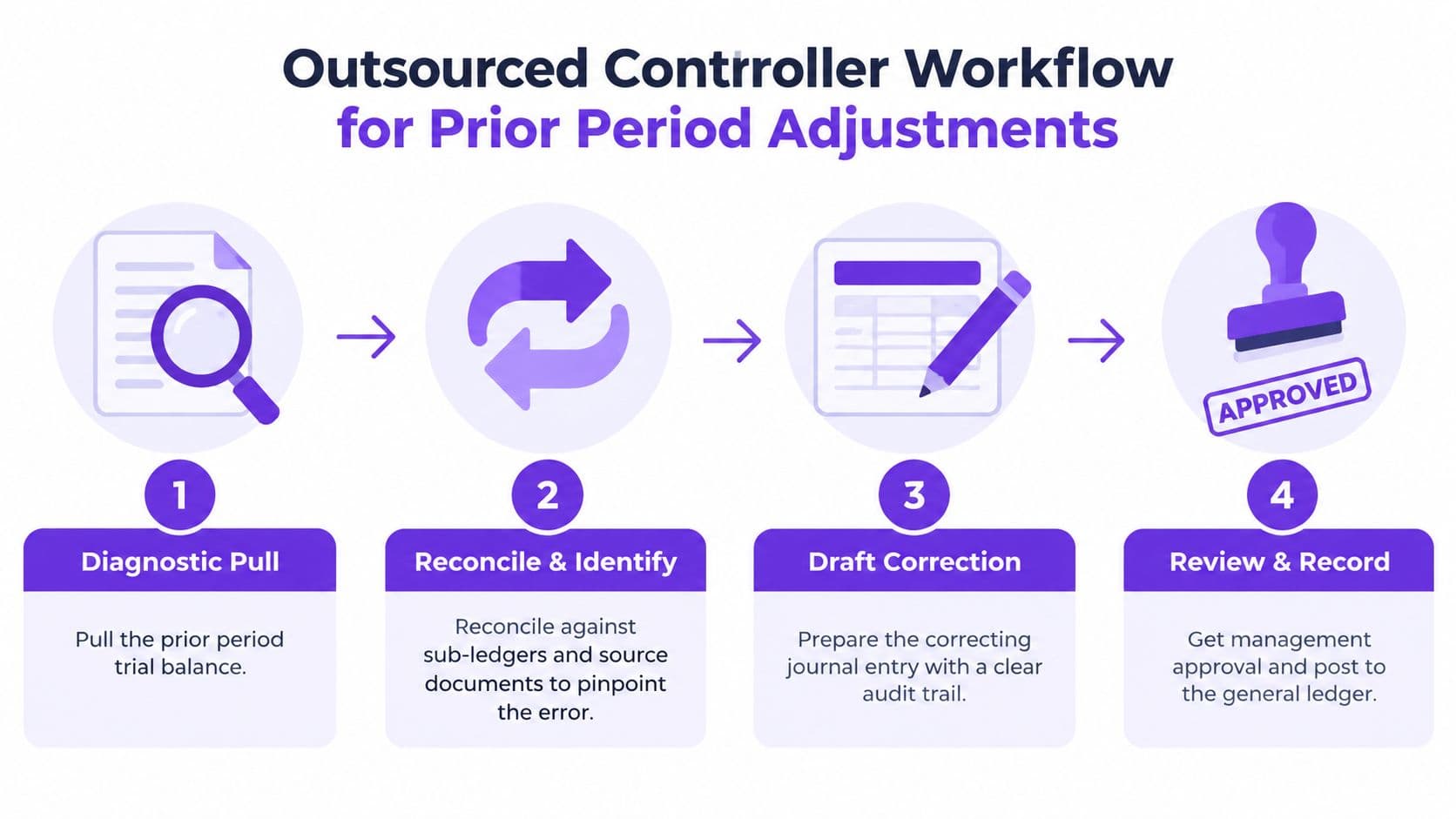
The operating workflow
-
Diagnostic pull: Pull the prior-period trial balance and isolate the accounts connected to the suspected error. In QuickBooks, export the transaction detail and audit log. In NetSuite, trace the source transaction, posting period, subsidiary, class, and approval history.
-
Reconcile and identify: Compare the general ledger with contracts, invoices, bank feeds, payroll registers, accounts receivable, deferred revenue, and tax records. The goal is to identify the original error, not merely the account that now looks unusual.
-
Draft the correction: Prepare the journal entry, supporting schedule, materiality memo, and disclosure draft. The entry should identify the original date, affected period, source documents, preparer, reviewer, and expected effect on retained earnings or another equity component.
-
Review and record: Management approves the treatment. The controller posts the correction in the appropriate accounting system, reruns the trial balance and financial statements, and ties the revised balances to the workpapers.
The tax review runs in parallel. Depending on the entity and filing history, the controller coordinates with the tax adviser on amended federal returns such as Form 1120-X or Form 1065, state nexus filings, payroll tax corrections, and revised quarterly estimated payments. Those filings require tax-specific analysis, so your controller shouldn't assume the book correction automatically determines the tax treatment.
A controller packages the final work for the auditor in a concise memo containing:
- Issue description: What was recorded, what should have been recorded, and when it occurred.
- Quantification: Gross effect by account, period, statement, payroll workflow, and tax category.
- Materiality analysis: Quantitative measures and qualitative considerations.
- Corrective entry: Debit, credit, posting date, and system reference.
- Disclosure: Draft footnote language and restatement tables, where applicable.
- Control response: The process change that prevents recurrence.
If your team needs ongoing support beyond a single cleanup, compare the workflow with outsourced controller services that cover close management, reconciliations, reporting, and audit preparation. Assemble the source documents now, request a preliminary materiality assessment, and engage a controller within 30 days of discovery to limit audit and tax exposure.
Jumpstart Partners provides outsourced controller and bookkeeping support for SaaS companies, agencies, and professional services firms that need a defensible correction and cleaner monthly reporting. Visit Jumpstart Partners to discuss the journal entry, materiality memo, tax coordination, and audit-ready package with a CPA-led team.