Financial Operations
Quarterly Financial Reporting: The Founder's Guide
Master quarterly financial reporting with SaaS-specific metrics, a step-by-step close checklist, and tools for investor-ready results. Get the practical guide
ByJumpstart Partners, CPA, QuickBooks ProAdvisor
··16 min readFor most public companies, the SEC requires Form 10-Q within 45 days after each of the first three fiscal quarters. That legal deadline makes an organized monthly close the only practical way to meet quarterly reporting obligations without sacrificing accuracy.
For founders and finance leaders at $500K to $20M revenue businesses, quarterly financial reporting isn't just an accounting exercise. It determines whether you understand cash pressure, revenue quality, customer retention, margin movement, and the decisions that deserve attention before the next quarter ends. A report that balances but arrives too late, hides deferred revenue, or excludes meaningful KPI movement isn't decision-ready.
The discipline also matters beyond public companies. Private SaaS companies, agencies, and professional services firms use quarterly packages for board meetings, fundraising, lender updates, tax planning, and operating reviews. My position is simple: you should build your internal reporting cadence as if every quarter has a filing deadline, even when the SEC doesn't regulate your company. That standard forces cleaner data and gives you time to act on the results.
Table of Contents
- The Critical Timeline of Quarterly Financial Reporting
- Accrual Versus Cash Accounting in Quarterly Reports
- Step-by-Step Quarterly Close Process
- SaaS Metrics and ASC 606 Compliance
- Red Flags and Common Errors to Avoid
- Tech Stack and Tooling Integration
- Building Investor-Ready Financial Statements
- Quarterly Versus Annual Reporting Decisions
The Critical Timeline of Quarterly Financial Reporting
The quarterly close starts before the quarter ends. Public-company reporting under SEC Form 10-Q requires filing after each of the first three fiscal quarters, with deadlines of 40 days for accelerated and large accelerated filers and 45 days for all other registrants (SEC Form 10-Q). Those deadlines compress account reconciliation, management review, disclosure controls, legal review, and filing preparation into a narrow window.
The rule has historical weight. Quarterly reporting became a formal U.S. requirement in 1970, when the SEC adopted Form 10-Q to replace Form 9-K. The rule required quarterly reports for the first three fiscal quarters within 45 days after quarter-end. Before that change, public companies weren't specifically required to provide quarterly information, although more than 70% already issued quarterly reports in practice, often because of exchange listing standards (SEC historical release).
Treat the close date as an operating deadline
A late reconciliation doesn't stay inside accounting. It delays variance analysis, weakens management discussion, postpones board materials, and leaves executives making decisions from incomplete information. The close date therefore acts as a strategic lever. If you know that payroll liabilities, bank activity, deferred revenue, commissions, and vendor accruals will be reviewed immediately after quarter-end, you can resolve exceptions before the final day.
Start with pre-close reconciliations, not a last-minute data hunt. Review open invoices, unapplied cash, credit-card activity, payroll reports, prepaid schedules, fixed assets, deferred revenue, and material contracts during the final weeks of the quarter. Your monthly close calendar should assign an owner and due date to every recurring account.
A strong quarterly package also separates accurate reporting from actionable reporting. Accurate statements answer what happened. Actionable statements explain why it happened, whether the movement is recurring, and what you should do next. Use your 13-week cash flow forecast process alongside the quarterly package so reported profit doesn't distract you from near-term liquidity.
Practical rule: If an account can't be reconciled monthly, it won't become easier to reconcile at quarter-end.
Accrual Versus Cash Accounting in Quarterly Reports
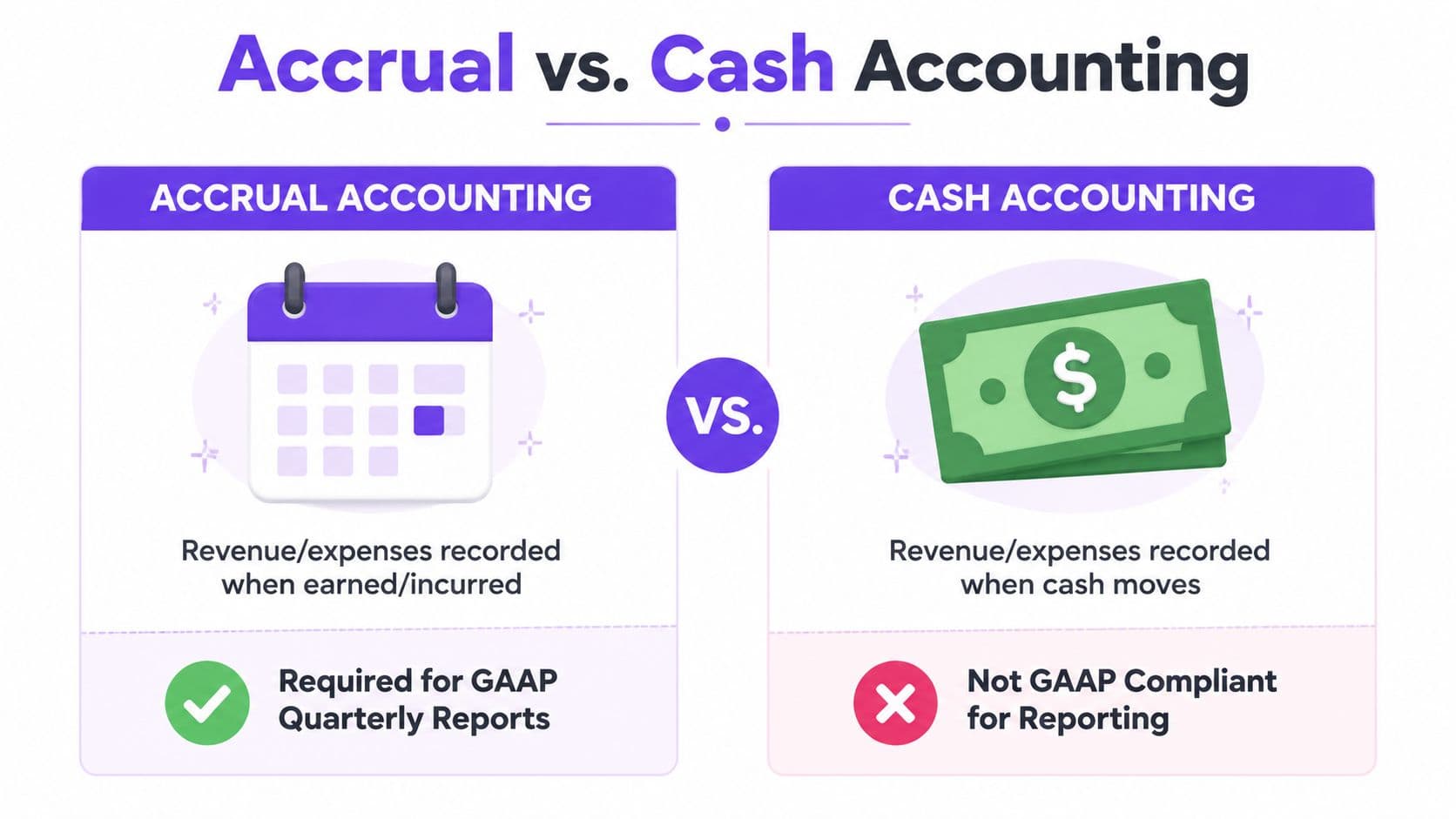
Cash accounting records revenue and expenses when money moves. Accrual accounting records revenue when you earn it and expenses when you incur them. For quarterly financial reporting under GAAP, the accrual view is the one that explains operating performance, even when your bank account follows a different pattern.
Consider an annual contract collected in January for $120,000. Under cash accounting, the business records the full $120,000 as January revenue. Under accrual accounting, the company recognizes $10,000 per month, because the service is delivered across the annual term. The cash receipt improves liquidity immediately, but it doesn't create a year's worth of earned revenue in one month.
Compare the two views at quarter-end
| Category | Cash Basis | Accrual Basis |
|---|---|---|
| Revenue timing | Recorded when cash is collected | Recorded when earned |
| Expense timing | Recorded when cash is paid | Recorded when incurred |
| Annual contract collected in January | $120,000 recorded in January | $10,000 recognized each month |
| Balance-sheet effect | Often limited deferred-revenue detail | Uses receivables, payables, prepaids, and deferred revenue |
| Management use | Shows cash movement | Shows operating performance |
At quarter-end, your bank balance and net income can diverge sharply. You may have collected cash for services you haven't delivered, paid an annual insurance premium before the coverage period, or incurred contractor costs that haven't been invoiced. The balance sheet carries those timing differences, while the cash flow statement reconciles net income to cash generated or consumed.
Build the bridge, don't choose a favorite number
Your quarterly package should show both profitability and liquidity. Start with the accrual P&L, then review operating cash flow, changes in receivables, deferred revenue, payables, prepaid expenses, and other working-capital accounts. That bridge tells you whether reported earnings converted into cash or whether timing differences are consuming resources.
Payroll and benefits create another common complication. If your business uses a professional employer organization, the treatment of payroll accruals deserves a documented policy and consistent reconciliation. The PEO Metrics guide to PEO accruals offers useful context for evaluating those entries. For a deeper accounting foundation, review what accrual accounting means for growing businesses.
Step-by-Step Quarterly Close Process
A quarterly close should run on a three-week schedule, with preparation beginning before the quarter ends. The purpose isn't to create more meetings. It's to move data collection and exception handling earlier, so the final close becomes a controlled verification process.
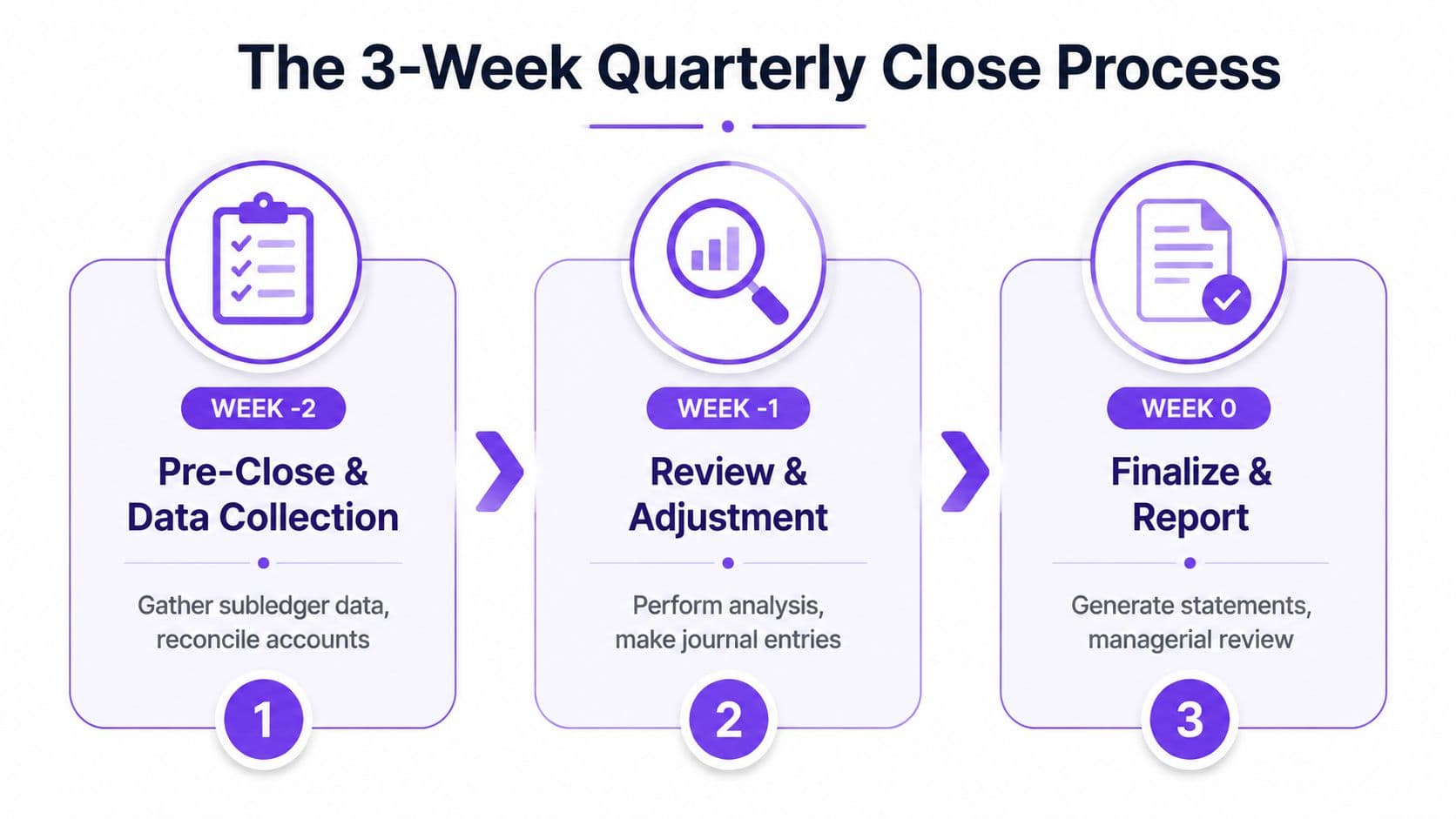
Week minus two, collect and reconcile
Begin with subledger completeness. Pull bank, credit-card, accounts receivable, accounts payable, payroll, payment processor, and fixed-asset data. Reconcile bank and credit-card accounts before the quarter closes, investigate old outstanding items, and confirm that customer invoices and vendor bills are in the accounting system.
Review contracts that affect revenue recognition, including renewals, discounts, upgrades, cancellations, usage charges, and implementation services. Confirm that your deferred-revenue schedule agrees with the general ledger. If your team needs a refresher on account-level structure, these ledger examples for small businesses provide a practical reference.
Week minus one, review and adjust
At this stage, finance should prepare the entries that depend on quarter-end information. Record depreciation, amortize prepaid expenses, accrue payroll liabilities, estimate unpaid vendor costs, and review commission accruals. Investigate unusual fluctuations instead of posting unexplained plug entries.
Use a checklist with named owners. A controller should review reconciliations, supporting schedules, and material journal entries before final statements are generated. The financial close process should also include a variance review against budget and the prior comparable period.
Week zero, finalize and report
On the final close days, lock the period after approved adjustments, generate the P&L, balance sheet, and cash flow statement, and complete a management review. Then prepare the board package, KPI schedules, covenant calculations, and narrative explanations.
Use this walkthrough as a training aid for staff who need to understand how the pieces fit together:
A five-day close is a useful internal target for growing companies because it leaves time for analysis rather than forcing executives to review raw reconciliations. Don't present the numbers until the balance sheet supports them and the major variances have an owner, an explanation, and a planned response.
SaaS Metrics and ASC 606 Compliance
SaaS revenue recognition fails when teams treat invoices as revenue. Under ASC 606, entities recognize revenue when control transfers and disclose disaggregated revenue, along with material changes in transaction price or prior-period performance obligations (PwC's ASC 606 revenue disclosure guidance).
That rule changes how you interpret MRR, ARR, churn, and gross margin. An invoice tells you what you billed. It doesn't automatically tell you what you earned during the quarter, which obligations remain open, or whether a modification changes the transaction price.
Separate operational metrics from GAAP revenue
Suppose a customer signs an annual subscription for $120,000 and the service is delivered evenly. The monthly recurring revenue run rate is $10,000, and the quarterly recognized subscription revenue is $30,000, assuming no implementation, usage, discount, or modification issues. The invoice may show $120,000 billed, while the income statement shows only the portion earned during the quarter.
| Measure | Calculation | Result |
|---|---|---|
| Annual contract value | $120,000 | $120,000 |
| Monthly recurring run rate | $120,000 ÷ 12 | $10,000 |
| Quarterly recognized revenue | $10,000 × 3 | $30,000 |
| Remaining deferred amount after one quarter | $120,000 − $30,000 | $90,000 |
Keep the operational dashboard and the GAAP ledger connected but distinct. MRR and ARR describe the recurring commercial engine. Recognized revenue describes the accounting result for obligations satisfied during the reporting period. Churn and retention explain customer movement, while deferred revenue explains timing.
Focus on contract events
Contract modifications, usage-based billing, refunds, credits, and changes in estimated consideration require review. A usage-based customer can generate a different recognized amount from one quarter to the next even when the base subscription remains unchanged. Your revenue schedule should identify the contract, performance obligations, recognition pattern, modifications, and supporting evidence.
The same principle applies outside SaaS. Teams evaluating revenue recognition for DTC brands can use the same discipline to separate order activity, fulfillment, returns, and earned revenue. For SaaS-specific implementation guidance, see ASC 606 revenue recognition workflows.
Benchmark the operating story, not just the close. In 2025 SaaS benchmark reporting, median gross revenue retention was 88%, top-quartile companies reached 93% or more, and total revenue gross margin was 77% median, with subscription-only gross margin at 81% (SaaS benchmark data). If beginning ARR is $1.0 million and GRR is 88%, retained ARR before expansion is $880,000. At 93% GRR, it is $930,000. That comparison turns a clean close into an operating decision about churn, expansion, and pricing power.
Red Flags and Common Errors to Avoid
A balanced trial balance doesn't prove that your quarterly report is reliable. It only proves that debits and credits agree. At the $500K to $20M revenue stage, errors often hide inside accounts that appear routine, then distort margins, retention analysis, cash forecasts, and investor confidence.
| Error Type | Financial Impact | Detection Method |
|---|---|---|
| Bank fees not recorded or mismatched | Overstates cash and understates expenses | Reconcile the bank statement to the ledger |
| Prepaid expenses left unamortized | Overstates assets and understates current expenses | Compare prepaid schedules with contract terms |
| Software subscriptions misclassified | Distorts cost of revenue, operating expenses, and margin | Review vendors and account mapping |
| Usage-based licenses not accrued | Understates expenses and liabilities | Compare usage reports with invoices received |
| Deferred revenue omitted or outdated | Overstates recognized revenue | Tie the revenue schedule to contracts and the GL |
| Payroll liabilities incomplete | Understates expenses and accrued obligations | Reconcile payroll registers to the liability accounts |
Warning signs that require escalation
Watch for old reconciling items, negative deferred-revenue balances, large manual journal entries, unexplained margin movement, and revenue that doesn't align with delivery activity. A quarter-end close that depends on spreadsheet overrides deserves controller review before anyone sends it to a board or investor.
GRR and NDR can also become misleading when accounting classifications change. Customer churn belongs in the retention analysis, but a billing correction shouldn't be mistaken for churn. Likewise, an unrecorded usage accrual can make gross margin appear stronger while hiding the cost required to serve customers.
Controller's standard: Every material balance-sheet account needs a reconciliation, supporting evidence, and a named reviewer. “The books balance” isn't a control.
Stop using the close as a ceremony. Require variance explanations for unusual movements, document the treatment of contract changes, and maintain a quarterly error log. The objective isn't to eliminate every judgment. It's to make each judgment visible, repeatable, and defensible.
Tech Stack and Tooling Integration
Your accounting system should receive organized data from the systems that create economic activity. Payment processors, payroll platforms, commerce tools, and subscription systems shouldn't operate as disconnected spreadsheets that finance staff rebuild at quarter-end.
For a smaller agency, QuickBooks or Xero can serve as the general ledger when the chart of accounts, bank feeds, approval workflows, and reconciliations are properly maintained. A scaling SaaS company with complex entities, revenue schedules, or consolidation requirements may need NetSuite. The platform matters less than the integration design and ownership rules.
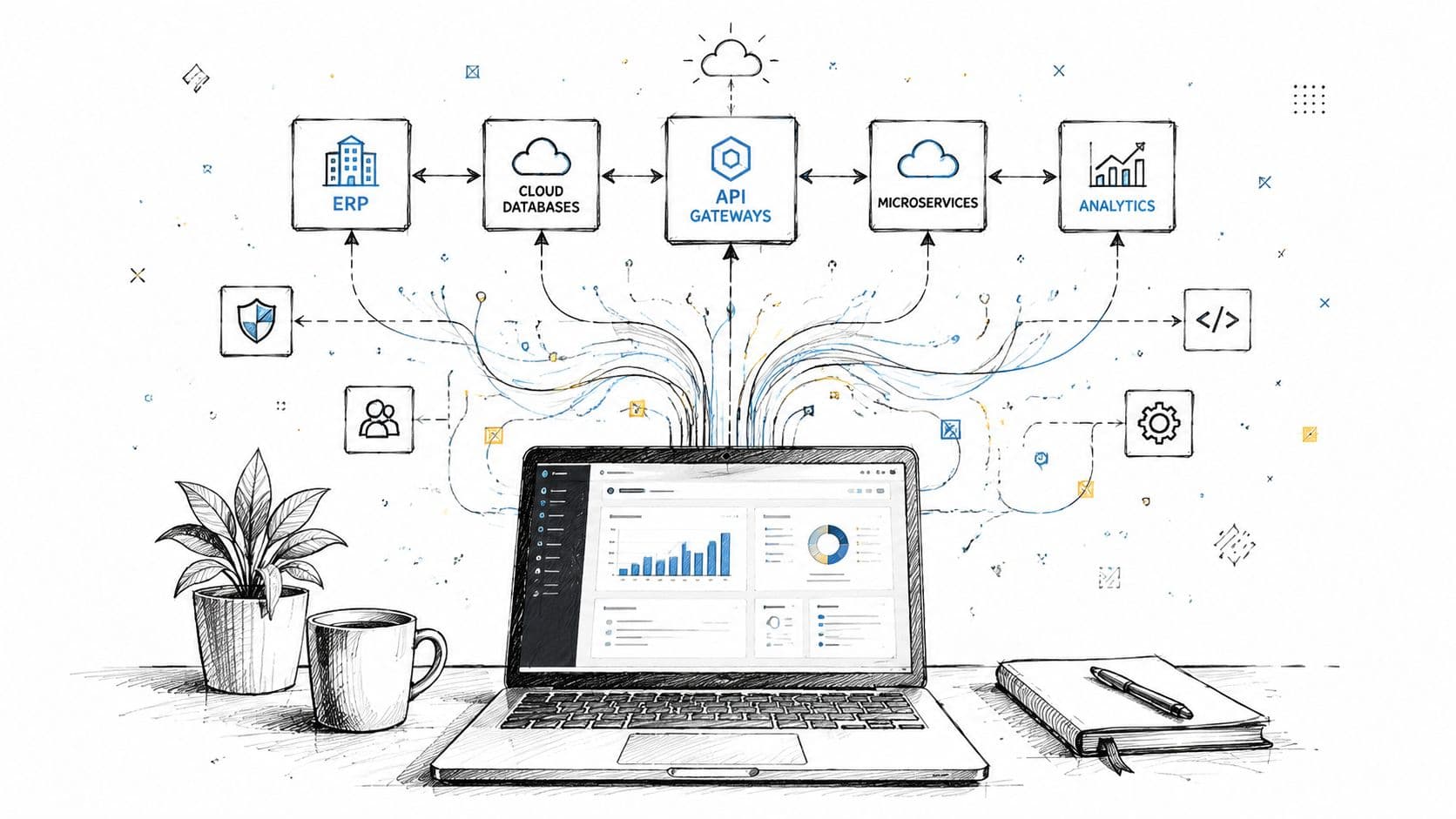
Connect the transaction sources
Use Stripe for subscription and payment data, Shopify for ecommerce activity, and Gusto for payroll inputs where those platforms match your operating model. Map each source to a controlled account structure, define how refunds and fees post, and reconcile the source totals to the general ledger.
Don't automate an unclear process. Automation can move bad classifications faster. First establish the expected source-to-ledger relationship, then add exception reporting for missing transactions, duplicate entries, failed syncs, unusual amounts, and unreconciled balances.
A reporting automation workflow should produce the P&L, balance sheet, cash flow statement, revenue schedules, and KPI exports from one controlled data model. Financial reporting automation can support that design, while Jumpstart Partners offers outsourced controller and bookkeeping services that integrate with platforms such as QuickBooks, Xero, NetSuite, Stripe, Shopify, Square, Gusto, and BambooHR.
Building Investor-Ready Financial Statements
Investor-ready financials don't stop at a standard P&L. They show the result, the comparison, the explanation, and the operating metric that confirms whether the movement is durable.
Start with a board-ready P&L that includes current-quarter actuals, budget, variance, prior comparable period, and variance explanation. Keep the account structure consistent. If professional-services revenue rises while utilization falls, explain the relationship. If SaaS gross margin declines while subscription revenue grows, identify hosting, support, implementation, or usage costs driving the change.
Use a package that answers management questions
| Report | Required view | Management question |
|---|---|---|
| P&L | Actual, budget, prior period, variance | What changed in revenue, margin, and operating expense? |
| Balance sheet | Current balances and reconciliation status | What assets and liabilities need attention? |
| Cash flow | Operating, investing, and financing activity | Where did cash come from and where did it go? |
| Revenue schedule | Billed, recognized, deferred, and remaining obligations | Is revenue quality consistent with contract delivery? |
| SaaS KPI page | MRR, ARR, churn, GRR, NDR, and gross margin | Is the recurring business strengthening? |
| Forecast | Updated cash and operating outlook | What decision must management make next? |
The cash flow statement deserves plain-language commentary. Explain whether operating cash improved because customers paid faster, because payables increased, or because deferred revenue rose. Distinguish investing activity, such as equipment or software purchases, from financing activity, such as debt or equity proceeds.
Finish with a short executive narrative. Name the two or three largest variances, state whether each is recurring, and assign an action owner. Investors don't need a longer document. They need a coherent connection between GAAP results, cash, customer economics, and the next operating decision.
Quarterly Versus Annual Reporting Decisions
Quarterly reporting requires discipline, but not every disclosure deserves the same treatment in every period. FASB guidance highlighted in 2025 notes that ASU 2023-09 expanded annual income tax disclosures, reinforcing the point that some decision-useful detail belongs primarily in annual reporting (KPMG quarterly outlook).
Use this decision framework:
| Put in the quarter | Reserve for annual reporting or investor materials |
|---|---|
| Material revenue changes and contract judgments | Broader annual tax-rate and jurisdiction detail |
| Cash movement and liquidity risks | Full annual disclosure expansion |
| KPI movement that changes an operating decision | Longer strategic narrative |
| Significant control issues or accounting changes | Supporting detail that isn't material to the quarter |
| Variances requiring management action | Investor-deck context that supplements, rather than replaces, required filings |
The SEC debate over optional semiannual reporting sharpens the question, but it doesn't remove the need for internal quarterly discipline. Public companies still face current Form 10-Q requirements unless the rules change, and private companies need a focused package covering cash, revenue quality, and KPI movement.
Schedule your first pre-close review today. Audit your chart of accounts for SaaS-specific categories, create a recurring monthly reconciliation calendar, and assign owners for deferred revenue, payroll accruals, usage costs, and KPI reporting. Your quarterly package should be shorter where detail adds no decision value, but never thinner where investors, lenders, or management need evidence.
If your close is late, your revenue schedules are manual, or your board package takes weeks to assemble, Jumpstart Partners provides outsourced controller and bookkeeping support for SaaS, agencies, and professional services firms. Visit the team to discuss a five-day close, ASC 606 workflows, cash-flow visibility, and investor-ready quarterly reporting built around your systems.