Financial Operations
Segment Reporting Requirements for Growing Businesses
Understand segment reporting requirements under IFRS 8 and ASC 280, with thresholds, calculations, disclosures, implementation steps, and audit-ready controls.
ByJumpstart Partners, CPA, QuickBooks ProAdvisor
··15 min readConsolidated revenue can look healthy while one product line loses money, a client category consumes too much delivery capacity, or a region absorbs resources without producing enough return. If your leadership team sees only one company-wide profit and loss statement, it can miss the operating choices that are driving the result.
That's why segment reporting requirements matter beyond the filing. They connect external financial disclosures to the way your leaders review performance and allocate resources. For a SaaS company, that may mean seeing subscriptions separately from implementation services. For an agency, it may mean distinguishing a managed-service practice from project work. The right structure helps you see where the business earns, spends, and invests, then explain those results clearly to financial-statement users.

Table of Contents
- Why Your Segment Reporting Exposes Business Risk
- Understanding Operating Segments and the CODM
- Comparing IFRS 8 and ASC 280 Rules
- Calculating Reportable Segment Thresholds
- Required Disclosures and Reconciliation Evidence
- Worked Examples for SaaS and Agencies
- Build an Audit-Ready Segment Reporting System
- Red Flags, Audit Readiness, and Next Steps
Why Your Segment Reporting Exposes Business Risk
A single consolidated P&L can hide opposite realities. Your subscription business may be profitable while implementation work runs at a loss. An agency's total margin may look steady while a large client group takes more delivery labor than its fees support. If management sees only the consolidated result, it can invest in the wrong offer, miss a deteriorating service line, or overlook a business that needs attention.
Segment reporting brings those differences into view. It isn't just an accounting exercise performed after leadership has made its decisions. Under IFRS 8 and ASC 280, the management approach ties operating segments to the information leaders regularly use to allocate resources and assess performance. IFRS 8 replaced IAS 14 and established the current international foundation for that approach. The IASB issued the standard on 30 November 2006, and it became mandatory for annual periods beginning on or after 1 January 2009, with early adoption permitted (IASB's IFRS 8 project history).
Consider a SaaS business whose leadership reviews recurring subscriptions and implementation services separately. A combined P&L may make growth appear straightforward, but separate reporting can expose whether implementation revenue covers the labor and resources required to deliver it. That distinction affects decisions about pricing, hiring, product investment, and how the company explains its results.
Your external reporting shouldn't invent a different business from the one management runs. But it also shouldn't treat every internal label as a reportable segment. The work begins by identifying the right operating units, then testing them against the applicable rules and documenting how their results connect to consolidated statements.
Understanding Operating Segments and the CODM
Start in the leadership meeting, not the organization chart. Identify the chief operating decision maker, or CODM, by determining who regularly reviews operating results and uses them to allocate resources or assess performance. The CODM is a function, not necessarily a particular job title. Depending on how you run the company, that function may sit with one executive or a group of leaders.
IFRS 8 defines an operating segment through three conditions. It must conduct activities that may earn revenue and incur expenses; its results must be regularly reviewed by the CODM for resource allocation and performance assessment; and discrete financial information must be available (IFRS 8 text). These conditions put the focus on how management operates the business, not on what labels happen to appear in a dashboard.
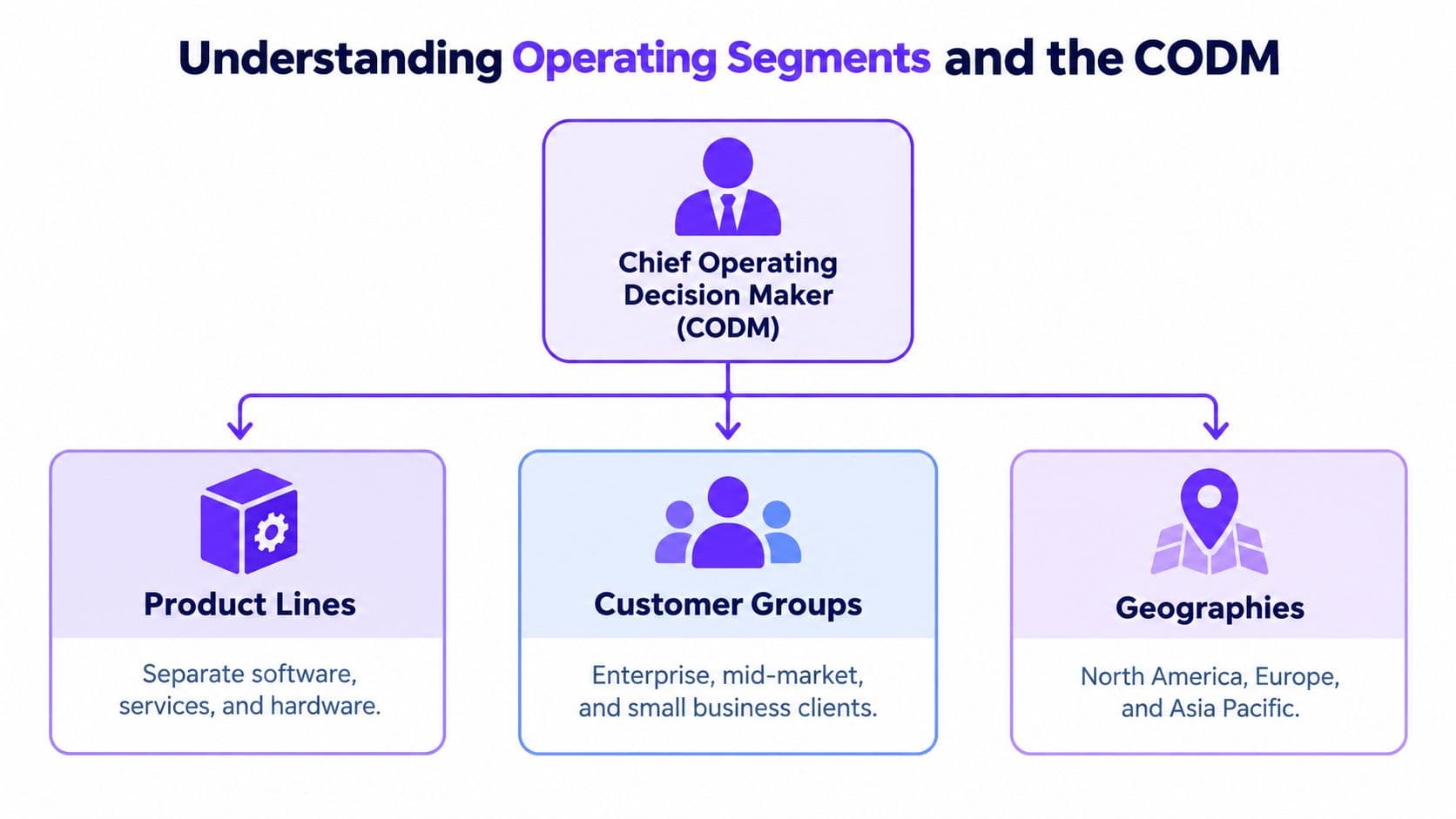
A product line, customer market, or geographic unit can qualify when it meets the criteria and management reviews its results as part of running the business. A legal entity doesn't qualify automatically just because it has its own registration, and an arbitrary dashboard category doesn't become an operating segment because someone can filter a report by it.
Work from the decision package
Collect the recurring materials the CODM uses: management reporting packages, budget reviews, forecasts, and performance dashboards. Check whether those packages show distinct financial results and whether leadership uses those results to make resource decisions. Keep the review trail. If the internal package changes, assess whether the segment analysis needs to change as well.
This approach also keeps the reporting system connected. A segment definition should make sense alongside your budgeting and forecasting structure, source-system mappings, and branch accounting practices. If you're also working through smaller-business reporting obligations in Australia, EndureGo Tax's overview of AASB 112 for small business offers related context, though it doesn't replace the segment analysis required under the relevant reporting framework.
Comparing IFRS 8 and ASC 280 Rules
IFRS 8 and U.S. GAAP's ASC 280 both start with the information management uses to run the business. They aren't interchangeable labels, though. Apply the framework relevant to your reporting obligations, then document the differences that affect your disclosures.
| Decision area | IFRS 8 | ASC 280 | Finance-team evidence |
|---|---|---|---|
| Operating-segment identification | Uses the management approach and the CODM's recurring review | Uses the management approach and the CODM's recurring review | CODM packages, meeting materials, and documented segment definitions |
| Reportable-segment tests | Revenue, profit or loss, and assets each have a separate 10% test | Revenue, profit or loss, and assets each have a separate 10% test | A period-specific threshold worksheet tied to the underlying records |
| External-revenue coverage | Reconcile segment information to consolidated amounts | Apply a separate 75% external-revenue coverage floor | External revenue by segment, consolidated revenue, and a coverage calculation |
| Additional disclosures | Report information about reportable segments and reconcile segment totals to consolidated amounts | Includes certain entity-wide disclosures, including revenue by product or service and geographic information | Disclosure schedules, reconciliation support, and geographic and product revenue detail |
For both frameworks, identify operating segments from CODM reporting first. Then determine whether aggregation is appropriate before applying the reportable-segment tests. Under IFRS 8 and ASC 280, the 10% thresholds test revenue, profit or loss, and assets. Meeting any one test can make an operating segment reportable (Deloitte's ASC 280 entity-wide disclosure overview).
ASC 280 also requires certain entity-wide disclosures about revenue by product or service and geographic information, including countries where revenue is earned and assets are held, regardless of how management organizes its operating segments. Keep those disclosures distinct from the CODM-based segment analysis. When presenting segment results and consolidated financial statements, explain the relationship between them. For a broader view of presentation considerations, see this guide to financial statement presentation.
Decision rule: Identify the operating units management actually reviews. Then apply the right standard, record any aggregation judgment, and preserve the evidence behind the conclusion.
Calculating Reportable Segment Thresholds
Build the calculation from your operating segments, not from arbitrary products, legal entities, or geographic labels. First assess whether segments can be aggregated based on similar economic characteristics and comparable operations. Similar customer groups, service lines, or delivery models can inform that judgment, but they don't eliminate the need to document it.
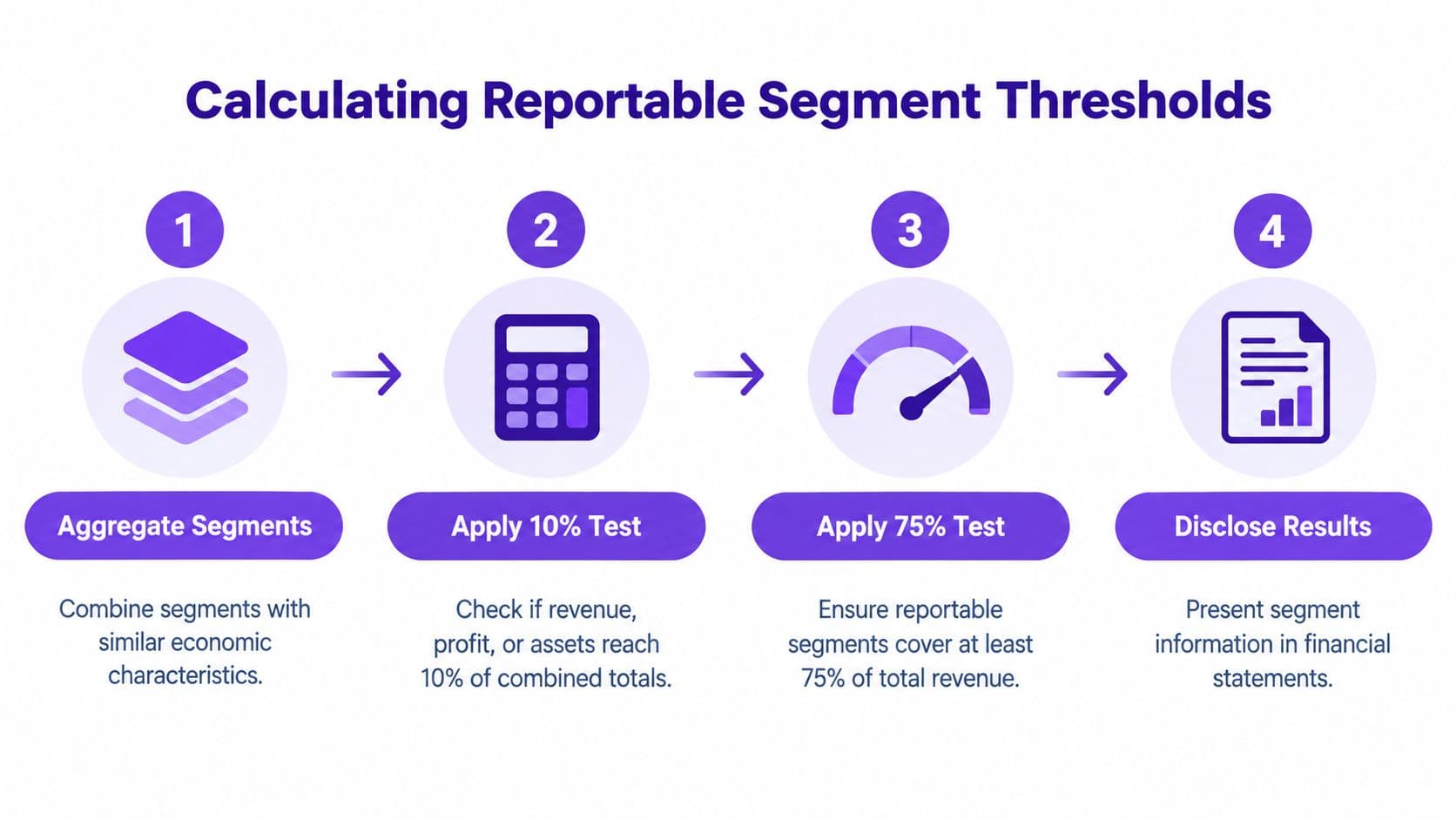
After identifying and, where appropriate, aggregating operating segments, run the three tests separately. The following example shows how the calculations work under ASC 280 (worked ASC 280 example).
| Test | Combined amount in the example | Threshold | Segment result |
|---|---|---|---|
| Revenue | $10 million | $1 million | $1.1 million of revenue passes at 11% |
| Assets | $4 million | $400,000 | $450,000 of assets passes at 11.25% |
| Profit or loss | $1.2 million of profit across profitable segments | $120,000 | $125,000 of profit passes |
Revenue test. A segment passes when its reported revenue, including external and intersegment revenue, reaches at least 10% of combined operating-segment revenue. In the example, $1.1 million divided by $10 million equals 11%, so the segment passes.
Asset test. A segment passes when its assets reach at least 10% of combined operating-segment assets. Here, $450,000 divided by $4 million equals 11.25%. The segment passes even if it doesn't meet the revenue threshold.
Profit-or-loss test. Compare the absolute amount of a segment's reported profit or loss with 10% of the greater of total profits from profitable segments or total losses from loss-making segments. If profitable segments have $1.2 million in total profit and loss-making segments have $300,000 in total losses, the larger amount is $1.2 million. Ten percent of that is $120,000, so a segment reporting $125,000 of profit passes.
Run the separate coverage test
The 75% external-revenue floor is not another 10% test. If reportable segments identified through the threshold analysis don't cover enough external revenue, add otherwise nonreportable segments until the required coverage is met. For example, $8.4 million of external revenue from initially reportable segments divided by $12 million of consolidated revenue equals 70%, which falls short. Adding a segment with $700,000 of external revenue raises the numerator to $9.1 million, or 75.83% of $12 million, satisfying the floor (Deloitte's explanation of the coverage test).
Use external revenue in the numerator and consolidated revenue in the denominator. Intersegment sales don't satisfy the coverage requirement. Management can also disclose smaller segments when it believes the information is useful to financial-statement users, so the worksheet is a control, not a substitute for judgment.
Required Disclosures and Reconciliation Evidence
A segment conclusion is only useful if the financial statements explain what management measures and how those measures connect to the consolidated results. Prepare a disclosure package that identifies reportable segments, describes the basis for measurement, and explains the CODM's role, including the CODM's title and position under the relevant U.S. GAAP disclosure requirements.
Under U.S. GAAP ASU 2023-07, public entities disclose significant segment-expense categories and amounts that are regularly provided to the CODM and included in the reported measure of segment profit or loss. The rule doesn't require separate public disclosure of every KPI in a management dashboard. Multiple profit measures belong in the disclosure only when management uses them to allocate resources and assess performance. The SEC filing example describing these requirements also notes the qualitative explanation of “other segment items” (SEC segment-expense disclosure example).
That distinction matters for SaaS, agency, and services teams. Your dashboard may track ARR, CAC, utilization, gross margin, bookings, or adjusted EBITDA, but the reporting question is whether the measure is part of the CODM's recurring decision process and, where required, how it reconciles to GAAP measures. Treating every metric as a formal segment disclosure can create inconsistent definitions across products or customer groups.
Make the bridge explainable
Reconcile segment totals to the consolidated financial statements, including reported segment profit or loss and other measures that require reconciliation. The schedule should identify eliminations and reconciling items such as corporate costs, financing, taxes, and other adjustments. Don't leave a difference as an unexplained balancing figure.
Retain the CODM packages, segment schedules, source data, calculation workpapers, allocation methods, and approvals for each reporting period. If you're building the consolidation process across entities, this guide to consolidated statements for UAE businesses provides useful background on consolidated financial statements. Keep it separate from your segment-specific accounting assessment.
Worked Examples for SaaS and Agencies

SaaS company
Suppose the CODM reviews recurring software subscriptions, implementation services, and a geographic region as separate parts of the business. Don't assume each item automatically qualifies as a reportable segment. Check whether the activities can earn revenue and incur expenses, whether the CODM regularly reviews their results to allocate resources or assess performance, and whether discrete financial information is available.
For the units that meet the operating-segment definition, the finance team should map subscription and implementation revenue from the billing platform into the accounting records. Identify intersegment revenue where one operating unit provides services to another. Assign expenses and assets using documented policies, then run the threshold worksheet and prepare the reconciliation to consolidated amounts.
A practical trail might begin with a Stripe revenue export and payroll data, continue through a reviewed segment schedule tied to the general ledger, and end with a reconciliation to the consolidated statements. If leadership tracks ARR and CAC, decide whether those measures are part of the CODM's recurring resource and performance decisions. A metric's presence in a dashboard alone doesn't answer the disclosure question. This guide to SaaS financial metrics can help clarify the operating measures your team tracks, but formal disclosures still require a standards-based review.
Agency
An agency may organize leadership reporting around managed services, creative production, or client markets. A single client, campaign, or delivery tactic does not become a segment. Start with the units management reviews, then assess whether similar service lines can be aggregated.
Map project revenue from the billing or project-management system to the accounting records. Assign delivery labor using a consistent, documented method and trace relevant asset balances to the segment schedule. Review whether the resulting measures match the information the CODM receives. Then reconcile segment totals to the consolidated statements, showing eliminations and other adjustments rather than relying on a dashboard screenshot as audit support.
In both businesses, the objective is a traceable chain from operational data to general ledger, segment schedule, and financial statements. Remember that external revenue drives the coverage test; intersegment sales don't count toward its numerator, as explained above. The walkthrough below complements the examples with a visual overview of segment reporting.
Build an Audit-Ready Segment Reporting System
Put ownership and evidence into the monthly finance rhythm. A segment worksheet that appears only at year-end invites stale definitions, unexplained changes, and rushed reconciliations. Assign a decision-maker for each control and retain proof that the control happened.
| Control | Owner | Evidence | Review timing |
|---|---|---|---|
| Segment definitions and aggregation judgments | Controller, approved by leadership | Current definitions, CODM package, approval record | When reporting structure or management review changes |
| Account and source-system mapping | Accounting lead | Chart-of-accounts mapping, billing and payroll extracts | During close and when systems change |
| KPI definitions and ownership | Finance and metric owners | Definition register, calculation logic, CODM reporting package | When measures or leadership use change |
| Intersegment activity and allocations | Controller or accounting lead | Elimination entries, allocation workpapers, support | Each close |
| Thresholds and reconciliations | Controller | Segment worksheet, ledger tie-out, consolidated bridge | Each reporting period |
Set up the chart of accounts and source-system mappings so finance can assign revenue, expenses, and assets consistently. Document how QuickBooks, Xero, NetSuite, Stripe, payroll records, and project systems feed the schedule where those systems are relevant. This chart of accounts guide offers additional context on how account structure supports reporting.
Define each KPI and assign an owner, but don't force every ARR, CAC, utilization, or margin measure into the formal segment schedule. The schedule should reflect the applicable reporting rules and the CODM's decision process. For a broader process review, use a strategic data quality assessment checklist to identify gaps in the systems and mappings that feed financial reporting.
Control principle: A number is audit-ready when your team can explain its source, method, review, and connection to the ledger.
Red Flags, Audit Readiness, and Next Steps
A dashboard isn't an audit trail. Before closing the period, challenge these common assumptions:
- “Our legal entities are our segments.” Confirm the CODM's actual operating view; legal structure alone doesn't settle the analysis.
- “No unit passed a 10% test, so we're done.” Check the separate external-revenue floor and whether management believes additional disclosure is useful.
- “The coverage floor is another threshold test.” Keep the 75% external-revenue calculation separate; intersegment sales don't count.
- “Every internal KPI belongs in the statements.” Identify which measures and expenses meet the applicable disclosure requirements.
- “The dashboard proves the numbers.” Tie data to the general ledger, document allocations, and reconcile to consolidated results.
Use an audit preparation checklist to organize the evidence, then verify that your file includes documented judgments, CODM review support, reconciled schedules, approval trails, and consistent annual and interim reporting. Assign an owner to resolve each gap, and don't wait until filing review to explain a change in segment definitions or methodology.
Start by collecting the CODM's recurring reporting package and identifying the operating units it shows. Then map each unit to source data and ledger accounts, run the required tests, and have leadership approve the documented judgments.
Jumpstart Partners provides outsourced controller and bookkeeping services for SaaS companies, agencies, and other growing businesses, including financial reporting support and audit-ready packages. Visit Jumpstart Partners to discuss whether controller support fits your segment reporting workflow and what a review of your current records would involve.