Financial Operations
What Is a Certificate of Incumbency
Discover what is a certificate of incumbency, when you need one for banking or fundraising, and how to prepare it to avoid costly delays.
ByJumpstart Partners, CPA, QuickBooks ProAdvisor
··14 min readA certificate of incumbency is an internal corporate document that confirms who currently has authority to act for your company, and it does not have a fixed legal expiration under U.S. state law. In practice, banks, auditors, and legal advisers often want a freshly issued version issued within 3 to 6 months of use.
You usually learn this when the timing is terrible. Your funding documents are almost ready, your new bank account is nearly approved, or a partner is waiting on signatures, then someone in legal or compliance asks for a certificate of incumbency and your team goes quiet.
That pause costs real momentum. If you can't prove who is authorized to sign, the other side won't rely on your contract, your banking package, or your diligence file. For founders and finance leaders, this document isn't trivia. It's a control point that keeps transactions moving.
Table of Contents
- Your Deal Is on Hold Until You Produce a What
- Defining the Certificate of Incumbency
- Key Contents and a Sample Template
- Incumbency Certificate vs Other Corporate Documents
- How to Obtain Authenticate and Avoid Common Pitfalls
- Your Action Checklist for Investor and Audit Readiness
Your Deal Is on Hold Until You Produce a What
A founder gets the wire instructions for a closing. Outside counsel sends the final signature packet. Then the bank replies with a short request: provide a notarized certificate of incumbency. Nobody on the management team has one ready. The board records are scattered between email, a law firm folder, and an old Dropbox directory. The signing date slips.
That's how this document shows up in real life. Not during a calm administrative cleanup. It appears when you're trying to close something important.
The reason is simple. The other side doesn't care what title someone uses in Slack or on LinkedIn. They want proof that the person signing has authority under the company's own records. If you're focused on creating legally binding agreements, this is one of the documents that supports that authority in practice.
Where the hold-up usually happens
The request often appears in transactions like these:
- Bank onboarding: The bank wants confirmation that the named signers are the same people authorized by the company.
- Fundraising closings: Investor counsel checks authority before relying on executed documents.
- Cross-border expansion: Foreign banks and service providers ask for a current authority record before opening accounts or onboarding the entity.
- Large commercial agreements: A prudent counterparty wants comfort that the contract was signed by someone who can bind the business.
If you're preparing diligence materials, your certificate of incumbency belongs beside the corporate records in your due diligence reporting workflow. Treat it like a readiness item, not a last-minute scramble.
Practical rule: If a transaction matters enough for lawyers, auditors, or a bank to review it, assume they'll want proof of signing authority.
Founders often dismiss this as paperwork because the company already exists and the officers are obvious internally. That's the wrong frame. A certificate of incumbency is a trust document for outsiders. If you don't have it, or if it's sloppy, the outsider slows the process until they can verify authority another way.
Defining the Certificate of Incumbency
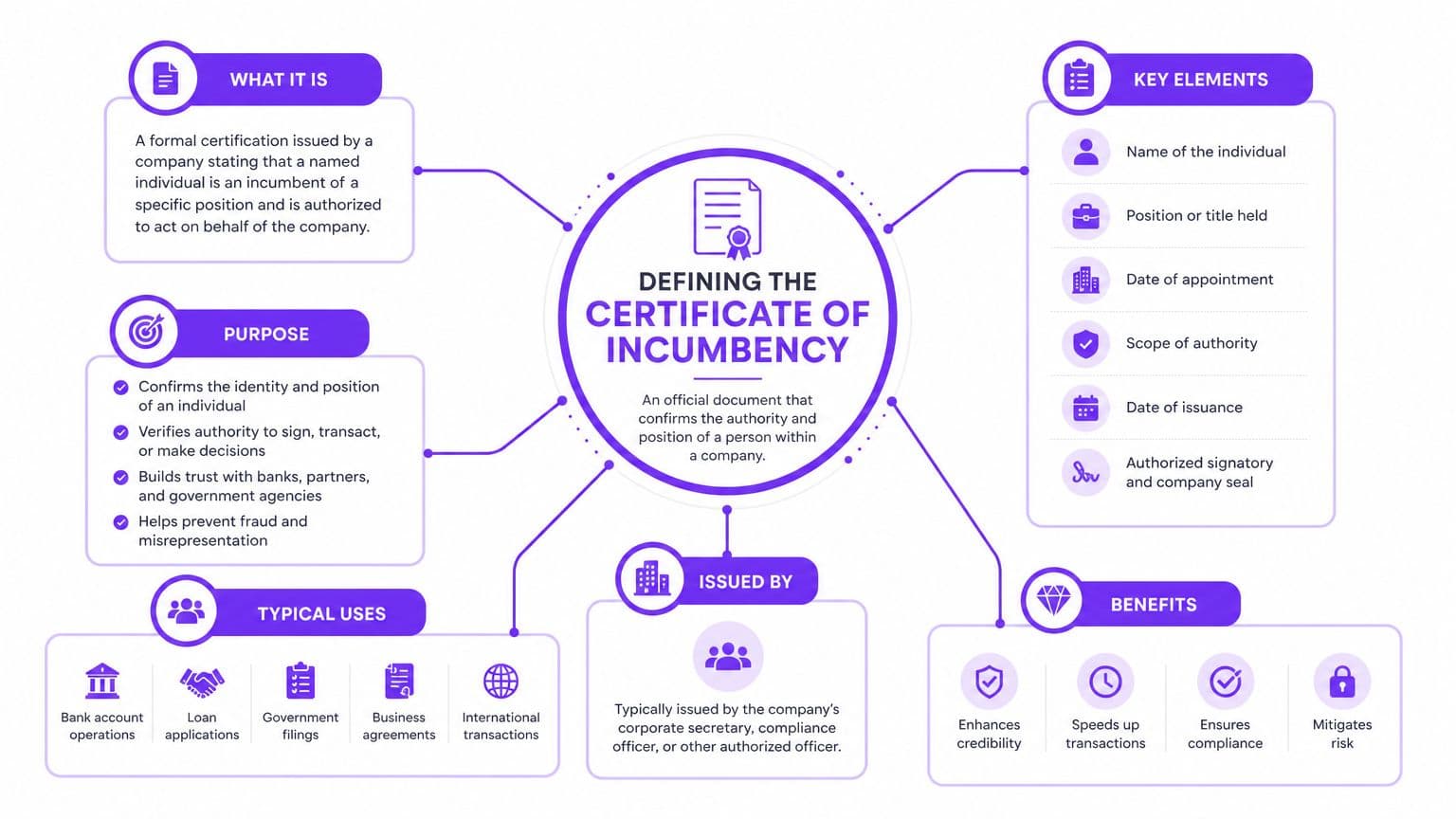
A certificate of incumbency is your company's internal authority record. It identifies the current officers, directors, members, or managers and confirms who is authorized to bind the entity in contracts, banking matters, and regulatory filings. It is typically issued by the company itself, often through the secretary or an authorized agent, not by the state, as explained by Delaware Inc. in its overview of the certificate of incumbency.
Think of it as a company-issued ID card for authority. A certificate of good standing proves your company exists and is compliant with state requirements. A certificate of incumbency proves who can act for it right now.
Why counterparties ask for it
This document became standard because it centralizes leadership information in one place. It commonly lists names, titles, appointment status, and sometimes shareholder details or specimen signatures. It is used when opening bank accounts, signing binding contracts, and presenting authority to regulators and other third parties, as described by Global Legal Law Firm's explanation of the document's development and use.
That history matters. The certificate evolved as a private corporate governance tool, not a state-issued form. That's why there are no universal statutory standards for format, and why your company prepares it from internal records such as bylaws, board resolutions, and shareholder registers.
Here is a short explainer if you want a visual walkthrough before drafting one:
Who should issue it
The issuing party is where many companies get sloppy. This is an internal document, so it should be prepared and certified by the corporate secretary or another properly authorized officer or agent. That person is certifying the state of the company's records as of a specific date.
Your best move is to support the certificate with clean record retention. If your board approvals, officer appointments, and equity records are a mess, the certificate won't save you. Fix the underlying archive first. A strong retention process for resolutions, bylaws, and governance records matters just as much as a strong retention process for accounting files, and this guide on how long to keep business records is a useful operational reference.
The certificate is only as credible as the records behind it.
Key Contents and a Sample Template
There is no universal statutory template. That doesn't mean anything goes. If you want the document accepted by counsel, banks, or auditors, it needs to be precise, current, and consistent with your actual records.
The core principle is non-negotiable. The certificate should match your underlying corporate records, including board minutes, bylaws, cap table, and appointment records, because discrepancies can undermine enforceability and delay onboarding, as noted by ICON Partners in its discussion of preparation and use.
What needs to be in the document
A workable certificate of incumbency usually includes:
- Company identity: Full legal name of the entity and, where relevant, jurisdiction of formation and registration details.
- Effective date: The exact date the certificate speaks as of. This is a point-in-time record.
- Certifying officer: The name and title of the person issuing the certificate on behalf of the company.
- Incumbency table: Each current officer, director, member, or manager listed by legal name and exact title.
- Authority statement: Language confirming that the listed people hold those offices and are authorized to act for the company.
- Specimen signatures: Often included when banks or cross-border counterparties want to match the signer to the authority record.
- Seal or notarization block: Often requested to strengthen evidentiary value in higher-trust transactions.
If you're an LLC, title discipline matters. Don't improvise role names. If your operating agreement uses “Manager” and “Member,” don't substitute “Director” because it sounds more formal. For a practical refresher on entity roles, Kons Law on LLC governance is a useful companion piece.
A practical sample template
Use this as a starting point, then have counsel review it against your entity documents.
Sample wording
The undersigned, being the duly authorized Secretary of [Company Legal Name], a [State] [Corporation/LLC], hereby certifies that the persons listed below currently hold the offices or positions stated next to their names as of [Date], and that each is authorized to act on behalf of the Company to the extent provided in the Company's governing documents and resolutions.
Name Title Date of Appointment Specimen Signature [Full Name] [Exact Title] [Date] [Signature] [Full Name] [Exact Title] [Date] [Signature] The undersigned further certifies that this certificate is based on the Company's current books and records, including its governing documents and resolutions, and remains effective as of the date written below.
Executed on [Date]
[Name of Certifying Officer]
[Title]
[Company Seal, if any]
[Notary block, if required]
A clean finance and reporting package helps because counterparties often request governance proof at the same time they ask for statements, cap table support, and organizational records. If you're building a standard diligence folder, these financial reporting package examples show the level of organization serious reviewers expect.
Incumbency Certificate vs Other Corporate Documents
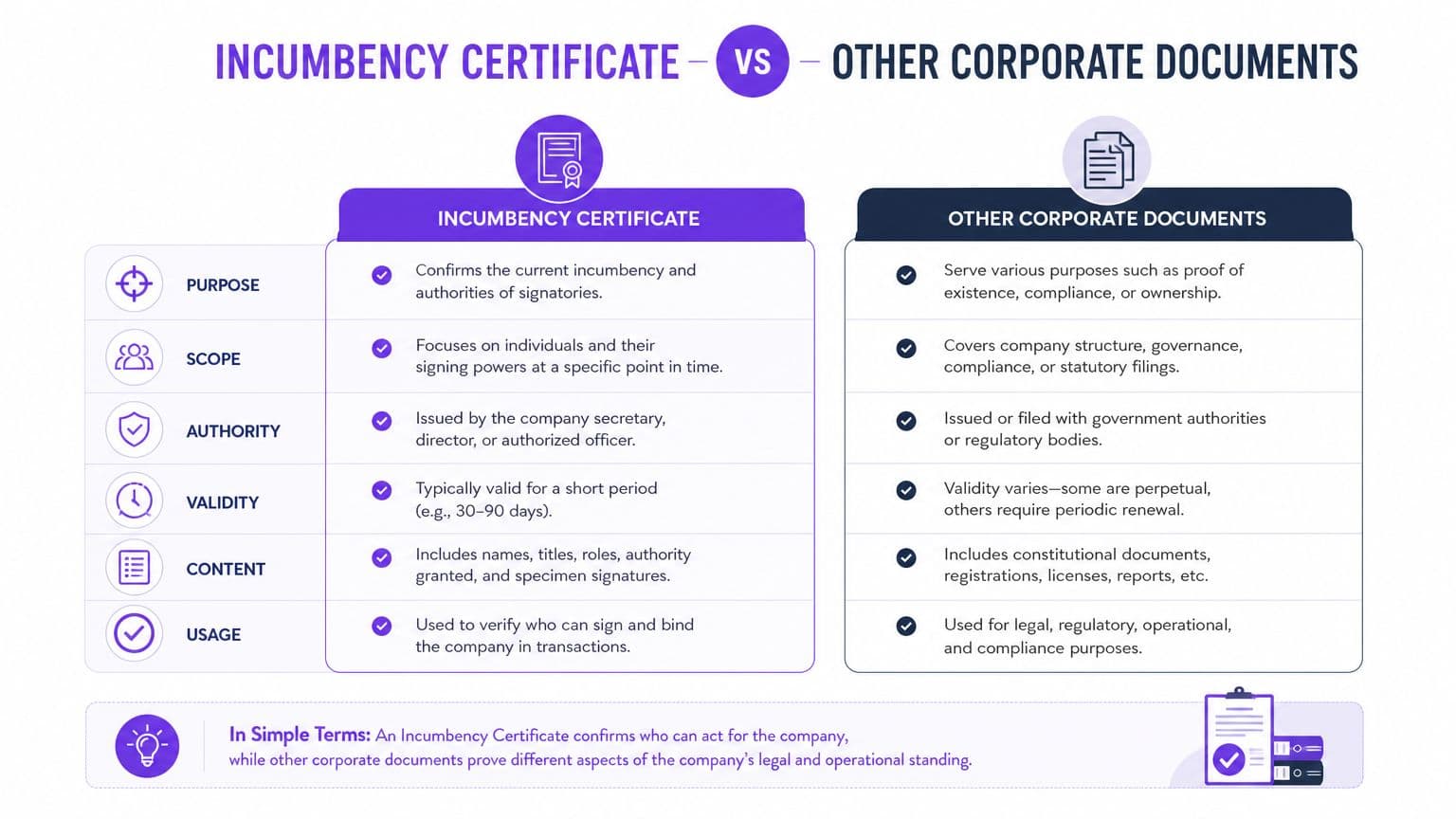
Most delays happen because someone sends the wrong document. A founder grabs a certificate of good standing from the state portal and assumes that's enough. It isn't.
A certificate of incumbency is an internal corporate authority document. A certificate of good standing is a state-issued status document. Those are different jobs. Investopedia also notes that the document is often confused with a government-issued filing, even though it is generally prepared by the company through the corporate secretary or another authorized officer, which is the core distinction many teams miss when dealing with banks and cross-border counterparties in Investopedia's explanation of the certificate.
Corporate Document Comparison
| Document | Issuer | Purpose | Typical Use Case |
|---|---|---|---|
| Certificate of Incumbency | The company, usually through the secretary or authorized agent | Verifies who currently holds authority to act for the company | Banking, contracts, diligence, cross-border verification |
| Certificate of Good Standing | State filing office | Confirms the entity exists and is in compliance with state requirements | Foreign qualification, lender packets, compliance support |
| Secretary's Certificate | The company secretary or authorized officer | Certifies corporate facts or attached resolutions, bylaws, or approvals | Closings, board approvals, transaction support |
| Incumbency Letter | The company | Provides informal or lighter verification of current roles | Preliminary diligence or lower-stakes requests |
The mistake that slows deals
The certificate of good standing tells the other side your entity is alive. It does not tell them whether your CEO, CFO, manager, or member has authority to sign. If a bank asks for proof of signatory authority and you send a good standing certificate, you haven't answered the question.
A secretary's certificate can be broader. It may attach board resolutions, certify bylaws, or confirm approval of a specific transaction. An incumbency certificate is narrower and more surgical. It answers one operational question: who holds office and signing authority as of a specific date?
If your team also gets tripped up on other entity documents, a plain-English reference like Acorn Business Solutions' company guide can help separate constitutional documents from authority certificates. That's useful because diligence requests often bundle them together.
Send the document that answers the request. Not the document with the most official-sounding title.
How to Obtain Authenticate and Avoid Common Pitfalls
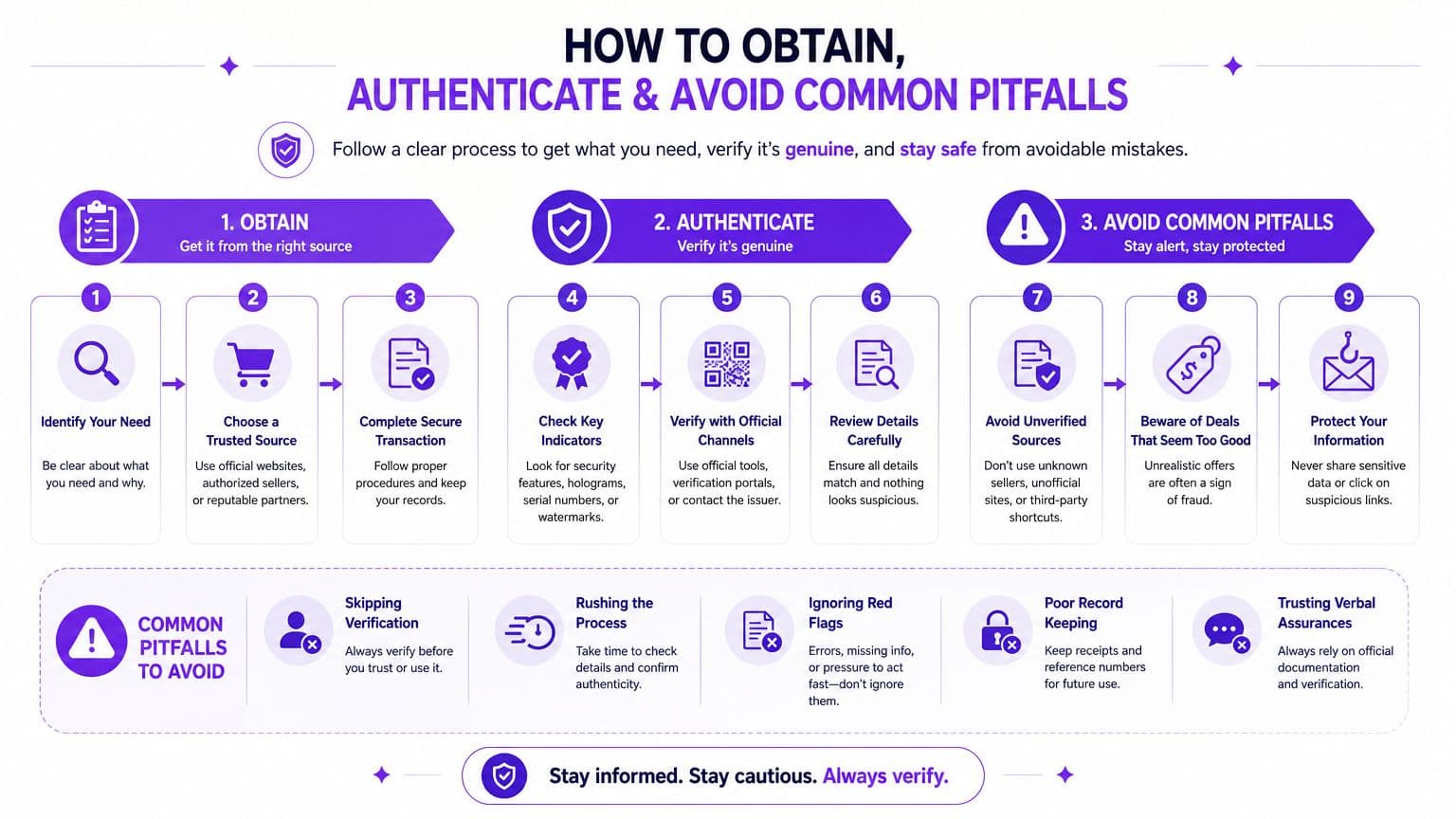
You don't need a complex process. You need a disciplined one. Most rejected certificates fail because the company rushed the draft, used stale information, or skipped the authentication layer the recipient expected.
Banks, auditors, and legal advisers often want a freshly issued version, commonly within 3 to 6 months of use, because they rely on it to verify signatory authority for transactions and compliance checks, according to Commenda's guidance on U.S. certificates of incumbency.
A clean workflow that gets accepted
Follow this order:
-
Pull official records Start with your bylaws or operating agreement, board minutes, written consents, officer appointment records, and any amendments.
-
Draft to exact titles
Use the titles that appear in those records. If the records say “President,” don't write “CEO” unless the records also authorize that title. -
Have the right person certify it
The corporate secretary or another authorized officer or agent should sign. Avoid self-certification if the facts make that look circular. -
Add notarization when the transaction calls for it
Not every use requires notarization, but many banks and international counterparties prefer it because it strengthens credibility. -
Handle international authentication early
If the document is going abroad, ask immediately whether the recipient needs an apostille or legalization. Waiting until the end is how teams miss closing dates.
If your company is preparing for a lender review or external audit at the same time, fold this process into your broader audit preparation checklist. Authority documents, accounting support, and legal records usually get reviewed together.
Red flags that trigger rejection
These are the mistakes that cause needless back-and-forth:
- Outdated leadership list: Your certificate names a former officer, omits a newly appointed manager, or ignores a recent board action.
- Title mismatch: The signature block says one thing, the certificate says another, and the board records say something else.
- Weak support files: Nobody can produce the resolutions or governing documents behind the authority statement.
- Missing date discipline: The certificate isn't clearly issued as of a specific date.
- International blind spot: You send a signed PDF, but the foreign bank required notarization and apostille.
A certificate of incumbency isn't hard to prepare. It's hard to defend when the underlying records are sloppy.
Your Action Checklist for Investor and Audit Readiness
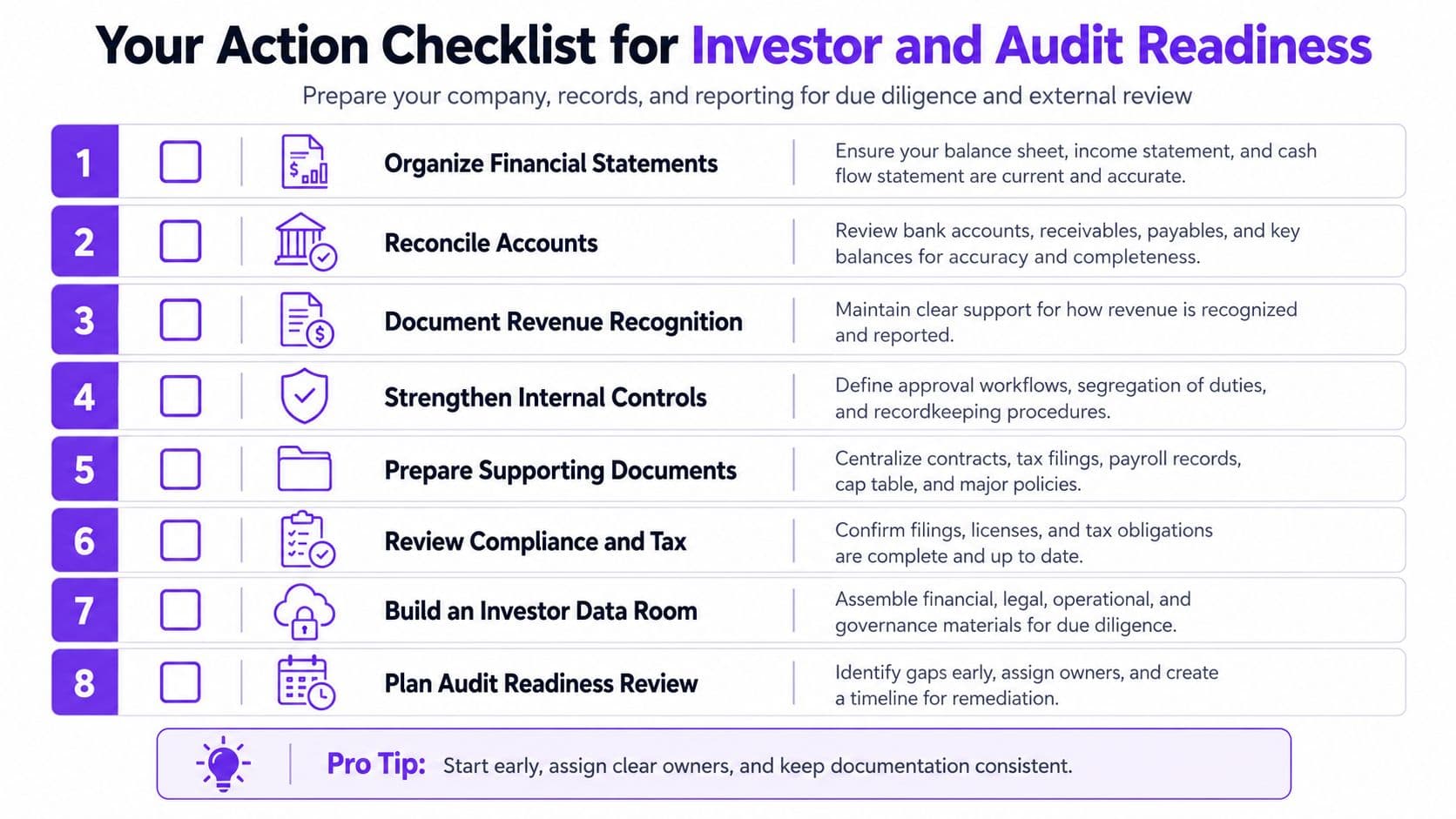
A certificate of incumbency becomes urgent only when your governance process is weak. Well-run companies don't scramble for this document. They issue it from an organized record set and move on.
The confusion starts because many people assume this is a state form. It isn't. Investopedia highlights that the document is often mistaken for a government-issued filing, when it is an internal company document prepared by an authorized officer. That misunderstanding is exactly why founders waste time searching the Secretary of State website instead of pulling internal records first.
What your team should do now
Use this operating checklist:
- Build a master authority list: Keep a current list of officers, directors, members, managers, and approved signers.
- Store the backup in one place: Board consents, bylaws, operating agreement, cap table support, and appointment records should sit in the same controlled folder.
- Create an approved template: Don't draft this from scratch during a live deal.
- Assign ownership: Name a primary and secondary person authorized to coordinate issuance.
- Reissue after changes: Any leadership, signatory, or structural change should trigger an update.
- Review on a regular cadence: If outside parties often want a recent certificate, don't wait until the next transaction.
- Pair it with diligence prep: Add it to your standing financial due diligence checklist so it gets refreshed with the rest of your readiness materials.
Common objections that waste time
Founders say, “Everyone knows I'm the CEO.” Internally, yes. Externally, that means nothing without records.
Finance leaders say, “We have a certificate of good standing already.” That proves the entity exists. It doesn't prove who can sign.
Operators say, “We'll prepare it when someone asks.” That's exactly backwards. If you wait for the request, you're forcing a time-sensitive transaction to depend on governance cleanup.
Keep the certificate current before the deal starts. That's what investor-ready and audit-ready companies do.
If you want your books, board support files, and diligence materials organized so requests like this never stall a transaction, talk to Jumpstart Partners. Their team helps growing companies build investor-ready and audit-ready financial operations, including the records discipline that keeps authority documents accurate when it matters most.