Financial Operations
What Is Accounts Payable? Definition, Workflow and KPIs
Learn what is accounts payable, how the AP cycle runs from invoice to payment, and which controls and KPIs keep your cash and close on track.
ByJumpstart Partners, CPA, QuickBooks ProAdvisor
··14 min readAccounts payable is the short-term liability a business owes suppliers for goods and services it has received but not yet paid for. Paying those bills faster isn't always better, even when your supplier gives you 30 to 90 days to pay.
For founders running SaaS companies, agencies, and professional services firms, the objective isn't an empty invoice queue. It's knowing which obligations are real, when cash must leave, and who has authority to release it. Treat AP as both a cash-flow lever and a control system, not a bookkeeping chore.
Table of Contents
- What Accounts Payable Means and Where It Sits
- How the Accounts Payable Cycle Runs From Invoice to Payment
- Controls That Stop Duplicate and Fraudulent Payments
- KPIs and Benchmarks to Track DPO and Aging
- When to Pay, Hold or Renegotiate a Bill
- Misconceptions and Red Flags in Your AP Process
- Decide Whether to Automate or Outsource Accounts Payable
What Accounts Payable Means and Where It Sits
Accounts payable sits among your current liabilities on the balance sheet. It represents supplier obligations, not available spending money. When your AP records are incomplete, your finance team starts the close with missing costs and builds cash forecasts around understated commitments.
The U.S. Treasury's accounting guidance defines AP around obligations for goods and property received, external services rendered, and other qualifying commitments. The important milestone is receipt and acceptance, not the payment date.
Follow the obligation, not the bank transaction
Say your SaaS company receives a $4,800 cloud hosting invoice in March for hosting consumed that month. You accept the charge but pay it in April.
| Event | Debit | Credit | Business effect |
|---|---|---|---|
| March hosting recorded | Cloud hosting expense $4,800 | Accounts payable $4,800 | March includes the cost and unpaid obligation |
| April payment released | Accounts payable $4,800 | Cash $4,800 | The obligation clears and cash falls |
You don't record another hosting expense when you pay. Doing so would count the same cost twice.
A purchase can also create an asset rather than an immediate expense. For example, an unpaid invoice for qualifying equipment increases the asset account and AP; paying it later clears AP.
Accounts payable compared with expenses and debt
| Item | What it records | When cash moves |
|---|---|---|
| Accounts payable | Unpaid balance for goods or services already received, such as the hosting bill | When you pay the bill |
| Expense | Consumption of goods or services in a period, such as March hosting | Not tied to a payment date |
| Debt | Borrowed money under a loan agreement | At borrowing and on the repayment schedule |
Typical AP items include software subscriptions, contractors, rent, cloud infrastructure, marketing services, and professional fees. Missing bills understate liabilities and expenses. Duplicate or unauthorized bills overstate costs and can drain cash.
Practical test: Has your business received the work, and is it still unpaid? Recognize the obligation. Don't wait for the bank transaction to make it real.
How the Accounts Payable Cycle Runs From Invoice to Payment
A reliable AP cycle leaves evidence at every handoff. The Washington State Auditor's Accounts Payable Guide supports separating responsibilities and matching invoices against purchasing and receiving records before payment.
Use this sequence to keep a bill visible from arrival through settlement.
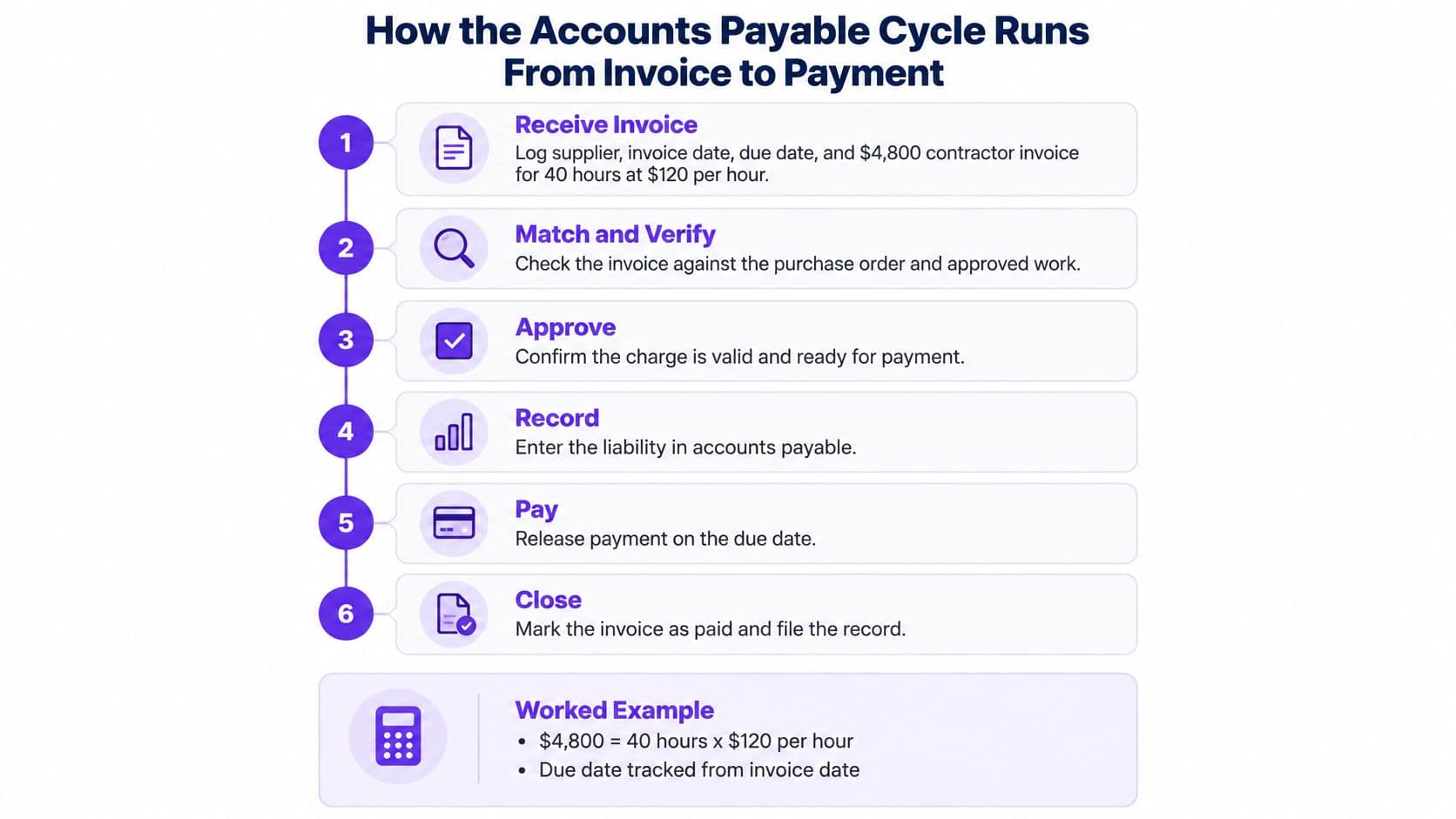
Move each invoice through a documented workflow
Consider a hypothetical contractor invoice: 40 hours × $120 per hour = $4,800.
-
Receive and log the invoice. Capture the supplier, invoice number, invoice date, due date, and amount in your bill register. The common slip is leaving the invoice in a project manager's inbox, where finance can't forecast or process it.
-
Match the obligation. Compare the invoice with the hypothetical $4,800 purchase order and approved timesheet confirming delivery of 40 hours. Send disagreements about hours, rates, or acceptance to an exception queue rather than paying first and investigating later.
-
Code the cost. Assign contractor expense and tag the relevant client or project so delivery margins reflect the work consumed. Don't dump everything into general overhead, which hides whether an agency engagement earned money.
-
Obtain the right approval. A sample policy could let a manager approve up to $5,000, with founder approval above that amount. Record the approval against the bill, because an informal chat message is easy to lose and difficult to audit.
-
Schedule payment. Under hypothetical net 30 terms, schedule payment for the contractual due date and check it against payroll and debt commitments. Don't confuse the invoice's arrival date with permission to pay immediately.
-
Pay and reconcile. Debit AP, credit the bank account, and match the bank transaction to the recorded bill. The common slip is recording the bank payment as a new expense, leaving the original bill open.
Keep the accounting system connected
In QuickBooks, Xero, or NetSuite, enter each bill against the vendor record using the bill-entry workflow. That routes the obligation into the AP sub-ledger, the detailed record supporting your balance-sheet account.
Entering an unpaid bill as a direct bank transaction bypasses AP aging. When the actual payment arrives, match it to the bill rather than creating another transaction.
Use a documented invoice reconciliation process to connect invoices, credits, and settlements. Before close, the AP general-ledger balance must equal the total open bills in the sub-ledger, after resolving adjustments and unapplied items.
Controls That Stop Duplicate and Fraudulent Payments
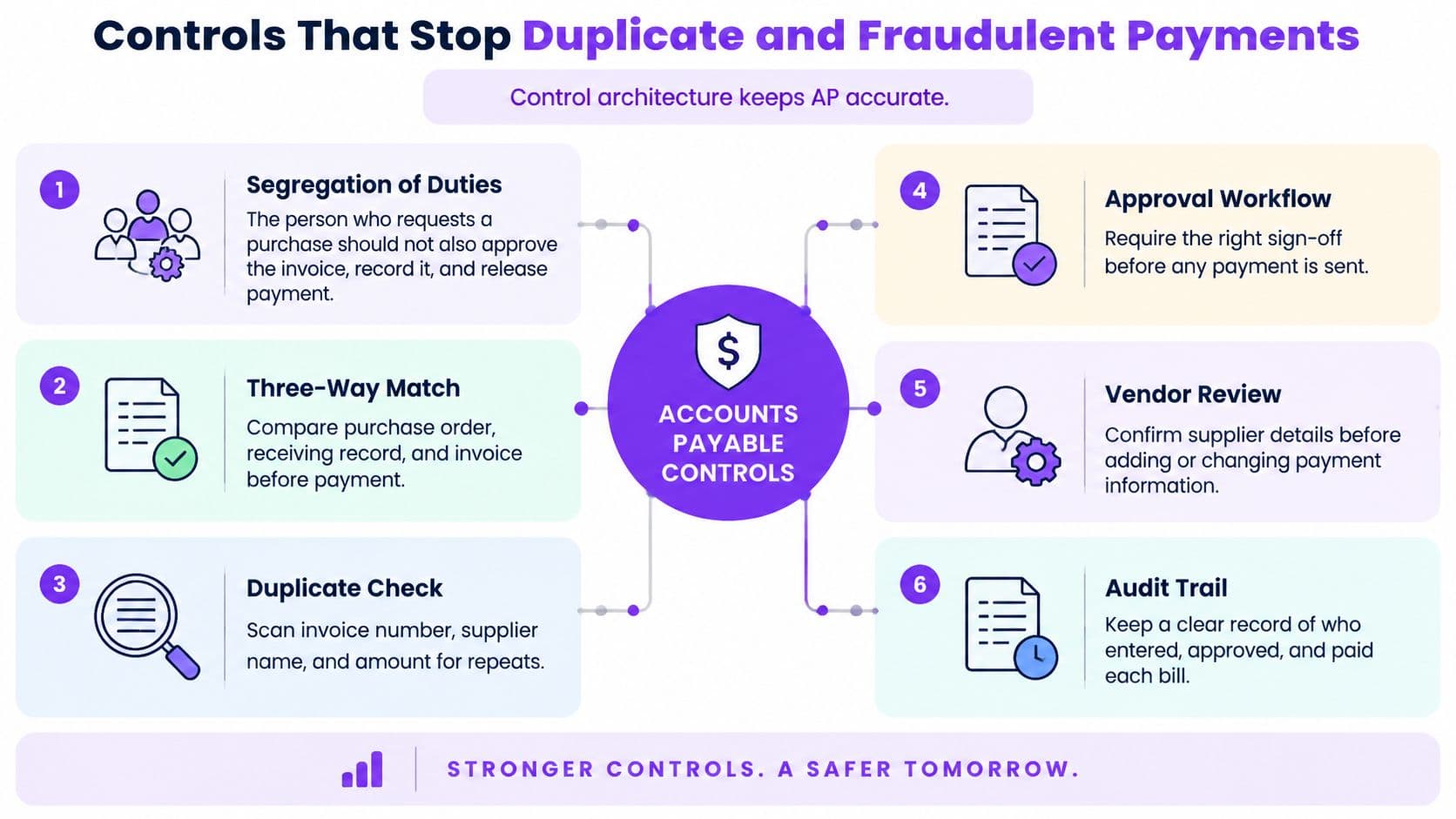
The person requesting a purchase shouldn't also approve it, record it, and release payment. If your team is small, separate payment release from bill preparation and give the founder an independent review role.
Automation doesn't remove that requirement. The SAP Concur 2026 AP automation trends report coverage reports that 77% of organizations still manually enter invoices, 7% describe AP as fully automated, and 19% use AI. Those adoption figures aren't proof that any particular workflow is controlled.
Set the rules before delegating
Put these controls in writing:
- Match before payment: Use a three-way match between the invoice, purchase order, and receiving evidence. For services, acceptance can be an approved timesheet or milestone sign-off.
- Name approvers: Assign approval thresholds to named roles and document substitute approvers.
- Protect vendor records: Require someone independent of bill processing to approve supplier creation and changes.
- Verify bank changes: Call a known supplier number already in your records. Don't use the number supplied in the change request.
- Detect duplicates: Compare vendor, invoice number, and amount, including invoices entered with slightly different formatting.
- Hold exceptions: Block payment until someone resolves missing receipts, disputed charges, or unusual instructions.
- Review access quarterly: Remove departed users and permissions that no longer match current responsibilities.
A captured invoice proves that software read a document. It doesn't prove that your company authorized the purchase or received the service.
The highest-risk delegation point is moving away from founder approval without establishing thresholds and an audit trail. Treat automation as control redesign, not just faster typing.
Use this control map when assigning responsibilities.
AI can assist with capture, matching, and anomaly detection. Keep human review for unusual vendors, related-party transactions, and payments outside normal procurement.
This week, select five payments from last month. Trace each to purchasing authorization, receipt evidence, and an approver. Any payment you can't trace exposes a control gap, even if the amount looks reasonable.
KPIs and Benchmarks to Track DPO and Aging
Days Payable Outstanding, or DPO, estimates supplier-payment timing:
DPO = accounts payable ÷ annual cost of goods sold × 365
For a hypothetical business with $120,000 of AP and $800,000 of annual COGS:
$120,000 ÷ $800,000 × 365 = 54.75 days, or about 55 days.
For a more representative period measure, use average AP rather than a single closing balance. Keep the calculation consistent so a reporting change doesn't masquerade as a cash-management improvement.
Read DPO alongside contractual terms
A rising DPO isn't automatically good. Your finance lead must establish whether it reflects negotiated terms, a different supplier mix, or overdue bills.
A falling DPO isn't automatically good either. You may be releasing cash before the contract requires it without receiving anything in return.
For service businesses without a meaningful COGS line, use a clearly defined supplier-related operating-expense denominator and label the result as an adapted payment-days measure. State that choice in every report, exclude noncash costs, and don't compare it directly with conventional COGS-based DPO.
AP aging buckets and the action for each
| Aging bucket | Typical status | Action |
|---|---|---|
| Current (not yet due) | Normal cash planning | Pay on the scheduled date |
| 1-30 days past due | Missing approval or unresolved receipt | Find the root cause and clear it this week |
| 31-60 days past due | Persistent dispute, approval delay, or cash constraint | Assign an owner and confirm a resolution date with the supplier |
| 61-90 days past due | Elevated escalation or service-interruption risk | Review with the finance lead and agree a documented settlement plan |
| Over 90 days past due | Possible duplicate, missed invoice or lost bill | Escalate to the founder and check for duplicates or unrecorded liabilities |
These are investigation prompts, not conclusions about every invoice. Age bills from their due dates, not their invoice dates.
Suppose $18,000 of the hypothetical $120,000 AP balance is more than 60 days past due. The calculation is $18,000 ÷ $120,000 × 100 = 15%. That's the share requiring escalation review, not a forecast that every supplier will stop work.
Report measures that trigger decisions
Use an accounts payable aging report to identify individual obligations behind the headline balance. Broad small-business payment benchmarks provide context, but your agreed supplier terms should determine whether your performance is acceptable.
Your monthly management package should include:
- DPO: Show the trend and explain changes.
- Total aging: Split the balance into due-date buckets.
- Overdue invoice count: Identify whether delays are isolated or widespread.
- Duplicate invoices caught: Track prevented errors and fix their source.
When to Pay, Hold or Renegotiate a Bill
Faster payment isn't always better cash management. Pay early when the economic benefit justifies it, hold unresolved charges through a documented exception process, and renegotiate before an affordable bill becomes an overdue one.
Make the decision against your cash commitments, not the pressure of an inbox.
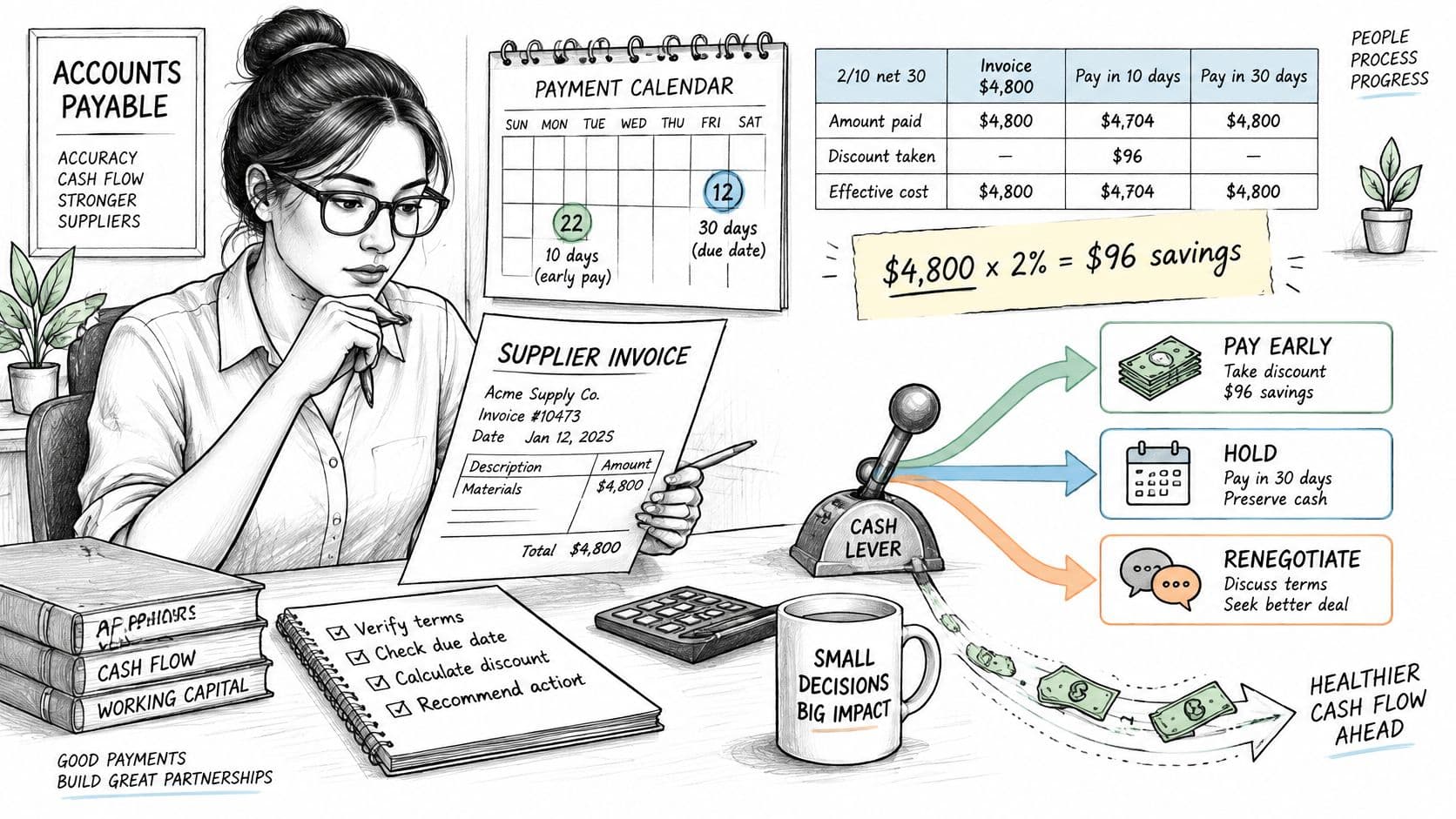
Calculate the value of paying early
Consider hypothetical 2/10 net 30 terms: a 2% discount for paying within 10 days, rather than paying the full amount within 30 days. The simple annualized return on paying early is 2 ÷ 98 × 365 ÷ 20 = 37.2%.
That's attractive when cash is available. If taking the discount pushes your forecast below your minimum cash buffer, preserve liquidity instead.
Late payment isn't an alternative discount strategy. According to Xero Small Business Insights, as reported in Xero's AP guide, US small-business payment delays fell from 9.3 days late in Q1 2025 to 7.8 days late in Q4 2025. Treat that as market context, not permission to miss your own deadlines.
| Decision | Legitimate approach | Harmful substitute |
|---|---|---|
| Pay | Use agreed terms and capture worthwhile discounts | Pay immediately without checking liquidity |
| Hold | Document the disputed amount, owner, and resolution date | Ignore the invoice |
| Renegotiate | Agree revised terms before payment is due | Use suppliers as an unplanned loan |
Payment timing belongs in the broader cash-planning routine.
Schedule approved payments around payroll and debt dates without breaking supplier agreements. Give every bill a pay date tested against your 13-week cash forecast, and have the founder or finance lead review that schedule weekly.
Misconceptions and Red Flags in Your AP Process
Your obligations aren't limited to invoices that have arrived. The U.S. Treasury's financial statement note on accounts payable recognizes estimation when services have been received but invoices aren't available at reporting date. In your business, finance should capture these costs through an accrual, often in a separate accrued-expenses account, rather than leave them out.
Missing that entry understates liabilities and overstates period profit. When the invoice arrives, clear or reverse the accrual so you don't recognize the cost twice.
Warning signs worth investigating now
| Red flag | First check this week | Likely cost |
|---|---|---|
| Supplier bank change without a callback | Call a known number before activating the change | Diverted cash |
| Payment without purchasing or receipt evidence | Trace last month's payments to authorization and acceptance | Unauthorized spending |
| AP doesn't tie to open bills | Reconcile the register to the ledger before sign-off | Unreliable working capital |
| Invoices over 90 days old without dispute notes | Review each bill and clear, dispute, or correct it | Supplier escalation and unreliable liabilities |
| Same vendor bills the same amount twice within 30 days | Compare invoice numbers, service periods, and credits | Duplicate cash outflow and overstated expenses |
| Close repeatedly ends with unrecorded bills | Build an unbilled-services accrual list | Overstated profit and a late close |
Repeated amounts aren't automatically duplicates, especially for subscriptions and retainers. They're a reason to check service periods before releasing payment.
Which failure is most plausible at your current size? A hypothetical $1M agency may need someone to own intake, while a $10M firm may need tighter delegated approval and system access controls.
Decide Whether to Automate or Outsource Accounts Payable
Automate when you already have written approval rules and a named monthly close owner. Outsource when nobody owns AP reconciliation or your team lacks the controller capacity to review it.
Automation helps with invoice capture, matching, and approval routing. Outsourcing supplies an accountable operator and reviewer, but you still need clear authority over payment release.
Comparing AP operating models
| Option | Cost | Control ownership | Speed to close | Fraud controls |
|---|---|---|---|---|
| In-house manual AP | Staff time and accounting software | Founder or controller | Slowest under comparable workload | Manual checks only |
| In-house automated AP | Staff time plus software and implementation | Finance lead with written thresholds | Faster when integrations work | Approval rules, restricted access, and exception review |
| Outsourced AP | Monthly fee from $2,500 after scope is confirmed | Named external owner with reviewed close | Faster with complete handoffs | Access reviews, separated duties, and approval evidence |
These are operating-model comparisons, not guaranteed outcomes. Automation without thresholds moves errors faster; outsourcing without access reviews leaves stale permissions in place.
Before choosing accounts payable outsourcing, complete a short readiness check:
- List open bills with their approver and due date.
- Trace recent payments through authorization, receipt, and matching.
- Tie AP to the bill register and assign unresolved differences.
Start with our Finance Ops Scorecard, which asks three quick questions to identify your first likely finance break, with no email required. For a broader review, our Finance Ops Diagnostic includes a current stack and handoff review, spreadsheet dependency map, unclear owner and review gap inventory, recommended cleanup path, and monthly routine recommendation.
Jumpstart Partners offers controller-led finance support and fixed-fee AP setup projects to clarify approvals, reconcile obligations, and connect payment timing to cash planning. Monthly finance help starts from $2,500 per month, after scope is confirmed. Visit Jumpstart Partners to start with the Finance Ops Scorecard or discuss a Finance Ops Diagnostic for your payable workflow.