Financial Operations
What Is Balance Sheet Reconciliation? a Step-by-Step Guide
Wondering what is balance sheet reconciliation? Learn why it matters, which accounts to reconcile, and how to do it step by step with worked examples.
ByJumpstart Partners, CPA, QuickBooks ProAdvisor
··18 min readBalance sheet reconciliation is the period-end process of comparing each balance-sheet account with independent evidence, investigating every difference, and recording a documented correction or explanation. You're looking at a cash balance that looks right, a board deck due tomorrow, and no clear file showing why that balance is right. That gap is the problem. A good reconciliation doesn't just make two numbers agree. It builds an evidence file you can defend to a lender, investor, auditor, or buyer without reconstructing the month from memory.
Table of Contents
- What Balance Sheet Reconciliation Is and Why It Matters
- Accounts You Reconcile and What Each One Proves
- How to Reconcile an Account Step by Step
- Reconciliation Cadence and Close Timeline
- Worked Example With Cash and Receivables
- Where Reconciliations Break and How to Fix Them
- Controls and Tools That Make Reconciliations Reliable
- Decide Whether to Reconcile In-House or Hand It Off
What Balance Sheet Reconciliation Is and Why It Matters
Think of a personal checkbook register checked against the bank statement each month. You compare what you recorded with what the bank recorded, explain deposits still in transit, and book the fees you missed. Balance sheet reconciliation applies that same discipline to every balance-sheet account, not only cash.
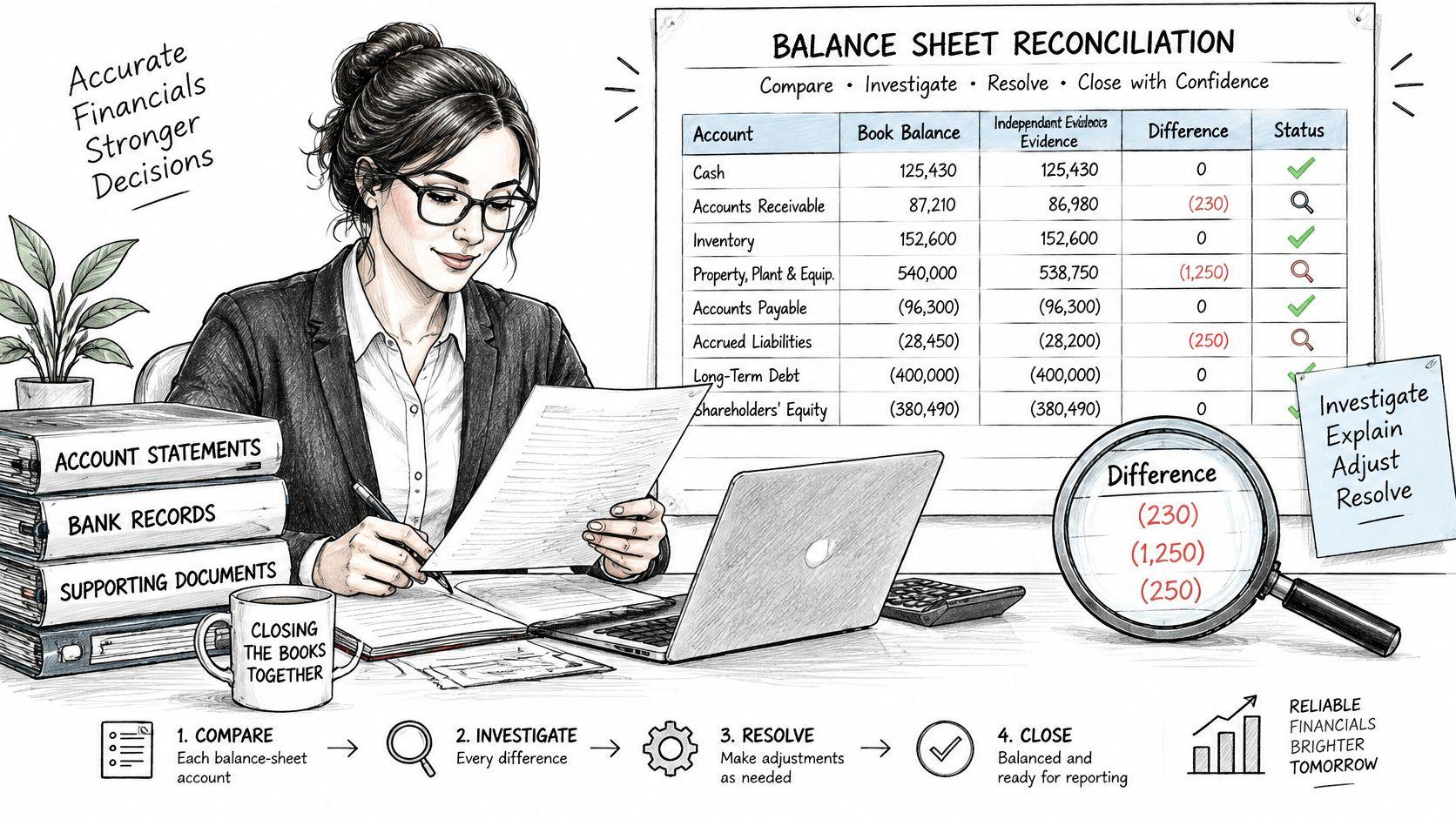
The COSO Internal Control Integrated Framework, originally issued in 1992 and refreshed in 2013, reflects the purpose behind this control. You're seeking reasonable assurance that assets, liabilities, and equity are complete, accurate, properly classified, and supported by evidence.
What This Means at Your Stage
At $500K to $20M in revenue, you don't need bureaucracy. You need numbers you can act on. If cash is overstated by an unrecorded bank fee, receivables include an invoice a customer never agreed to pay, or deferred revenue is released too early, your margin, runway, and hiring decisions sit on sand.
Monthly reconciliation before you close the ledger stops small errors from compounding. A missed $550 bank item is a nuisance in one month. Twelve months of missed processor fees, unapplied payments, and stale accruals become a restatement conversation.
Every reconciling item ends in one of three places:
- Matched: The ledger and the independent record agree, and evidence supports both sides.
- Explained: The difference is real and temporary, such as a deposit in transit, with an owner watching it clear.
- Corrected: You post a journal entry because the ledger was wrong or incomplete.
A zero difference doesn't prove accuracy. An unsupported journal entry can force two records to agree while the accounting stays wrong.
That's why avoiding common reconciliation errors matters as much as learning the mechanics. Your file should show the account, period, book balance, independent balance, each difference, the evidence, the correction, and who reviewed it. When you learn how to analyze a balance sheet, that evidence is what turns a static report into a reliable view of cash, working capital, and obligations.
Accounts You Reconcile and What Each One Proves
Each account needs a different reference document. Cash proves itself against the bank. Receivables prove themselves against customer detail. Deferred revenue proves itself against contracts. If you use the wrong reference, you'll match totals and miss the actual error.
The Washington State Auditor's bank reconciliation guidance describes reconciliation as a control that proves each account agrees to an independent source or detailed supporting schedule at a defined reporting date. For cash, differences fall into timing items, omitted ledger entries, items in the ledger but not at the bank, or errors.
The Lookup Table You Will Reuse
| Account | Compare against | Typical reconciling items | What it proves |
|---|---|---|---|
| Bank and cash | Bank statement | Deposits in transit, outstanding checks, bank fees, interest | Cash exists and is recorded in full |
| Accounts receivable | Customer-level subledger and invoices | Unapplied payments, credit memos, invoices posted late | Customers owe what you report |
| Accounts payable | Vendor statements and unpaid bills | Unrecorded bills, duplicate entries, payment timing | Every obligation is recorded |
| Fixed assets | Asset register and depreciation schedule | Disposals not removed, missing depreciation, capitalization errors | Assets exist and depreciation is correct |
| Accruals | Accrual schedule and post-close invoices | Reversals not posted, expenses booked in the wrong period | Expenses sit in the right period |
| Owner's equity | Equity roll-forward and capital records | Unrecorded distributions, unsupported contributions | Ownership changes are documented |
| Deferred revenue | Contract schedule and billing records | Revenue recognized early, billings not matched to contracts | Revenue is recognized as it is earned |
| Payroll liabilities | Payroll register and tax filings | Unremitted taxes, timing of payroll runs | Liabilities match what is owed |
Behind every row sit five objectives. You're testing completeness, existence, cutoff, valuation, and ownership. Completeness asks whether everything is recorded. Existence asks whether recorded items are real. Cutoff asks whether they landed in the right period.
Valuation and ownership catch subtler problems. A receivable can exist but be overstated after a credit memo. Equipment can sit on your register after you sold it. A SaaS contract can be billed in full while only part of the service has been delivered, which means the rest belongs in deferred revenue, not revenue.
For subscription businesses, start with three accounts if you're reconciling nothing else this month. Reconcile cash, accounts receivable, and deferred revenue first. Those three drive runway, collections, and reported growth, and errors there distort the decisions you make fastest.
How to Reconcile an Account Step by Step
Use the same six steps every month. Consistency matters because your reviewer, auditor, or successor needs to follow the file without asking you what happened.
The visual below shows the sequence at a glance before you work through each step.
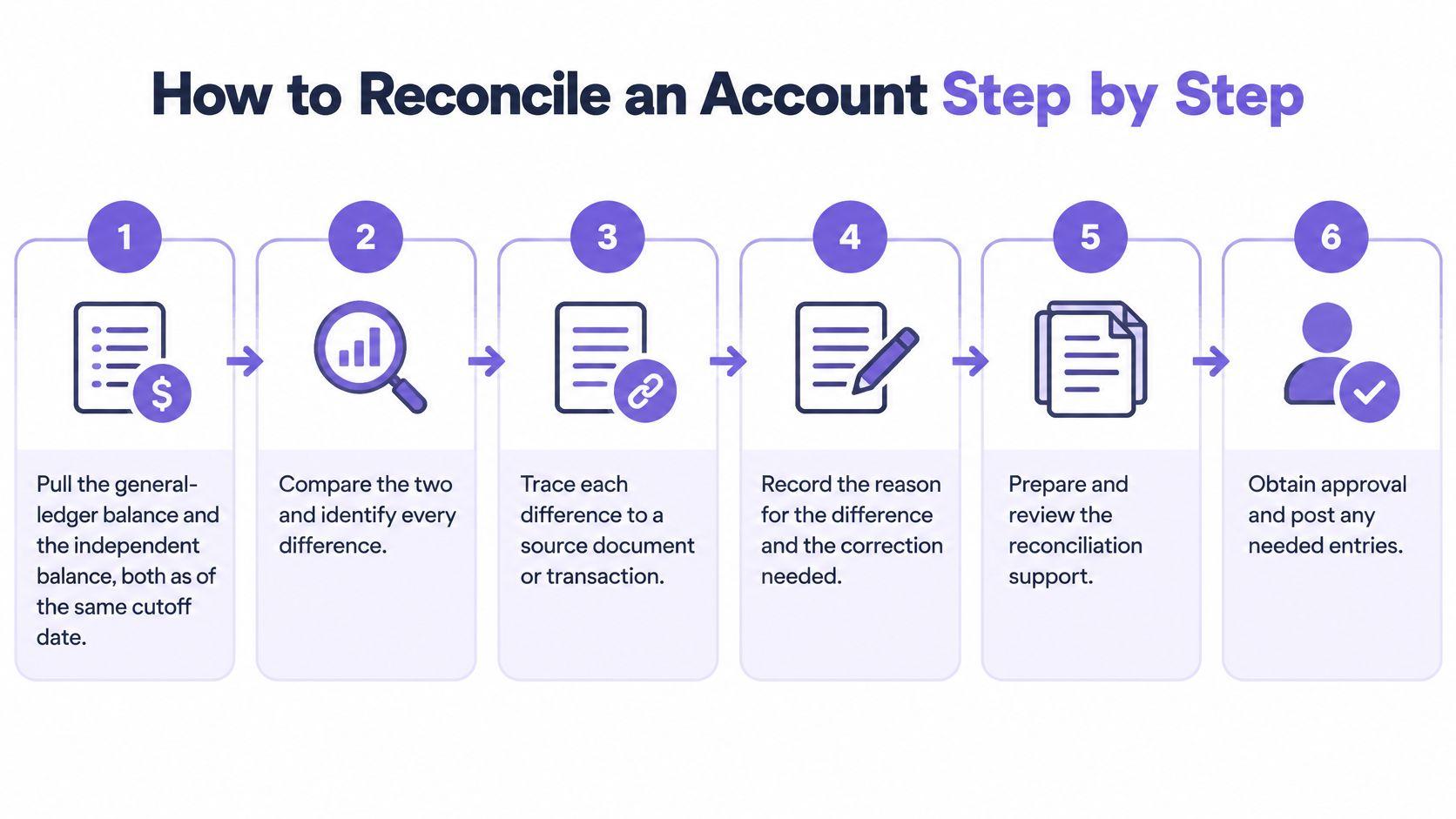
The Six Steps
- Pull both balances at the same cutoff. Take the general-ledger balance and the independent balance as of the same date. A bank statement through December 31 compared with a ledger through January 3 will manufacture differences that don't exist.
- List every difference. Compare totals and activity, including accounts where the ending balances agree but individual transactions don't. Agreement at the top can hide two offsetting errors underneath.
- Classify each difference. Label it a timing item, an omitted ledger entry, a recording error, or unknown. Classification tells you the next action. Timing items clear on their own, omissions need entries, and unknowns need investigation.
- Attach evidence to every item. Link the bank line, invoice, contract, vendor statement, or payroll report. A note saying timing difference isn't evidence. The document showing the date and amount is evidence.
- Post corrections and assign unknowns. Book journal entries for errors and omitted items. Give every unknown a named owner and a due date before close ends, not after someone asks about it next month.
- Get review and sign-off. Record the preparer, date, reviewer, and approval. Confirm the residual difference is zero, or fully explained by listed items that will clear.
If you want the cash version in more detail, work through how to reconcile bank accounts alongside your first live month. The habit transfers directly to receivables, payables, and deferred revenue once the reference document changes.
The short walkthrough below shows the mechanics in motion if you learn better by watching than reading.
What Your Template Must Contain
Build one template and reuse it. Include the account and period, book balance, independent balance, reconciling items with amounts and aging, evidence reference, required journal entry, and preparer and reviewer. Aging matters more than most founders expect, because a reconciling item that's 10 days old is normal and one that's 100 days old is a problem wearing a label.
Completion rule: A reconciliation is complete only when the last dollar of difference has a documented explanation, evidence, and owner.
Reconciliation Cadence and Close Timeline
Don't reconcile everything on the same day just because the calendar flipped. Frequency should follow transaction volume and risk. High-volume cash moves daily, so waiting a month turns a five-minute check into an afternoon of archaeology. Equity changes rarely, so a quarterly roll-forward gives you the same assurance for less effort.
| Account | Frequency | Timing | Reviewer |
|---|---|---|---|
| Bank and cash | Daily or weekly for high volume, monthly otherwise | Each business day or week | Controller |
| Accounts receivable | Weekly for card-heavy subscription businesses, monthly otherwise | After payment and payout runs | Controller |
| Accounts payable | Monthly | After the bill cutoff, before close | Controller |
| Accruals and deferred revenue | Monthly | Close days 2 to 3 | Controller |
| Fixed assets | Monthly for additions, quarterly roll-forward | After purchases and disposals | Controller |
| Payroll liabilities | Monthly | After each payroll run | Finance lead |
| Owner's equity and debt | Quarterly | When loan statements or distributions occur | Founder or controller |
In 2025, 50% of finance teams reported taking six or more business days to close their books in a survey of 100 finance professionals published by CFO and based on Ledge's 2025 month-end close benchmarks. That doesn't prove a faster close for you. It does show where the middle of the pack sits.
Set a Five-Day Target and Work Backward
A close inside five business days is a practical target when reconciliations happen during the month. Reconcile cash weekly, clear processor payouts as they land, and update deferred revenue when contracts are signed. By close week, you're confirming balances instead of discovering them.
Sequence matters too. Accruals and payables need to land before final margin reporting, because late vendor bills change expenses. Deferred revenue needs contract review before you release revenue numbers. Use a written month-end closing checklist so dependencies are visible, not held in one person's head. At Jumpstart Partners, close, reporting, review points, and owner responsibilities are made explicit before the monthly cadence starts. Write yours down the same way, with an owner and review point for each step, before your first month runs.
Worked Example With Cash and Receivables
Numbers make this concrete. Say you're a SaaS company closing December. Your bank statement and your ledger disagree, and your receivables subledger disagrees with the ledger by a smaller amount. Neither gap is a crisis yet. Both need a documented answer.
December Bank Reconciliation
Start with the bank side. The statement shows $52,900. You deposited $4,000 on December 31 that the bank recorded in January, so add it. You also have $8,650 in checks you issued that recipients haven't cashed, so subtract those. Your adjusted bank balance is $48,250.
Now work the book side. Your general ledger shows $47,700. The bank credited $550 of interest that you haven't booked yet, so add it. Your adjusted book balance is also $48,250. The two adjusted balances match, and the unexplained difference is $0.
| Line | Amount |
|---|---|
| Balance per bank statement | $52,900 |
| Add deposit in transit | $4,000 |
| Less outstanding checks | $8,650 |
| Adjusted bank balance | $48,250 |
| Balance per general ledger | $47,700 |
| Add interest credited by bank, not yet booked | $550 |
| Adjusted book balance | $48,250 |
| Unexplained difference | $0 |
Check the arithmetic yourself. $52,900 + $4,000 = $56,900, and $56,900 − $8,650 = $48,250. On the book side, $47,700 + $550 = $48,250. Every dollar of the original $5,200 gap between the statement and the ledger now has a name.
The reconciliation isn't finished when the math works. You still post a journal entry debiting cash and crediting interest income for $550. You list the outstanding checks by number, payee, and date so next month's preparer can confirm they cleared. You keep the deposit slip or bank feed record for the $4,000 deposit in transit.
Receivables With a $2,500 Gap
Your customer subledger totals $212,400. The general ledger shows $209,900. The difference is $2,500, and it equals exactly one invoice amount, which is your first clue.
You trace it to an invoice issued December 30 that posted to the billing system and subledger but never reached the ledger. The fix depends on what you sold. If you delivered the service in December, debit accounts receivable and credit revenue for $2,500. If the customer prepaid for future service, debit accounts receivable and credit deferred revenue instead.
That distinction is the whole point. A matching exercise would force the totals together. An evidence file forces the reviewer to check the contract, confirm the service period, and approve the recognition treatment before signing.
The correcting entry is the real output of a reconciliation. The matching totals only tell you where to look.
Where Reconciliations Break and How to Fix Them
The most common misconception is simple. Founders see a zero difference and assume the account is right. It isn't proof. Two records can agree because both contain the same wrong entry, or because someone plugged a journal entry to force a tie-out before close.
Public-company filings keep surfacing the same weakness. One recent SEC filing described fixed-asset errors tied to management's failure to investigate and resolve reconciling items. The lesson scales down cleanly. Unresolved items don't stay small, they get buried under next month's activity.
Diagnose by Symptom
| Symptom | Likely cause | Fix |
|---|---|---|
| Difference equals one transaction amount | Missed posting on one side | Post the missing entry and reconcile again |
| Outstanding checks older than 90 days | Checks never cashed or voided | Contact the payee, then void and reverse the entry |
| Difference grows each month | Broken feed, such as payouts that net fees and refunds | Map the source flow and fix the feed |
| Balance ties but the account looks wrong | Wrong account or classification | Review the journal and reclassify |
| Deferred revenue ties but revenue is early | Revenue recognized before performance | Recheck against the contract schedule |
| Unknown items persist across months | No owner assigned | Assign an owner and due date, then escalate |
| Processor payouts do not match sales | Fees and refunds netted in one entry | Record gross sales, fees and refunds separately |
A growing difference deserves your fastest attention. Payment processors often net fees, refunds, and chargebacks into one payout, so booking the payout as revenue understates sales and hides costs. Record gross sales, fees, and refunds on separate lines and the reconciliation becomes readable again.
Why the Stakes Are Higher Than Cleanup
The Association of Certified Fraud Examiners 2024 report analyzed 1,921 investigated occupational-fraud cases from 138 countries and territories representing more than $3.1 billion in reported losses. Financial-statement fraud appeared in only 5% of cases but carried the highest median loss at $766,000.
Reconciliation won't catch every fraud. It does expose unsupported entries, unusual write-offs, missing liabilities, and fictitious receivables while they're still internal problems. Enforce one rule. No difference stays unexplained past close without a named owner and due date.
Controls and Tools That Make Reconciliations Reliable
In 2025, 94% of surveyed finance teams reported using Excel during the month-end close, according to Ledge's Month-End Close Benchmarks report. Spreadsheets are your default whether you chose them or not. Accept that, then wrap controls around the files instead of pretending a new tool fixes weak review.
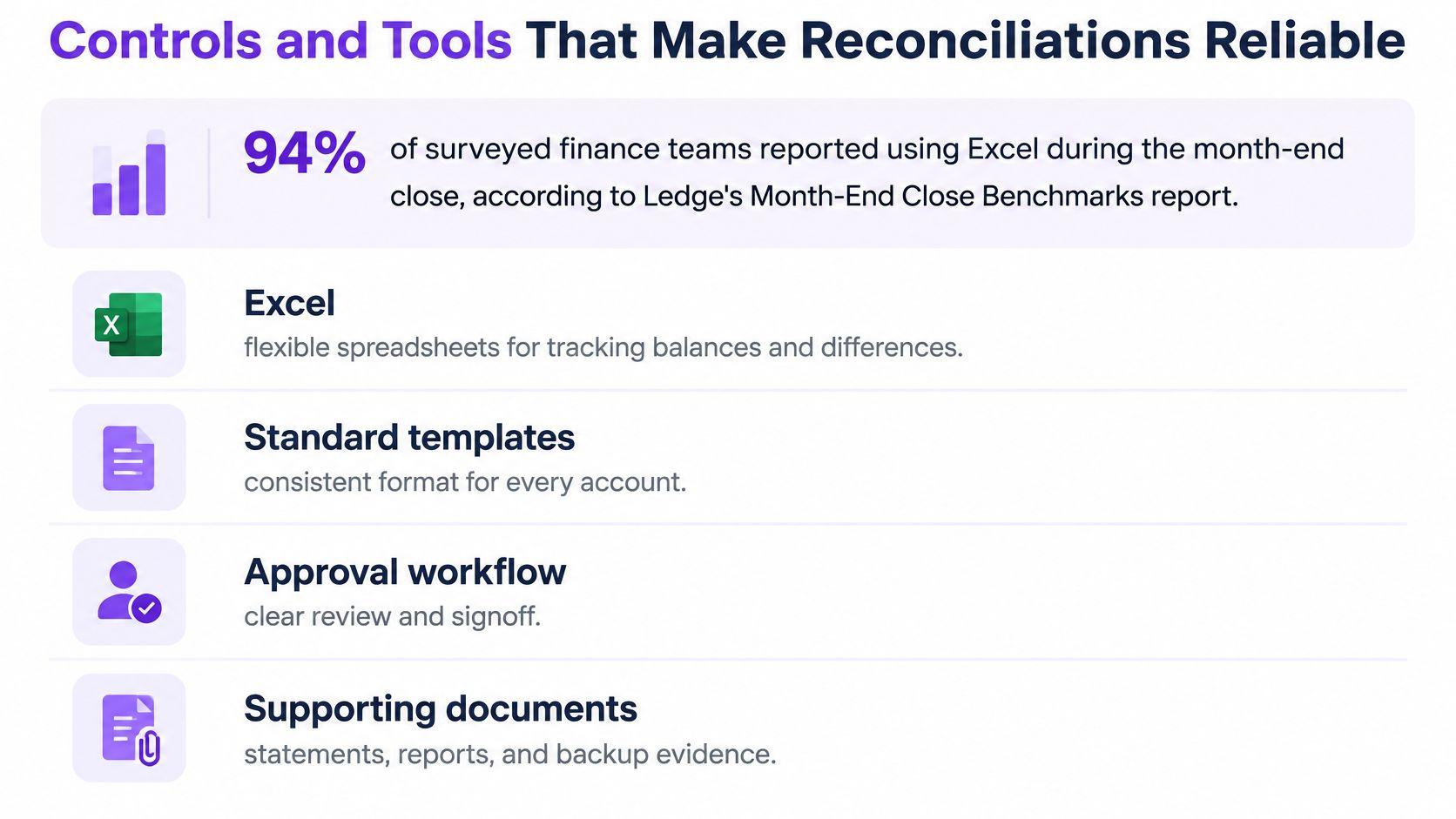
Your Control Checklist for This Month
- Separate preparer and approver: The person who builds the reconciliation never signs it off alone, even in a two-person finance team.
- Attach evidence to every item: Store the statement, invoice, contract, or register behind each reconciling line, not in someone's inbox.
- Set an approval threshold in writing: Require a second approval for manual adjustments above an amount you choose and document.
- Sign off before close: Every account gets a reviewer signature and date before you release reports.
- Keep one evidence folder per month: Name files by account and period so an auditor can find what they need without a tour.
Use tooling in the right order. Start with your accounting platform's bank feeds and reconciliation modules in QuickBooks, Xero, or NetSuite for cash and card payouts. Add a shared, version-controlled template for balance-sheet accounts the platform doesn't handle well, such as deferred revenue and accruals. When volume outgrows manual matching, evaluate reconciliation automation tools for transaction matching and exception queues.
The spreadsheet risk isn't the spreadsheet. It's the unversioned file on a laptop, edited after review, with no record of who changed a balance. Version control and locked final copies close that hole cheaply.
Before signing, your reviewer checks four things. The book and independent balances agree to source documents. Every reconciling item has evidence and an owner. Aging sits within your threshold. The required journal entry is posted, not promised. If any check fails, the account isn't reconciled, whatever the difference column says.
Decide Whether to Reconcile In-House or Hand It Off
Effort isn't always the missing ingredient. Sometimes the process itself has outgrown the team running it, and pushing harder produces the same late, fragile close. Count your red flags before you decide.
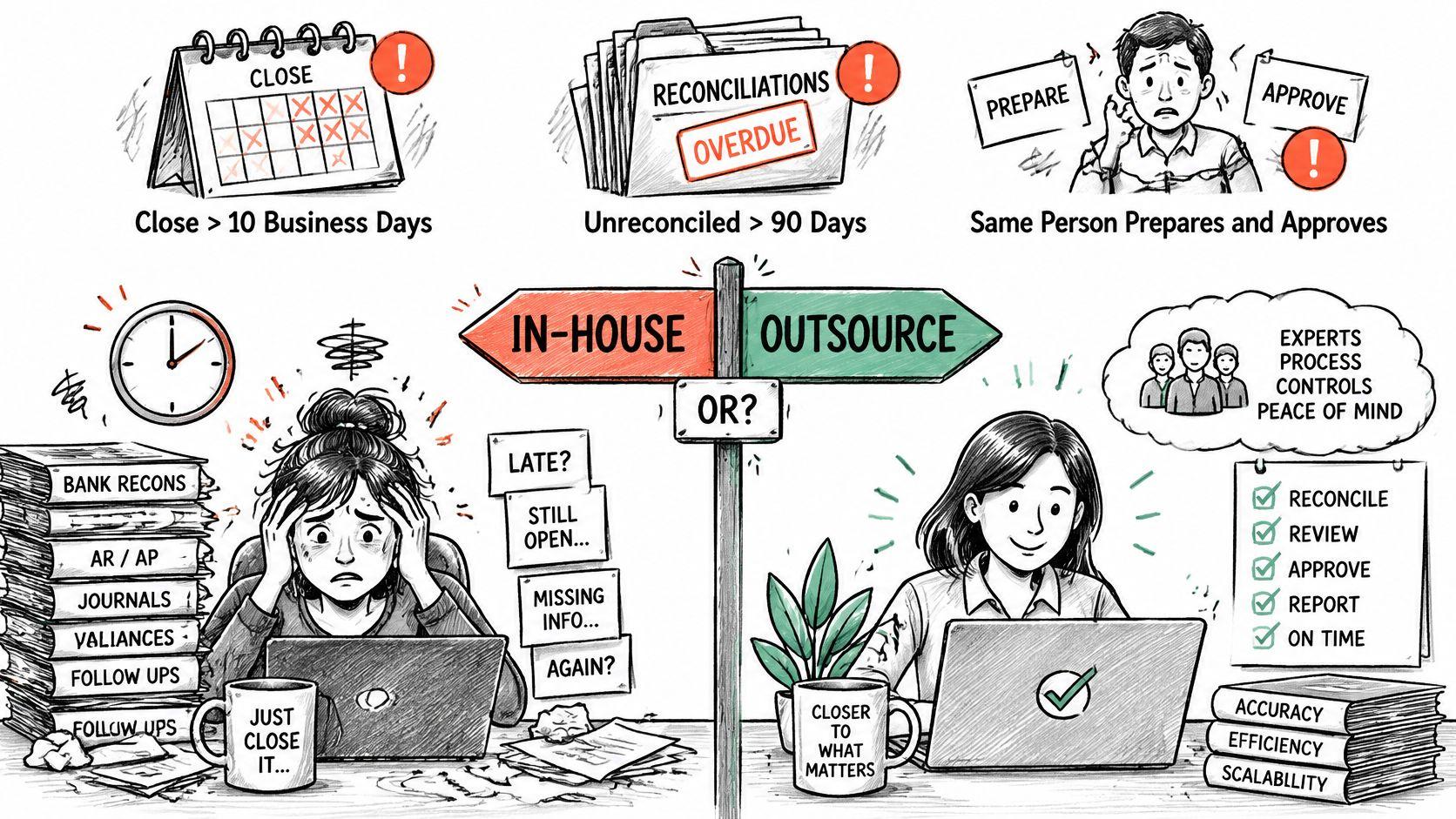
Warning Signs Your Process Needs a Controller
- Close runs past 10 business days: Reports arrive too late to change any decision that month.
- Items older than 90 days keep appearing: The same unexplained lines roll forward because nobody owns them.
- One person prepares and approves: Your review control exists on paper only.
- You can't explain a variance yourself: Every question requires a call to your bookkeeper before you can answer a board member.
- Bank accounts sit unreconciled over a month: Cash, your most basic number, is unverified.
- A fundraise, audit, or lender review lands within two quarters: Diligence will ask for exactly the evidence files you don't have.
Three or more red flags means you need controller-level ownership, not more hours from the current setup. Structured reconciliation services exist for this point, when transaction volume and reporting demands exceed what a bookkeeper plus founder review can verify.
Our Finance Ops Diagnostic is a $3,500 fixed fee delivered in 5 business days. It includes a current stack and handoff review, a spreadsheet dependency map, an unclear owner and review gap inventory, a recommended cleanup path, and a monthly routine recommendation. We also offer complimentary ROI assessments to help you determine whether controller services make financial sense for your specific situation.
Do three things this week. First, reconcile last month's bank account using the six steps and time how long it takes. Second, count your red flags from the list above. Third, if your count is three or more, book the ROI assessment before your next close instead of after it disappoints you again.
If your reconciliations are late, unreviewed, or held together by one spreadsheet and one person's memory, we can rebuild the process around named owners, evidence files, and a close you can defend. Our controller-led team handles balance-sheet reconciliations, month-end close, and reporting for growing SaaS, agency, and professional services firms. Visit Jumpstart Partners to book your complimentary ROI assessment and find out whether controller support pays for itself in your business.