Financial Operations
What Is Outsourced Accounting? a Founder's Guide
Wondering what is outsourced accounting? See which services it covers, how it differs from in-house bookkeeping, and when growing businesses should switch.
ByJumpstart Partners, CPA, QuickBooks ProAdvisor
··17 min readOutsourced accounting means assigning some or all of your finance and accounting work to an external firm while you keep the financial decisions and the accountability for the numbers. The provider executes the processes. You own the judgment calls, the bank access, and the sign-off.
71% of business leaders already outsource at least some accounting work, according to Capterra's 2023 survey of 297 business leaders. That figure reframes the question. It isn't whether an outside team touches your books. It's which parts you hand over, and which parts you refuse to hand over.
Most explanations of what is outsourced accounting stop at a service list. The distinction that matters is that outsourcing transfers execution, never accountability. Your name sits on the statements, your approval releases the payment, and your review is what stops a misposted journal entry from reaching an investor deck. The risks that bite are access control and provider concentration, not the time zone your team works in.
Table of Contents
- What Outsourced Accounting Covers, Service by Service
- Outsourced Versus In-House Accounting and Bookkeeping
- What Outsourced Accounting Costs and How It Is Priced
- Close, Revenue and Metrics
- Keeping Control of Cash, Records and Data
- Red Flags and Myths That Derail Outsourcing
- When Outsourced Accounting Makes Sense by Revenue Stage
- Book a Finance Assessment Before You Hand Off Work
What Outsourced Accounting Covers, Service by Service
The scope runs from data entry to policy design, and the tiers differ by rhythm as much as by skill. Transaction work runs daily or weekly. Close and review run monthly. Reporting and control design run quarterly or on request. Knowing which rhythm you're buying tells you what problem the engagement solves.
| Service tier | Typical tasks | Typical rhythm |
|---|---|---|
| Transaction processing | Recording income and expenses, bank and card reconciliations, accounts payable, payroll administration | Daily to weekly |
| Month-end close and review | Accruals and deferrals, deferred revenue schedules, variance review, period lock, financial statement preparation | Monthly |
| Management reporting | KPI packs, cash-flow forecasting, budgeting support, board and investor packages | Monthly to quarterly |
| Controller and compliance support | Audit preparation, tax coordination, policy design, internal control design | Quarterly or on request |
Accounts payable is usually the first tier companies release, and the handoff mechanics of accounts payable outsourcing matter more than the fee, because a sloppy handoff shows up as missed vendor terms inside a month.
The full map of what a provider can absorb looks like this.
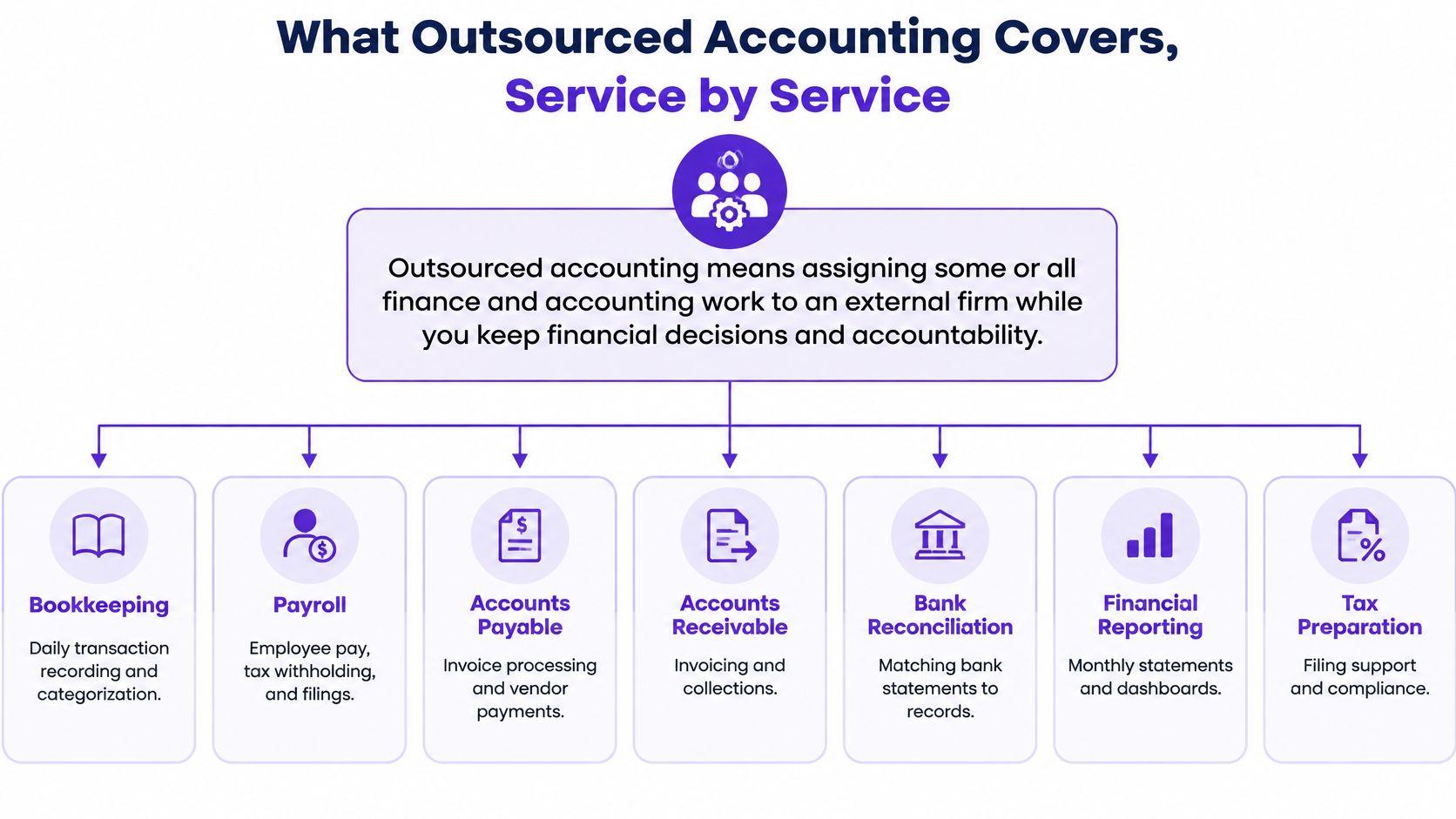
Outsourcing reaches well past data entry. In the same 2023 Capterra survey of 297 business leaders, 65% said they required full-time support from accounting firms for tax compliance or other complex work, 48% identified tax compliance as an outsourced need, and 50% identified audit outsourcing.
Here's the filter I use for any task. If it's recurring, rule-based, and produces a documented output you can review, it can be outsourced. If it requires a judgment about timing, collectibility, or contract interpretation, it stays with a qualified reviewer even when the provider does the preparation.
For a growing company, the model swaps variable external capacity for the fixed cost of a complete internal finance department, and it buys specialist expertise before you can justify a full-time controller. The delivery model keeps shifting, too. Moving finance teams from pilots to execution is where the next round of scope decisions gets made.
Outsourced Versus In-House Accounting and Bookkeeping
Bookkeeping records what happened. Accounting applies policy and control procedures so the record can drive a decision. That's the line to hold when you compare delivery models.
Owning a fleet means paying drivers, maintenance and insurance whether or not the vans run. Leasing a fleet on a service contract turns those costs into a monthly charge tied to use. An in-house finance team is the fleet you own.
| Criterion | In-house finance team | Outsourced accounting firm |
|---|---|---|
| Cost structure | Fixed salaries, benefits, software and training | Variable monthly fee tied to agreed scope |
| Access to specialists | Usually one or two generalists; specialists are hired full-time | Tax, revenue recognition and audit specialists available on demand |
| Speed of scaling | Hiring takes months and adds fixed cost before revenue arrives | Scope can increase or decrease monthly under the agreement |
| Day-to-day control | Direct supervision and immediate access to people and records | Oversight through agreed controls, review cycles and access rights |
| Institutional knowledge | Stays with employees and can leave with them | Must be written into workflows, checklists and handoff files |
I'd take the outsourced model on cost structure alone for most companies under $5 million in revenue, then decide the rest criterion by criterion. Specialists are the second reason: a provider covering tax, revenue recognition and audit work costs less than one senior hire, and you don't carry the seat through a slow quarter.
Institutional knowledge is the row that catches people. In-house, it walks out with a resignation. Outsourced, it has to live in close calendars, checklists and handoff files, so ask to see those documents before you sign. The same logic decides which tier you're buying, since the difference between a bookkeeper and a controller is review authority rather than task volume, so confirm who signs off on your account.
The model is older than most founders assume: research from North Carolina State University traces it to the 1990s business-process-outsourcing wave, when companies began contracting external firms for accounting, human resources and data processing as repeatable operating functions rather than year-end favors.
Drop the idea that outsourcing buys you a cheaper bookkeeper. It buys a different delivery model, and it works when you already know which decisions stay in the building.
What Outsourced Accounting Costs and How It Is Priced
Providers typically charge a fixed monthly retainer for a defined scope, per-transaction fees for high-volume bookkeeping, or a hybrid retainer with extra charges for work such as audit support or ad hoc analysis. A retainer shifts more volume risk to the provider, while transaction-based pricing can make costs rise as activity increases. Compare the scope and pricing triggers behind outsourced accounting services before evaluating quotes.
For an $8 million SaaS company, the following comparison is illustrative, not a market quote.
| Option | Annual cost | Monthly equivalent |
|---|---|---|
| In-house controller at $130,000 salary plus 25% payroll taxes and benefits | $162,500 | $13,542 |
| Outsourced controller-level package at $6,500 a month | $78,000 | $6,500 |
| Same package in year one, including a $3,000 onboarding fee | $81,000 | $6,750 |
In year one, the outsourced option costs $81,000 against $162,500 for the in-house controller, a difference of $81,500. From year two, the annual difference is $84,500, before accounting for software licences, recruiting fees, or the cost of an unfilled role. Those costs sit with the company for an in-house hire.
At the smaller end, the trade-off changes. A $600,000 business paying $2,200 a month for a bookkeeper-only package spends $26,400 a year. At that spend, a full-time hire may offer more direct control, but it is still one person and one review path. Leave or a departure can interrupt the work.
A quote also needs scrutiny beyond its headline price. Ask whether the ledger, payroll and bill-pay tools are included or charged as software pass-through costs. Confirm how many bank, card and merchant accounts the scope covers, since additional accounts require more reconciliation work. Check exit and export fees, including export costs and how long access remains after termination. Finally, ask what triggers renewal increases and how much notice you will receive.
Get three written quotes against one scope. Specify the same accounts, deliverables, close date and review layer in each. A matching scope makes the price differences meaningful and clarifies what work is transferred, while accountability for approving the books remains with the business.
Close, Revenue and Metrics
A close is complete when the numbers are reconciled, reviewed and ready to use. The order matters more than who performs the work: cut-off, cash, accruals, revenue schedules, variance review and approval all need clear owners.
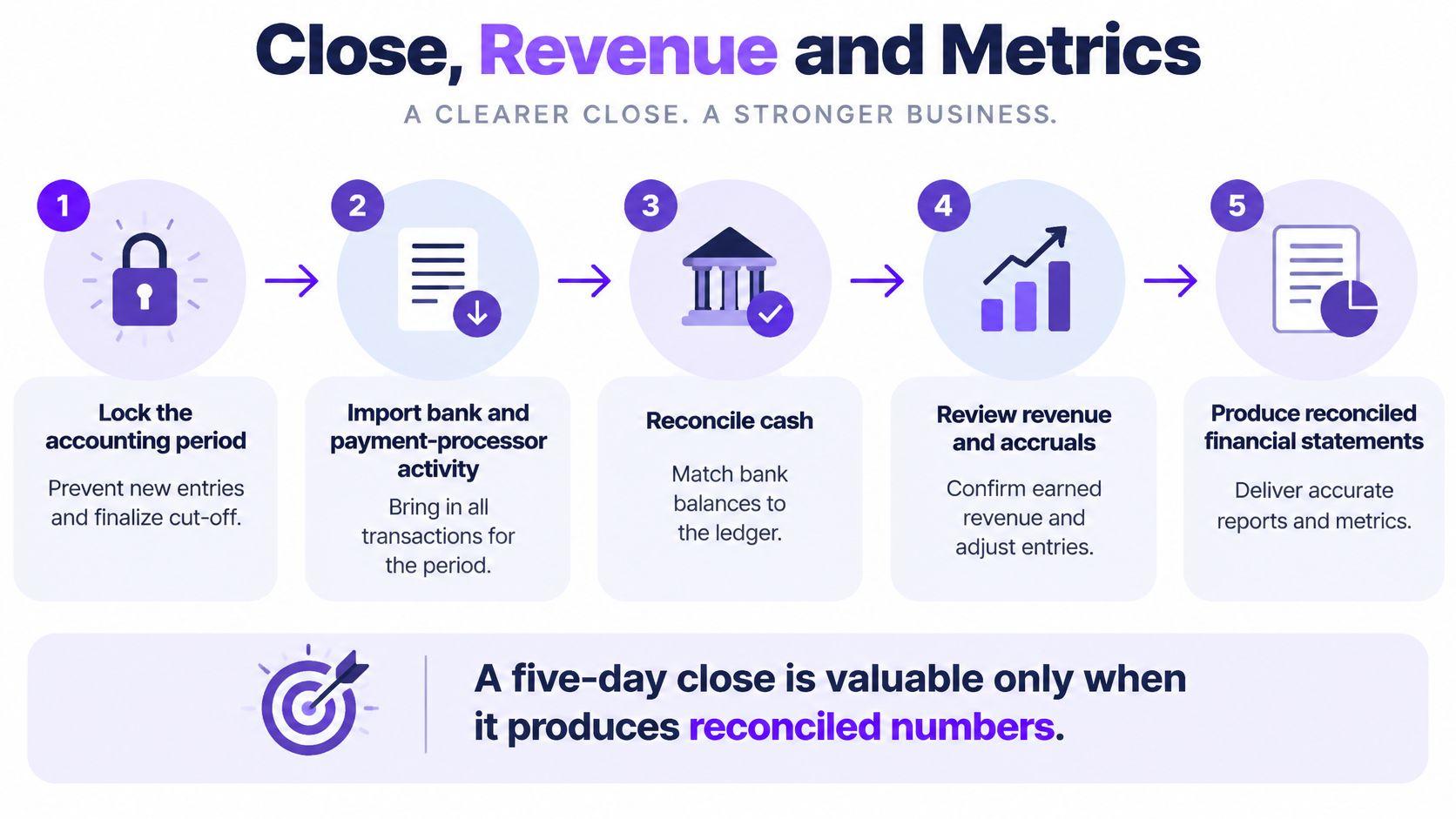
- Lock the period. Set the cut-off date and stop routine entries for that period.
- Import bank and processor activity. Capture transactions, refunds and fees.
- Reconcile cash. Match each bank balance to the ledger.
- Post payroll and accrued expenses. Include costs incurred but not yet invoiced.
- Update receivables and payables. Confirm customer balances and vendor obligations.
- Calculate deferred revenue. Rebuild the schedule from contract data rather than carrying forward last month's file.
- Review unusual transactions. Check duplicates, coding errors and unexpected variances.
- Approve the statements. Review comes before sign-off.
A month-end close checklist helps keep these steps in order as transaction volume changes. Outsourcing can transfer the work, but the founder still needs to approve the reporting view and resolve decisions that affect the business.
Why a cash-only month gets profit wrong
Consider a digital agency with $1.2 million of annual revenue. In one month, it bills $100,000, has $18,000 of unbilled work, owes contractors $12,000 for work already done, and has $5,000 of prepaid software to amortize. A cash-only view misses the unbilled work and contractor accrual, and does not account for the prepaid expense. Correcting all three raises pretax profit by $1,000 compared with the cash view: $18,000 minus $12,000 minus $5,000. The IRS guidance for small business taxpayers notes that businesses generally must use accrual accounting for inventory sales and purchases unless they qualify as a small-business taxpayer.
Revenue recognition on a multi-element contract
Suppose a customer signs a $120,000 annual contract: $96,000 for a subscription and $24,000 for implementation. The subscription is earned at $8,000 a month ($96,000 ÷ 12). Implementation revenue is earned in month one if the obligation is satisfied then. Recording the full invoice as January revenue would overstate month-one revenue by $88,000 ($120,000 minus the $32,000 earned).
The ASC 606 five-step model requires a business to identify the contract and performance obligations, determine and allocate the transaction price, then recognize revenue as each obligation is satisfied. SEC-filed revenue policies also require collectibility to be probable before the model applies. An invoice alone does not establish revenue if the arrangement is unsigned or unenforceable.
The metrics that only hold on reconciled books
Two hundred customers paying $100,000 a month produce $1.2 million of ARR ($100,000 × 12). If cancellations and downgrades total $8,000 while expansion and new business add $12,000, net monthly growth is $4,000, or 4% of the starting $100,000. With $140,000 of monthly cash operating costs and $840,000 in the bank, simple runway is six months ($840,000 ÷ $140,000).
Those metrics fail if a Stripe deposit is recorded as revenue while fees, refunds, chargebacks and taxes remain mixed together. SaaS accounting policies filed with the SEC describe subscription revenue as recognized ratably over the subscription period beginning when the service becomes available, rather than when the customer pays. Each reported figure should trace to a supporting document. The same record-tracing discipline applies when checking VAT on tour bookings.
Keeping Control of Cash, Records and Data
Outsourcing transfers execution, not accountability, and the controls that keep you accountable have to exist before the first reconciliation.
Set a $5,000 payment approval threshold and require two approvers for any vendor payment above $25,000. If monthly accounts payable holds 40 payments averaging $3,000, that's $120,000 leaving the account each month. The preparer assembles the batch. New vendors, changed bank details, duplicate invoices and anything above the second threshold go to documented review before release.
That separation of preparation, review and approval is the entire design. One person reconciles the bank. A second reviews the reconciliation. You approve cash movements above the threshold. The review step looks like this in practice.

Payment fraud is what drives this. KeyBank's 2025 survey found that 41% of small-business owners ranked payment fraud as their top concern, followed by phishing and email scams at 27% and identity theft at 26%.
Where concentration risk enters
One provider that controls the ledger, the bank integrations, vendor payments and payroll can distort cash and reported results at the same moment. That's a concentration problem, not a location problem, and it's why your side of the arrangement keeps independent payment approval and direct access to source records.
| Control | What the agreement should specify | Risk it prevents |
|---|---|---|
| Role-based access | Named users, permission levels, and who can view or post in each system | Unauthorized entries and over-broad access |
| Payment approval thresholds | Dollar limits, number of approvers above each limit, and documented sign-off | Single-person payment release |
| Audit logs | Log retention period and your right to export logs on request | Undetected changes to records |
| Access removal | Deadline for removing a user's access after a staff change or contract end | Former staff or vendors keeping system access |
| Reconciliation review | Reconciliation frequency, reviewer name, and review deadline each month | Unreconciled cash and hidden errors |
| Exit and data handover | Complete export of ledgers and files, and a transition period with named support | Being locked into one provider |
Daily transaction matching is the discipline that makes reconciliations trivial rather than terrifying, and the approach in reconciling ecommerce transactions daily scales to any merchant account.
The real test of an engagement is the exit. If you can't export complete records and move to another provider inside a defined period, you don't own your books, you're renting them.
Written access control policies do more for fraud prevention than any provider guarantee, because they tell every reviewer exactly what they're allowed to approve.
Red Flags and Myths That Derail Outsourcing
Watch for these before you sign, and treat any two of them as a reason to keep looking.
- No named reviewer. If nobody can tell you who reviews your close and signs it off, nobody is accountable for the accuracy.
- Shared logins or shared bank credentials. Your provider should work inside your software under named users, not yours.
- No written close calendar. A provider without a committed close date is improvising.
- Vague answers on AI. Ask which tools touch your data, whether it's retained or used for model training, and who reviews AI-generated entries.
- Invoices booked as revenue. It flatters the month and misleads every investor who reads it.
- No exit plan. No export commitment and no transition period means you have little negotiating power at renewal.
AI has widened the trust gap rather than closed it. Intuit's 2026 Accountant Technology Survey reported that 88% of accounting professionals used AI for at least one client service, while 54% used it only situationally rather than through repeatable workflows. The same survey found 80% outsourced at least one service and 65% planned to increase outsourcing, which makes AI and external teams complementary capacity rather than substitutes. On the trust side, 60% of surveyed professionals said clients asked always or frequently for proof of AI data protection, while only about one-third proactively explained their AI use.
Three myths are worth killing outright. Outsourcing doesn't remove your responsibility, because you still hold bank access, payment approval and statement sign-off. An outside team isn't riskier because of where it sits, since risk comes from weak access controls and missing review, not geography. And bookkeeping isn't finance visibility, because bookkeeping records events while visibility needs reconciled data and a KPI pack.
Automate categorization and anomaly flagging. Keep revenue recognition, accruals, unusual contracts, tax-sensitive treatment and management estimates under qualified human review.
When Outsourced Accounting Makes Sense by Revenue Stage
The right model depends on two things: your revenue band and how much control you're prepared to keep. Here's how the fit usually lands between $500K and $20M.
| Revenue band | Best fit | Typical scope | Move up or stop when |
|---|---|---|---|
| Under 500K | Bookkeeper or self-managed software | Bank feeds, categorization and monthly reconciliations | Close runs late or investors ask for reporting |
| 500K to 5M | Outsourced bookkeeping plus monthly close | Reconciliations, payables, receivables, accruals and deferred revenue | The founder spends time on reconciliations instead of pricing, hiring or sales |
| 5M to 20M | Controller-level support | Management package, multi-element revenue recognition, board or investor packs and audit preparation | A fundraise or audit is coming, contracts mix subscriptions and implementation, or client profitability is unknown |
| Any stage | Not ready yet | Nothing outsourced until processes are documented | No documented processes, no internal reviewer and no approval rules |
Below about $500K, with one bank account, simple cash needs and no investor reporting, a bookkeeper or your own software is enough. The waste starts when you buy controller-level review for a business that hasn't defined a chart of accounts yet.
The triggers to move up are concrete. Your close regularly runs past the window you planned. A fundraise or audit is on the calendar. Contracts mix subscriptions, usage fees and implementation work. Or your books can't tell you which clients are profitable.
The signals against moving are just as concrete. You have no documented processes to hand over. Nobody internally can review the provider's output. And you have no appetite to define approval rules, which means every cash control stays theoretical.
The decision is about control and timing, not about whether outsourcing is respectable. Test fit on a real month of your own data before you test it on a sales pitch.
Book a Finance Assessment Before You Hand Off Work
Before you commit to anything, diagnose your own setup. A provider inherits whatever you hand over, and a messy handoff stays messy at a higher monthly fee.
- List every system that touches cash, and who currently has access to each one.
- Write down your close date and the last month that closed late.
- List open reconciliations and the person who owns each.
- Note any upcoming fundraise, audit or board package and when it lands.
- Request an ROI assessment before you request a proposal.
That last step matters because pricing without fit is just a number. Our engagements are CPA-led, and our complimentary ROI assessment is built to tell you whether controller-level support makes financial sense for your specific situation, including the case where the answer is no. A diagnostic runs for five business days and ends with a written workflow map handed over before either side commits to a retainer, so you can see the plan on paper first. A good provider shows those control terms in writing, in the agreement, before you sign anything.
Jumpstart Partners runs the close, the reconciliations, the revenue recognition and the KPI reporting that make the numbers in this guide real for SaaS companies, agencies and professional services firms between $500K and $20M in revenue. If you're deciding whether an outsourced controller replaces a hire or sits alongside one, start with the assessment and get the answer for your own books rather than a generic package. Visit Jumpstart Partners to book the conversation and see the workflow map before you commit to anything.